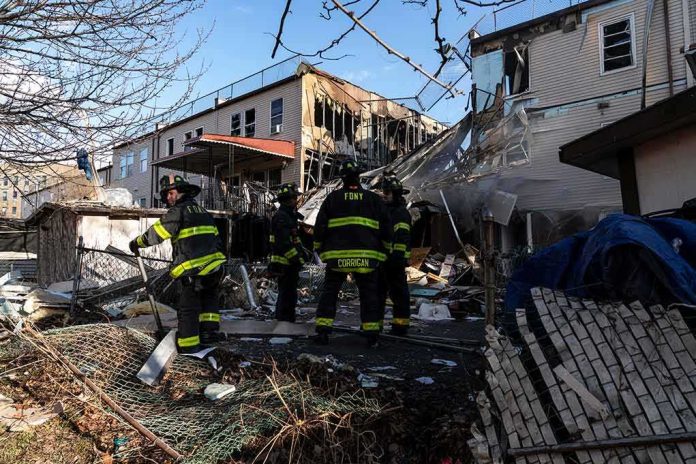
As night fell over Flatbush, firefighters pulled survivors from a collapsed Brooklyn building while the confirmed death toll climbed.
Story Highlights
- Officials confirmed multiple deaths and injuries as rescue crews worked through unstable debris.
- About 250 first responders searched the rubble using dogs, drones, and hand tools.
- Cameras captured at least one live rescue as crews removed people from the collapse zone.
- Investigators are examining nearby excavation and the building’s condition as possible factors.
What Happened: A Busy Intersection Turns Into a Disaster Zone
Emergency crews rushed to the area around Flatbush and Bedford Avenues shortly after 4 p.m., when a multi-story building came down into an adjacent construction site. Reporters on scene described a wide debris field, twisted metal, and heavy dust hanging over the block. Rescue teams moved fast to set up command, triage, and search lanes. Officials said the search would run through the night as they worked to find anyone still trapped under the rubble.
Firefighters and medics from the Fire Department of the City of New York, supported by New York City Police Department K-9 teams, swarmed the site. CBS and NBC put the response at roughly 250 personnel. Crews crawled across unstable piles, dug by hand, and used bucket lines to move debris. Drones scanned voids. Search dogs worked the perimeter. Vacuum trucks and other tools supported the effort. The scale and methods fit a rescue, not only a recovery, according to on-scene reporting.
Lives at Stake: Confirmed Victims and Live Rescues
Officials and major outlets reported multiple deaths and a rising injury count as the night wore on. ABC and CBS later reported at least eight people dead and at least 17 injured. Numbers changed as crews found more victims and moved patients to hospitals. Cameras captured at least one person pulled alive from the rubble around 6:15 p.m., underscoring that teams still believed more survivors could be found. Officials warned more people might be in the collapse zone.
Reporters noted two people were removed soon after the collapse, and later updates described additional victims recovered. Some identities and conditions were not immediately confirmed by authorities, which is common in a chaotic scene. The city’s medical examiner will release names after notifications. Officials urged patience as they checked hospitals, site logs, and witness accounts to complete a verified list of the dead and the injured.
Where and Why: The Site, the Dig Next Door, and an Ongoing Probe
Coverage placed the collapse at or near 1321 Flatbush Avenue, with an adjacent excavation along Bedford Avenue. Some early reports listed varying addresses, but all pointed to that intersection and the excavation pit beside an older structure. City records and reporting said construction next to the building had been underway for months. Investigators are reviewing the site history, permits, and the building’s structural condition to determine what triggered the failure.
Excavation beside older masonry can change how soil and groundwater support a wall. It can also add lateral pressure or remove bracing if work is not sequenced or shored well. But age, wear, and unpermitted changes inside an older building can also weaken it. Officials have not issued a cause. The Department of Buildings will examine plans, inspections, photos, drone footage, and debris patterns to connect the chain of events that led to the collapse.
System Stress: Big-City Building Booms and Safety Tradeoffs
New York City has seen accidents tied to excavation and structural failures over the years. City safety summaries list dozens of incidents each year, including those linked to excavation or materials falling. The broader trend shows that worker falls, equipment mishaps, and soil work all remain recurring hazards across the five boroughs. Those records provide context for how often complex urban construction can go wrong if guardrails fail.
Search underway a day after deadly Brooklyn building collapse https://t.co/fd34SWAWwM
— Reuters (@Reuters) November 12, 2026
Residents across the political spectrum often feel big projects move faster than oversight. People worry that permits, inspections, and self-certifications can leave gaps. Others say red tape slows safer fixes and drives up costs. This tragedy cuts through those arguments. Families want answers and accountability. Workers want strong, clear rules that are actually enforced. Neighbors want confidence that the building next door will still stand tomorrow. The facts from this probe will matter to all of them.
What Comes Next: From Rescue to Answers
City agencies will release an incident timeline with dispatch times, rescues, and confirmed casualties. The Department of Buildings and structural engineers will test key parts of the debris, review excavation sequences, and check shoring and underpinning plans. If investigators find violations, they can halt work, fine companies, or refer cases for prosecution. Accurate answers on occupancy and the victim list will come from hospital records and the medical examiner.
Right now, the mission is simple: find every person in that rubble and bring them home. As those efforts shift to investigation, the focus will turn to whether construction activity, building defects, or both caused the wall to fail. Clear facts, not spin, will decide next steps. New Yorkers deserve a city where growth does not put families, workers, and neighbors in harm’s way—and where promises of safety are backed by proof.
Sources:
youtube.com, abcnews.com, cbsnews.com, nytimes.com, nbcboston.com, nbcnewyork.com, abc7ny.com, nyc.gov, abc7news.com