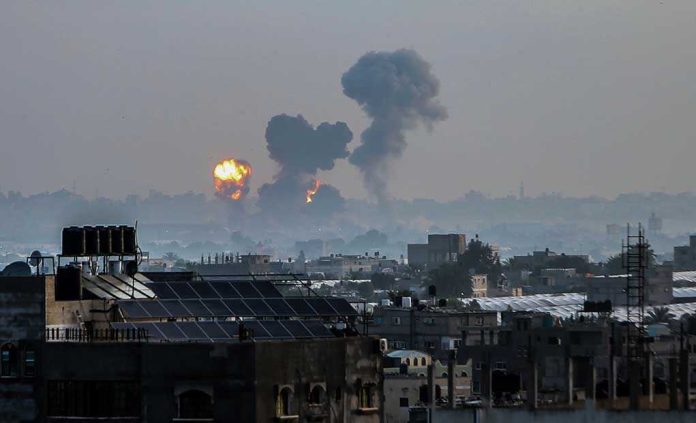
The alleged use of a mysterious “sonic weapon” by the US military in Venezuela has ignited global intrigue and speculation.
Story Highlights
- A Venezuelan guard claims US forces used a “sonic weapon” during a raid to capture Nicolás Maduro.
- The operation reportedly resulted in 100 Venezuelan soldier deaths with no US casualties.
- The White House Press Secretary amplified the story, although no official confirmation exists.
- Speculation surrounds the potential use of advanced US military technology in the operation.
The Eyewitness Account
A Venezuelan security guard at the Fuerte Tiuna military base in Caracas described a harrowing scene as US forces, allegedly using a mysterious “sonic weapon,” carried out a raid to capture President Nicolás Maduro on January 3, 2026. The eyewitness reported that the weapon caused symptoms akin to an internal head explosion, nosebleeds, and vomiting blood among Venezuelan soldiers. While the US military remains silent on these claims, the account has captured widespread attention and raised questions about the technology used.
The report emerged amid the backdrop of long-standing tensions between the US and Venezuela under Maduro’s regime. The US has repeatedly expressed its intent to neutralize Maduro’s government, citing issues such as socialism, migration, and alliances with countries like Russia and Iran. This incident, if true, underscores America’s commitment to using advanced military capabilities to achieve their geopolitical objectives.
Tactical Superiority and Controversy
The operation, reportedly dubbed “Operation Absolute Resolve,” involved drones, helicopters, and advanced weaponry that overwhelmed Venezuelan defenses, which are heavily reliant on Russian-supplied air defenses. The US’s technological edge, demonstrated through precision strikes and drone attacks, facilitated the capture of Maduro without any reported US casualties. However, the use of a “sonic weapon” remains unverified, fueling debate over the legality and ethical implications of such technology.
The White House Press Secretary, Karoline Leavitt, added to the controversy by sharing the viral story on social media, urging readers to pay attention. This move has amplified the narrative of US military supremacy in the region, although it lacks official confirmation from US authorities. The political implications of this incident continue to unfold, with supporters and critics alike weighing in on the ramifications.
Historical Context and Technological Advances
This incident is not the first time the US military has been linked to the development of advanced directed-energy weapons. Former intelligence sources have suggested that the military has long explored technologies like microwaves and lasers capable of causing pain and incapacitation. Such technologies have been the subject of speculation in other global conflicts, further complicating the narrative around the alleged “sonic weapon” used in Venezuela.
Analyses from military experts point to the possibility that the symptoms described by the eyewitness could be consistent with known microwave or directed-energy weapon effects. However, without concrete evidence or forensic analysis, these claims remain speculative. The story’s sensational nature and the lack of corroborating evidence highlight the challenges of verifying such accounts in the context of modern warfare.
Implications and Future Considerations
The alleged use of a “sonic weapon” during the raid has significant implications for both US-Venezuela relations and the broader geopolitical landscape. In the short term, the incident has sent shockwaves across Latin America, serving as a deterrent to other nations considering alliances with adversaries of the US. Politically, the operation has sparked debates over US military intervention and sovereignty violations.
In the long term, the incident may trigger an arms race in directed-energy technologies, with nations seeking to develop or acquire similar capabilities. The operation also calls into question the effectiveness of Russian air defenses, potentially undermining their influence in the region. As the story continues to evolve, it remains a poignant reminder of the complexities and ethical challenges posed by modern military technologies.