
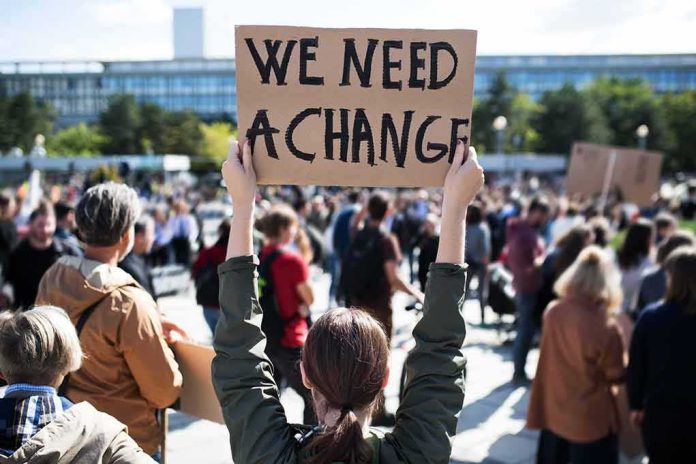
Masked students at Middle Tennessee State University marched to ban a student group after a disputed event, pitting speech rights against safety claims in plain view.
Story Snapshot
- About 30 students marched at Middle Tennessee State University and urged a ban of a Turning Point USA chapter
- Protesters cited “white nationalist rhetoric” and alleged attacks on minorities at an October event
- The chapter refused to apologize, citing First Amendment free speech protections and campus policy
- A petition passed 550 signatures, but no university finding or sanction has been reported
What Sparked the March at Middle Tennessee State University
Local television station WSMV reported that about 30 students marched on November 12, 2026, at Middle Tennessee State University in Murfreesboro. They chanted “fascists off our campus” and called on the school to disband its Turning Point USA chapter. Organizers linked the protest to an October event that featured podcaster Joshua Haymes. They said the event carried racist attacks, white nationalist rhetoric, and anti-LGBTQ+ statements. Their petition passed 550 signatures seeking a ban on the chapter and on Haymes.
Students framed the October gathering as harmful to the campus community. They argued that the university should not fund or host groups that invite speakers they view as extremist. They said school leaders must protect students from harassment masked as debate. WSMV’s reporting quoted their claims about the event’s tone and content. But their statements did not include a transcript or video that confirmed specific quotes made on campus. That gap shapes how the dispute is judged.
How the Turning Point Chapter Responded
The Middle Tennessee State University chapter of Turning Point USA said it will not apologize for hosting Joshua Haymes. The chapter stated its policy is to uphold the First Amendment of the United States Constitution and to promote free speech on campus. It said that students who do not want to hear speakers can leave the event. The group urged the university to follow the law and existing policies rather than ban speakers or the chapter itself.
Campus reporting earlier in the year described Haymes’s appearances as open debates that drew students from different political backgrounds. Those events were framed by supporters as public forums where anyone could take a microphone and engage on faith and politics. That picture supports the chapter’s claim that its events are debate-style and viewpoint-based, not closed rallies. It does not, by itself, resolve what words were used in October at Middle Tennessee State University.
What We Know And What We Do Not
WSMV’s coverage confirms a protest, a petition topping 550 signatures, and a chapter that stands firm on speech rights. The station reported that organizers had not received a public response from Middle Tennessee State University’s president at the time. The available record does not identify any university finding of harassment, threats, or a policy breach tied to the October event. That leaves the debate focused on speech versus safety, not on a specific rule violation.
@MarshaBlackburn @timburchett @RepTimBurchett
Protest to remove Turning Point USA chapter at MTSU https://t.co/qsWzCOKCdV via @YouTube
— Tokaise (@Tokaise) November 16, 2026
Joshua Haymes’s public profile fuels the clash. He is known as a former pastor and host of a podcast that critics call far right. Separate reporting has highlighted past remarks that drew heavy backlash, which helps explain why students demanded a ban. But the sources provided do not show a verified record of what he said at Middle Tennessee State University in October. Without that, the call to dissolve a student group risks being seen as viewpoint discrimination rather than a measured policy response.
Why This Matters Beyond One Campus
Across the country, speaker fights now hit the same nerve. Opponents cite harassment and safety; supporters cite free speech and viewpoint neutrality. Surveys and case studies show more attempts to disinvite speakers in the past decade, while most campus events still go on. These disputes can turn into power struggles where leaders avoid hard calls. That vacuum feeds the belief, shared by many across the aisle, that institutions protect themselves first and the public last.
What To Watch Next at Middle Tennessee State University
Watch for an official response from Middle Tennessee State University. A clear statement on policy, process, and any evidence review would help. If the school receives formal complaints, it can assess them under speech and conduct rules. If none appear, the focus will remain on whether a student group can be banned based on disputed claims about content. A neutral, written standard applied evenly to all groups would reduce charges of bias from both sides.
Bottom Line For Readers
Students marched, a petition grew, and a chapter doubled down on free speech. The facts on the record do not yet show a policy breach tied to the October event at Middle Tennessee State University. That puts pressure on the school to be transparent and even-handed. Many Americans, left and right, see scenes like this and conclude that leaders dodge tough choices. Clear rules, fair process, and public evidence are the antidote to that doubt.
Sources:
thegatewaypundit.com, wsmv.com, talkingpointsmemo.com, lmtribune.com, mtsusidelines.com