
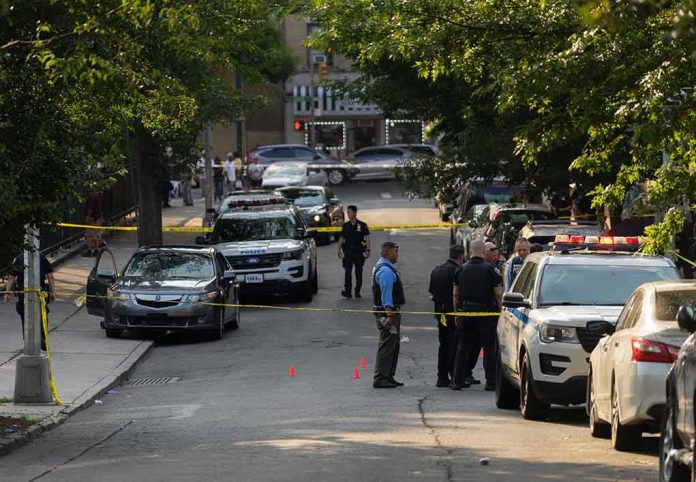
When parents in a quiet Seattle neighborhood start dragging metal planters into the street to stop bullets tied to prostitution rings, something in the social contract has snapped.
Story Snapshot
- North Seattle neighbors near Aurora Avenue barricaded side streets after repeated shootings they link to rival prostitution operations.
- Residents describe bullets flying into apartments and past infants while they say City Hall “does nothing” and police presence feels sporadic.
- Seattle’s own data and police leadership claim violent crime and shootings are trending down citywide, deepening the disconnect.[4]
- This clash crystalizes a bigger question: when prostitution and organized vice move in, how far should regular citizens go to reclaim their block?
When a family neighborhood becomes the off-ramp for vice
Aurora Avenue North has long carried a reputation as Seattle’s rough corridor, but residents near 97th to 102nd describe the last stretch as something different: prostitution and gunfire merging into a nightly pattern.[2][3] Neighbors tell local reporters that sex buyers cut through their side streets to reach suspected prostitution hotspots along Aurora, bringing with them johns, pimps, and the rivalries that increasingly end with gunshots.[2][3] That pipeline runs past playgrounds, bedroom windows, and parked minivans, not industrial back lots.
Multiple residents say bullets no longer just echo in the background; they hit home—literally.[2][3] One neighbor described a bullet punching through the wall above his six-week-old baby’s sleeping area, while others reported rounds striking fourth-floor apartments and parked cars.[2][3] Police reportedly recovered about 40 shell casings after at least one recent shootout, and neighbors say four separate shootings erupted within roughly 72 hours on the same block.[2][3] For families already on edge, that kind of volume signals escalation, not randomness.
City Hall talks strategy while neighbors drag planters
Residents say they did not skip straight to barricades.[2][3] According to their account, they emailed the mayor’s office, contacted city council members, and pressed Seattle Police leadership for concrete action, including enforcement of a city law aimed at curbing street-level sex trafficking along Aurora.[2][3] The response they describe is a familiar one: polite emails, references to “ongoing efforts,” and invitations to community meetings. What they did not see, in their view, was consistent enforcement meaningfully changing the nightly reality outside their windows.[2][3]
City leaders offer a different angle. The mayor’s office and Seattle Police say they have increased “emphasis patrols” in the corridor and deployed a gun violence reduction unit to Aurora during late-night hours.[2][4] Police Chief Shon Barnes publicly reports that homicides, shootings, and “shots fired” calls are down citywide, with shootings and shots-fired incidents reduced by about one quarter and homicides on track for a sharp yearly drop.[4] Seattle’s crime dashboard backs the idea that, on paper, the city overall does not resemble a war zone.
When statistics clash with the sound of gunfire
This is where the friction becomes almost philosophical. Data dashboards aggregate citywide; parents putting their kids to bed experience crime block by block.[2][4] A neighborhood can be a glaring hot spot while the rest of the city cools off, yet city leaders still cite aggregate trends. For residents, hearing that shootings are “down 25 percent” while they pick bullet fragments off their porch feels less like reassurance and more like gaslighting, even if the numbers are technically accurate.[4]
Community policing theory actually predicts this moment. Federal justice guidance on community policing emphasizes that police are no longer the sole guardians of public order; citizens become “active allies” when they perceive that traditional enforcement is not keeping up.[3] That language sounds noble in a policy paper. On Aurora, it looks like neighbors renting equipment, hauling in massive steel planters, and building physical choke points so sex buyers and suspected pimps cannot use their side streets as escape routes or hunting grounds.[2][4]
The barricades: desperate self-defense or dangerous precedent?
Residents frame the barricades as a last-resort safety measure, not vigilante theatre.[2][4] They argue that slowing or deterring cut-through traffic tied to the prostitution trade reduces opportunities for drive-by shootings and makes it harder for rival pimps or traffickers to cruise for territory without exposure. To many of them, blocking a street with planters is common-sense harm reduction, the suburban equivalent of locking a gate when wolves circle the backyard.[2][4]
Terrified Seattle neighborhood builds massive barricade across streets amid horrific crime wave https://t.co/FhOKxk9bZ0
— Sanford Tillman (@sgtilltwtr) May 26, 2026
Officials raise two objections. First, emergency responders worry that do-it-yourself roadblocks could delay ambulances or fire trucks, turning a defensive tactic into its own public-safety hazard.[4] Second, Seattle’s transportation department can classify unauthorized barriers as illegal obstructions and remove them, effectively telling residents to step back and trust the very system they believe already failed.[4] For many conservatives, this is the insult layered atop the injury: the state enforcing code against homeowners while tolerating rampant vice and predatory prostitution networks along a major corridor.
What Aurora reveals about power, prostitution, and public duty
The Aurora saga is not just about one noisy strip of Seattle; it is a stress test of who holds real power when organized vice moves in. On one side, you have prostitution operations that behave more like transregional criminal businesses, often with ties crossing multiple states and countries.[1] On the other, you have families with email accounts, a shrinking local police force, and an expectation that their taxes buy a basic right: to put their kids to bed without ducking gunfire. The barricades are that expectation, poured into metal and gravel.
Seattle’s own embrace of community partnership gives residents moral cover to act, but common sense says the endgame cannot be a patchwork of citizen-built fortifications every time City Hall hesitates to confront prostitution and trafficking aggressively.[3] Sustainable order requires the city to do the hard, politically uncomfortable work: crack down on the criminal ring leaders, protect trafficked women as victims, and unapologetically defend residential blocks from becoming the overflow zone of the sex trade. Until that happens, do not be surprised if more neighborhoods decide that if the city will not build a wall between them and organized vice, they will.
Sources:
[1] Web – Why Is Ballard So Crime-Ridden? | Post Alley
[2] YouTube – Seattle’s Greenwood neighborhood calls growing crime a ‘state of …
[3] Web – [PDF] Understanding Community Policing – Office of Justice Programs
[4] YouTube – Seattle police chief sees progress in hiring, response to violent …