When a city invites a faith leader to offer an opening prayer, the constitutional question is not “which theology is right,” but whether the government’s doors are open on equal terms; Bartow, Florida’s dust‑up over a Muslim invocation is a case study in how legislative prayer is lawful when access is neutral—and combustible when citizens mistake inclusion for endorsement.
At a Glance
- Legislative prayers are constitutional if offered under a neutral, nondiscriminatory process and not used to proselytize or denigrate other faiths.
- Bartow’s imam was scheduled through an inclusion‑oriented process after outreach from another minority faith; officials stated all traditions are welcome.
- Protesters recited the Lord’s Prayer over the imam’s remarks, conflating government neutrality with hostility to their tradition—an error the Supreme Court has rejected.
- The durable solution is a clear, content‑neutral invocation policy, orderly meeting rules, and equal access for willing speakers from any faith or none.
What actually happened in Bartow—and why the mechanism matters
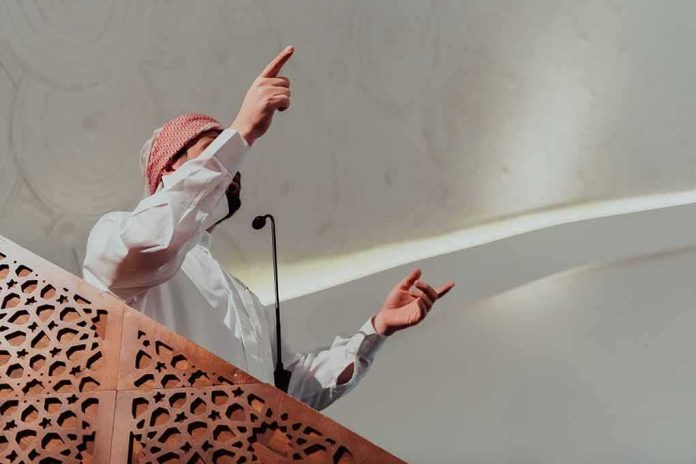
The Bartow City Commission placed Imam Sajid R. Bhuiya of the Masjid Al‑Nur Mosque on its November 16 meeting agenda to deliver the invocation. When he rose to speak, a sizable group in the gallery stood and recited the Lord’s Prayer in unison—punctuated by “Jesus is King” and similar declarations—effectively drowning out the opening of his remarks before order was restored and the imam completed a brief, English reading asking for wisdom for city officials. The disruption was not spontaneous in the procedural sense but a response to the city’s choice of an Islamic prayer leader, which critics characterized as a departure from local tradition rooted in Christianity.
City Attorney Sean Parker explained publicly how the speaker came to the lectern: a representative of a local Hindu temple had first contacted the clerk’s office about giving an invocation; after scheduling hiccups, Parker suggested the clerk reach out to the local mosque, which accepted an available date. Officials emphasized that, while past practice often featured Christian prayers, the city’s invocation opportunity is open to all faiths on equal terms. That sequence matters. Under controlling constitutional law, process—how speakers are selected, not which creed they profess—is the fulcrum.
The constitutional frame: Marsh, Town of Greece, and the line between heritage and endorsement
The Supreme Court has addressed legislative prayer squarely twice in modern times. In Marsh v. Chambers (1983), the Court upheld opening prayers for a state legislature, leaning on the “unbroken history” of such invocations dating to the First Congress and declining to apply the familiar Lemon test. It treated the practice as a ceremonial acknowledgment, not an establishment of religion. Three decades later, Town of Greece v. Galloway (2014) extended that logic to a municipal board, approving a volunteer‑led invocation program so long as access was not exploited to proselytize, disparage, or advance a single faith, and participation did not coerce attendees. The point is not that prayer must be stripped of sectarian content; the point is that the government’s administration of the forum must be evenhanded.
Town of Greece is especially instructive for cities like Bartow. The Court accepted that invocations might reflect the community’s religious demographics and could be explicitly Christian at times, but it required a “policy of nondiscrimination” that welcomes other traditions if they volunteer. Courts and commentators since have read Town of Greece to mean that municipalities need not sanitize prayers into generic civil religion—what they must avoid is gatekeeping that privileges one creed or excludes others from the podium.
Where the public dispute really lies: inclusion versus tradition
The fiercest objections in Bartow were not about meeting procedure but about identity—residents asserting that a “Christian nation” or local custom should control the content of official prayer. Under the law, that is not how the calculus works. The Supreme Court’s framework permits sectarian content precisely because it expects diversity to be handled by access rules, not by censoring religious particularity. Bartow’s officials—by articulating that the opportunity is open to all faiths and by scheduling a Muslim speaker after outreach from a Hindu community member—acted in line with that model.
Protesters who sought to silence the imam by counter‑praying transformed viewpoint diversity into a zero‑sum contest at the microphone. That may feel, to some, like defending tradition; in practice, it undermines the very constitutional compromise that preserves it. If cities are driven to eliminate invocations entirely to keep order, the result is less public prayer, not more—and the loss falls first on the majority faiths that most often accept the invitation under neutral systems.
How to run a legally durable—and civically healthy—invocation program
Experienced municipal lawyers converge on a pragmatic playbook that flows from Town of Greece and avoids avoidable fights. First, adopt a written invocation policy that establishes a nondiscriminatory, open process: maintain a directory of congregations and secular ethical societies within the jurisdiction; rotate or schedule by request on a first‑come basis; and make clear that any willing volunteer within those bounds may offer the opening words. Second, refrain from editing prayer content except to enforce the narrow limits the Court has approved—no proselytizing, disparagement, or exploitation of the forum to advance or attack a faith—recognizing that a brief, tradition‑specific address is permissible. Third, articulate at each meeting that participation is voluntary: attendees may stand or sit, bow their heads or not, without consequence.
Finally, pair inclusion with order. Public‑comment periods are designed for disagreement; the invocation slot is not. Meeting rules that prohibit interruptions, chanting, or counter‑demonstrations during formal proceedings protect everyone’s speech by channeling it to the proper segment of the agenda. When officials enforce those rules evenhandedly—whether the speaker is a pastor, imam, rabbi, or humanist—they convert abstract neutrality into lived fairness.
In Bartow, Florida, a Muslim invocation speaker at a city council meeting was *repeatedly* interrupted by Christian zealots who screamed out the Lord's Prayer.
One deranged activist later told the council, "These people do not belong here." pic.twitter.com/JySWZWCW4c
— Hemant Mehta (@hemantmehta) November 19, 2026
Why this pattern will recur—and how communities can lower the temperature
Because legislative prayer is a heritage practice the Court has chosen to preserve, and because American religious life is plural and dynamic, moments like Bartow’s are not anomalies; they are stress tests of civic maturity. The legal baseline is settled enough—Marsh and Town of Greece govern—that most conflicts are not about the Constitution so much as about social adjustment to genuine inclusion. Cities that proactively explain their policies, publish their speaker rosters, and invite broad participation reduce the element of surprise that fuels backlash. Faith leaders who accept the invitation serve their neighbors well by keeping invocations brief, civic‑minded, and free of proselytizing, as the Bartow imam did by reading in English and praying for officials’ wisdom.
There is a hard truth here for majorities and minorities alike. A government that is allowed to host your prayer only by excluding your neighbor’s is a government that, one day, may exclude yours. The constitutional settlement—open the forum, keep it neutral, police decorum—protects everyone. Communities that embrace it will keep their traditions and their peace.
Sources:
thegatewaypundit.com, wtsp.com, mycharisma.com, yahoo.com, pembrokepinesflnews.com, clickorlando.com, edge.sagepub.com, pewforum.org, justice.gov, lawandpolitics.org