
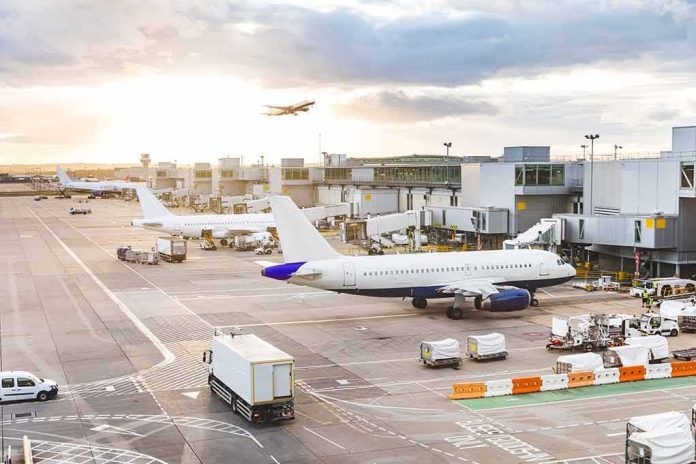
An Iranian drone strike ripping through Kuwait’s main civilian airport is the latest warning shot that America’s enemies are not respecting ceasefires, civilian life, or international borders—and our people and interests in the region remain squarely in the crosshairs.[1]
Story Snapshot
- Iranian drones and missiles hit Kuwait International Airport’s Terminal 1, injuring workers and forcing a full shutdown of flights.[1]
- Kuwait’s government publicly blamed Iran for “aggression” on its territory and said at least one person was killed and several wounded in related strikes.
- The attack struck civilian infrastructure during what media called a “shaky” ceasefire, raising fresh doubts about Iran’s respect for any deal.[2]
- Conflicting casualty details and limited forensic data show how wartime fog and media spin can muddy the truth while still revealing a serious escalation.
Iranian Drones Hit a Civilian Airport, Not a Military Base
Reports from Kuwait and regional outlets agree on one central fact: Iranian drones struck Kuwait International Airport, damaging Terminal 1 and injuring several airport employees.[1] Kuwait’s Defense Ministry described “several drones” hitting Terminal 1 as part of “Iranian aggression,” and said the strike caused “significant material damage” to the terminal.[1] Airways industry reporting likewise noted that a drone hit Terminal 1 on February 28, 2026, injuring multiple workers and disrupting normal airport operations.
Broadcast coverage added that kamikaze-style drones launched from Iran slammed into a passenger terminal, making this one of the most serious attacks on civilian infrastructure since the latest round of hostilities began.[2] Footage and live reports described fires and heavy smoke around airport facilities, consistent with fuel or infrastructure damage. Unlike military installations, commercial airports are filled with civilians, reinforcing concerns that Iran is willing to use civilian targets to send strategic messages across the Gulf.[1]
Kuwait Shuts Its Airport as Casualties and Confusion Mount
Immediately after the strikes, Kuwait suspended air traffic and shut down operations at its main international airport, diverting or delaying flights while authorities assessed damage and secured the site.[1] Arab News reported that Kuwait said Iranian missile and drone attacks on its territory killed one person and wounded several others, forcing Kuwait International Airport to close temporarily. Other outlets emphasized “several wounded” and extensive infrastructure damage, without confirming a final death toll, reflecting the confusion of early wartime reporting.[2]
Kuwait Airways later resumed flights from another terminal, signaling that while the attack was serious, it did not permanently destroy the entire airport complex. This aligns with accounts describing major damage and fire at Terminal 1 rather than total destruction of all passenger facilities.[1] For travelers, workers, and airlines around the world, the message was clear: one Iranian drone strike was enough to halt a key regional hub, disrupt global aviation schedules, and remind everyone how vulnerable civilian infrastructure remains in modern drone warfare.[1]
Ceasefire “On Paper,” War in Reality
Media and regional officials repeatedly described the broader situation as governed by a “fragile” or “shaky” ceasefire between the United States and Iran, yet the Kuwait attack unfolded in the middle of this supposed pause.[1][2] Arab News noted that fighting continued sporadically despite the ceasefire, and that Iran claimed responsibility for attacks on American military assets in Kuwait and Bahrain. American Central Command, for its part, said many missiles launched by Iran toward neighboring states were intercepted or broke apart before hitting targets, though that statement initially reported no casualties.[1]
The airport strike demonstrates how little such ceasefires mean when regimes like Iran see an opportunity to pressure the United States and its partners by hitting symbolic civilian targets.[1][2] Reports indicate that Iran framed its barrage of missiles and drones as retaliation for American strikes on Qeshm Island, while American officials countered that Iran had attacked first.[1][2] Regardless of the sequencing, drones hitting a civilian passenger terminal during an alleged de-escalation period expose how adversaries can sign onto diplomatic language while still escalating on the ground.
Conflicting Details, but a Clear Pattern of Escalation
Not every headline claim around this incident is fully supported by the available facts. Some dramatic framings spoke of a “destroyed passenger terminal,” yet the documented record points to heavy damage, fire, and operational shutdown, not total structural obliteration, especially given that other terminals resumed operations after inspection. Casualty counts also vary: one outlet references a single fatality and multiple wounded tied to Iranian attacks on Kuwaiti territory, while others describe several injuries and no confirmed deaths at the airport itself.
An Iranian drone and missile strike heavily damaged Terminal 1 at Kuwait International Airport on Wednesday, June 3, 2026, killing one person and wounding at least 63 others, according to Kuwait’s Ministry of Health. #nigeria24 https://t.co/6fRo4uhYvz pic.twitter.com/RhTTCoIB0M
— NIGERIA 24 (@Nigeria24live) June 3, 2026
There is also a gap between official blame and publicly available forensic proof. Kuwait’s Foreign and Defense Ministries attributed the attack to Iran and called it Iranian aggression, while media cited Iranian Revolutionary Guard claims of missile and drone strikes against American bases in the region.[1][2] However, the open record shared so far does not detail debris serial numbers, radar tracks, or technical analysis that would typically accompany a full investigation.[1] Even so, the pattern is unmistakable: Iranian drones and missiles are being used to hit civilian-linked infrastructure near American interests, during a supposed ceasefire, in ways that test Western resolve and regional stability.
Sources:
[1] Web – CEASEFIRE BROKEN: Iranian Drone Attack Destroys Airport Passenger …
[2] YouTube – Iranian Drones, Missiles Hits Kuwait Airport, Several …