A deadly rear-end collision between two high-speed trains on Spain’s Madrid–Andalusia line killed dozens and shut a key corridor, exposing system failures that should never reach passengers.
Story Snapshot
- Officials reported a rear-end crash on the Madrid–Andalusia high-speed route in Toledo province.
- Local authorities said one train was stopped when another, traveling the same way, hit it from behind.
- Early death counts ranged from at least 10 to at least 46, with dozens injured.
- Services by Renfe and Iryo were involved; two carriages derailed after impact.
What Authorities Confirmed About the Crash
Spain’s rail infrastructure manager said two trains collided from behind on the high-speed line linking Madrid to Andalusia, and halted traffic on the corridor. Regional officials in Castilla-La Mancha said both trains were moving the same direction and the lead train was stopped when the trailing train struck it. Reports placed the crash area in Toledo province along the Madrid–Seville corridor, with differing nearby town pairs listed in early updates. Emergency teams evacuated survivors and moved the injured to hospitals.
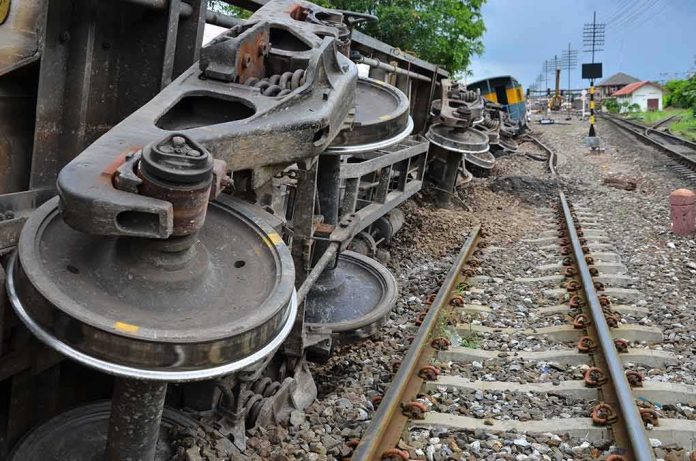
Regional and media briefings identified the trains as a Renfe high-speed service and an Iryo high-speed service headed south from Madrid. Accounts described a violent rear impact that pushed cars off the rails, with two carriages derailing and sliding down an embankment or into a ditch. Images and video from the scene showed significant damage to the rear coaches and debris along the right-of-way. Rail traffic on the line was suspended while responders worked and investigators secured evidence.
Casualties and the Scale of the Disaster
Local authorities cited by national and international outlets reported at least 39 deaths, while other updates mentioned at least 10 and later at least 46 fatalities as counts evolved during rescue operations. Dozens more were injured and taken to hospitals across the region. These ranges are common in the first hours after a mass-casualty event, when responders focus on rescue, not precise tallies. Officials warned that numbers could rise as crews reached all cars and confirmed identities.
Passengers described a sudden jolt, then chaos in dark, damaged cars. First responders moved quickly to stabilize the scene and cut through wreckage. The death toll places this among Spain’s worst rail disasters in recent years. Political parties paused campaign events nationwide in a sign of mourning and respect for victims and families as emergency work continued along the line. Support services and hotlines were opened for relatives seeking updates on loved ones.
Why Rear-End Collisions Happen on Modern Rail
Rear-end crashes often involve a stopped or slowed lead train and a following train that does not have enough time or distance to brake. Engineering reviews list rising train speeds, signaling failures, and human error as common factors in such collisions. Research on train collisions also finds that failures to obey or display signals are a frequent cause, along with speed and rule violations. Modern systems aim to block these chains, but when layers fail together, outcomes can be severe.
Investigators will examine dispatch orders, signal aspects, train control logs, radio calls, track equipment, and onboard event recorders. They will seek to confirm whether the forward train was stationary and why, and how the trailing train’s protection systems responded. They will look at braking performance, visibility, and maintenance records. Authorities have not released a final cause, and early possibilities remain unproven until technical reports are complete.
What This Means for Travelers and Trust
High-speed rail depends on tight schedules, clear signals, and strong safety layers that leave no single point of failure. When those layers falter, everyday people pay the price. Travelers expect that control centers, onboard systems, and trackside equipment backstop each other, even if one part slips. This crash shows how one weak link, multiplied across a chain, can turn a normal trip into a mass-casualty disaster. Families and commuters deserve answers and fixes, not excuses.
Spain High-Speed Train Crash: Death Toll Rises to 68, Investigation Underway
Read : https://t.co/z47YffAJYh#SpainTrainCrash #Spain #TrainAccident #Renfe #Iryo #BreakingNews #RailSafety #WorldNews
— The IndustrialPunch (@industrialpunch) October 28, 2026
For readers in the United States, this story hits close to home. Both parties talk about modern infrastructure, but maintenance and safety often lose out to politics and press events. Whether the problem is staffing, aging gear, software, or training, the result is the same: people get hurt when systems fail. Transparent findings and fast, specific safety upgrades are the only way to earn back public trust on any rail line, in Spain or here at home.
Sources:
irishtimes.com, independent.ie, independent.co.uk, ianslive.in, thenews.com.pk, cbc.ca, link.springer.com, railtec.illinois.edu