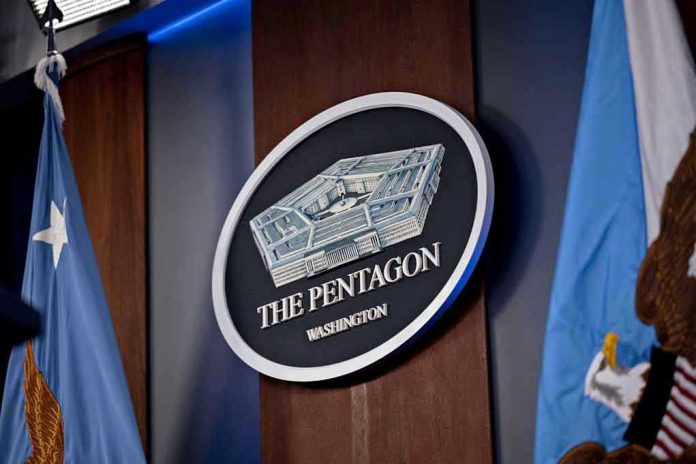
President Trump has approved a U.S. Army firing squad for Fort Hood terrorist Nidal Hasan, marking the first military execution in more than six decades.
Story Highlights
- Pentagon says President Trump approved a firing squad for Nidal Hasan’s execution
- Defense Secretary Pete Hegseth recommended the method; Trump approved it
- Hasan was convicted for killing 13 at Fort Hood in 2009
- This would be the first U.S. military execution in over 60 years
Pentagon Confirms Approval and Method
Pentagon spokesman Sean Parnell said Defense Secretary Pete Hegseth recommended, and President Donald J. Trump approved, death by U.S. Army firing squad for convicted terrorist Nidal Malik Hasan. Reports quote the Pentagon statement by name and connect the decision directly to Trump and Hegseth. The announcement states the execution will proceed by firing squad, a method that remains lawful in select jurisdictions and historically tied to military justice.
News outlets describe this as the first U.S. military execution in more than 60 years, underscoring the rare and historic nature of the move. Coverage notes the approval as a clear executive decision inside the military chain of command. While outlets relay the Pentagon’s words, they do not publish an order document. The reporting, however, consistently attributes the decision to Parnell’s statement on behalf of the Department of Defense.
Who Hasan Is and What He Did
Nidal Hasan was convicted for the 2009 Fort Hood attack that killed 13 people and wounded many others. Military authorities secured a death sentence after court-martial proceedings. The case has long stood as a symbol of jihadist terror on U.S. soil, carried out against unarmed American service members. Families waited years for final resolution. The approved method signals the military’s intent to carry out the lawful sentence with clarity and certainty.
Officials framed the step as execution of a final judgment, not a re-litigation of facts. The Pentagon’s statement ties responsibility to current leadership and the military justice system. The focus remains on Hasan’s proven crimes and the rights of victims to see the sentence enforced. This decision aligns with a view that justice must be sure and not indefinite. It also tells would-be attackers that America’s military will answer acts of terror with firm law and order.
Why Firing Squad Now
States and agencies have faced mounting problems with lethal injection, from drug shortages to botched attempts. That has pushed some jurisdictions to consider alternatives that meet constitutional standards and work in practice. Analysts and reports describe firing squads as rare in modern times but operationally reliable. Since 1976, firing squads account for a tiny share of U.S. executions, a fraction of one percent. The method’s revival reflects a search for sure procedures that avoid prolonged failures.
Idaho recently made the firing squad its primary execution method after repeated lethal injection setbacks and supply issues. That shift shows a broader trend: officials are choosing methods that can be performed by trained teams with predictable results. The military’s decision on Hasan arrives in this context. It follows the same practical test: can the government carry out a lawful sentence in a controlled, constitutional way? Recent reporting suggests firing squads meet that test when other methods stall.
What This Means for Justice and Deterrence
The approval communicates that terror against Americans brings firm consequences. Families who lost loved ones at Fort Hood have waited since 2009. The government’s move signals closure is coming, not drifting further away. For service members, it upholds a core truth: the Uniform Code of Military Justice still means what it says, even in the hardest cases. A sentence, once final, will be carried out with discipline and respect for the law.
This case also resets expectations about military accountability. The last U.S. military execution occurred more than half a century ago, making this decision historically significant. Officials did not detail logistics, timing, or location in the public reporting. But the chain of authority is plain: the Secretary of Defense recommended it, and President Trump approved it. That clarity reflects a government ready to act, not delay, when justice is due.
Sources:
idahostatesman.com, forms-idoc.idaho.gov, idahonews.com, nypost.com, idoc.idaho.gov