
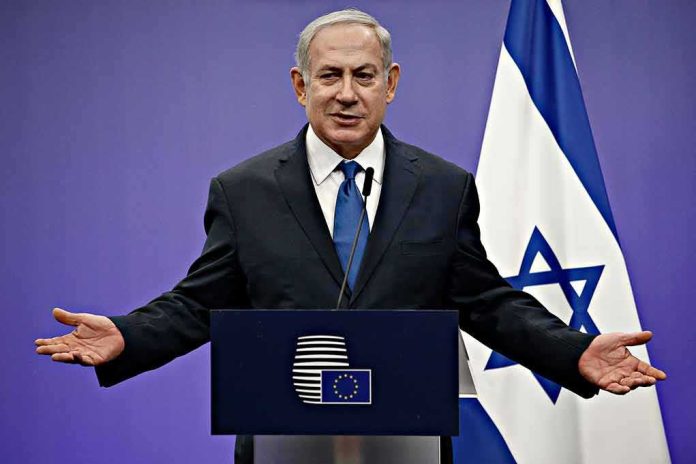
Israel’s election just stripped Prime Minister Benjamin Netanyahu of his parliamentary majority, yet he still controls the single largest bloc in a deadlocked Knesset where no side can govern alone.
Story Snapshot
- Netanyahu’s bloc won 53 of 120 Knesset seats, eight short of the 61 needed to govern.
- Likud remains the largest single party with 27 seats, while rival Gadi Eisenkot’s Yashar party took 21.
- Arab-led parties captured a record 19 seats, giving them new leverage in coalition talks.
- Eisenkot calls Netanyahu a “caretaker” leader without a mandate and accuses him of letting politics drive wartime decisions.
- Weeks of difficult coalition negotiations lie ahead, with no guaranteed path to a stable government.
Election Leaves No Outright Winner
Israel’s Central Elections Committee released final results showing Netanyahu’s right-wing and far-right coalition won 53 of 120 Knesset seats. The opposition bloc led by Eisenkot took 48 seats, and Arab-led parties won 19. Likud remains the single biggest party with 27 seats, but the result leaves every bloc short of the 61-seat threshold needed to form a government on its own.
Unproven Fraud Claims Surface
As final numbers came in, Netanyahu’s party pushed unsubstantiated claims that Arab-led parties had “stolen” the election, suggesting possible foreign help. Election officials released the results without disputing their accuracy, and no evidence has been presented publicly to support the fraud allegations.
Israel has no modern precedent for forming a government led by an Arab-majority bloc, and deep ideological splits make that path unlikely despite the math. President Isaac Herzog has begun consultations with party leaders to see who can realistically assemble a 61-seat coalition in the coming weeks.
Rival Says Netanyahu Lost the Public’s Trust
Eisenkot, a former military chief, said the results prove voters have turned on Netanyahu. He called him “a caretaker prime minister, without a mandate or the people’s trust,” and warned him directly: “Don’t you dare use Israel’s security for your political needs”. Eisenkot also said he watched “deep dysfunction” in wartime decisions, with political considerations placed above all else.
Eisenkot pressed Netanyahu for an exit strategy during the Gaza war and says none ever came, with Netanyahu instead insisting on fighting until “total victory”. He also noted that a goal he once supported — destroying Hamas’s military and government power within a year — remains unmet more than three years later.
Hostage Families Question Motives
Families of hostages taken during the October 7 attack have accused Netanyahu of putting his own political survival ahead of their relatives’ safety. A poll cited by the British Broadcasting Corporation found 49% of respondents believed Netanyahu kept the war going mainly for political reasons. Military-affairs commentator Amos Harel argued the prolonged conflict helped Netanyahu maintain a constant state of emergency that served his hold on power.
Modi should shudder because Trump has lost mid term polls in the USA and Netanyahu has failed to get a Knesset majority in Israel BUT Rahul Gandhi, who has lost almost every election in India should feel confident.
Congidiot logic pro max!
— Anurag A Katriar (@KingKatriar) November 4, 2026
A System Built for Gridlock
Israel’s proportional voting system has long produced fragmented parliaments where the biggest party rarely governs alone. Academic research describes decades of narrow, unstable coalitions that hand outsized leverage to small parties and individual lawmakers. This election fits that pattern: Netanyahu’s bloc is the largest organized force, but institutionally incomplete without eight more seats.
Analysts expect the coming negotiations to stretch for weeks, with ultra-Orthodox, secular, and Arab-led parties all holding pieces of the puzzle. Whoever eventually forms a government will likely rely on a razor-thin majority, the same instability that has defined Israeli politics for much of the past three decades.
Sources:
france24.com, apnews.com, foreignpolicy.com, ianslive.in, npr.org, nbcnews.com, bbc.com