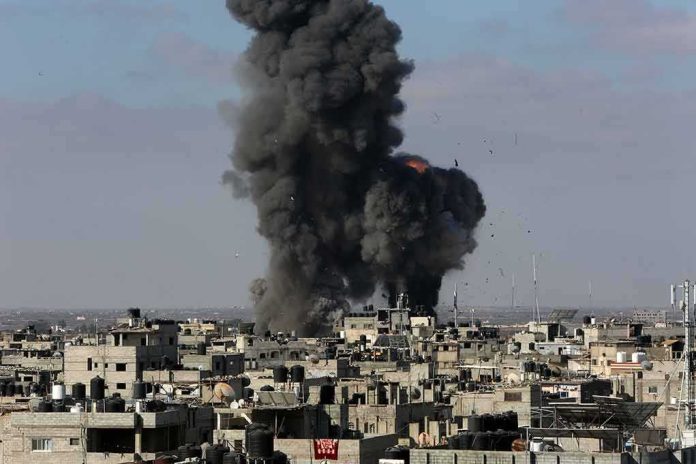
Ukraine fired more than 1,000 drones at Russia as voting ended, and Moscow reported deaths and a hit on a major oil refinery.
Story Snapshot
- Officials said over 1,000 Ukrainian drones targeted Russia, with hundreds aimed at Moscow.
- Moscow’s mayor reported 450 drones intercepted near the capital and damage at an oil refinery.
- Russian authorities said at least two people were killed in the Moscow region.
- Russia’s Defense Ministry claimed 1,100 drones were shot down across the country.
What Happened Overnight and Why It Matters
Ukrainian forces launched a large drone wave at Russia on Sunday, the last day of Russia’s parliamentary vote. Reports said more than 1,000 drones were used, with hundreds headed for Moscow. Moscow’s mayor called it the largest-ever strike on the capital. Russian officials said at least two people died in the Moscow region and that an oil refinery in the city was damaged. Russia’s Defense Ministry said air defenses shot down about 1,100 drones across Russia and nearby waters.
The timing raised stakes. Moscow’s mayor linked the attack to the vote and said the goal was to disrupt elections. He also said the attacks failed to stop the process. Several outlets carried those claims, while also noting that some drones reached the Moscow Oil Refinery and that a residential building was struck, underscoring the limits of interception in a mass event. These details point to a fight over both real damage and public perception.
Damage Reports and Conflicting Numbers
Officials gave different figures. Moscow’s mayor said more than 1,600 drones had been intercepted since Saturday, including 450 near the capital, while the Defense Ministry cited about 1,100 shot down overnight countrywide. Such gaps are common in wartime reporting. Local authorities said two people were killed and several injured in the Moscow region, and that the refinery in Kapotnya sustained damage. Independent confirmation of exact counts was not available through these reports.
Key facts held across sources. Major outlets reported the total scale surpassed 1,000 drones, that hundreds targeted Moscow, and that the refinery was hit. The Associated Press report highlighted both the size of the strike and the interceptions claimed by Russian officials. U.S. and international outlets echoed those points, including the Defense Ministry’s tally and the mayor’s 450 near the capital, which positioned the event as the most intense on Moscow to date.
Why Drone Warfare Keeps Escalating
This strike fits a growing pattern in the war. Both sides have used large drone swarms to stress air defenses, shake supply lines, and shape the news cycle. Data and prior coverage show Ukraine has scaled up long-range strikes, while Russia has surged daily drone use against Ukrainian cities and infrastructure. The trend points to cheaper, numerous drones changing how both sides project power deep behind the front lines, at lower cost than missiles but with steady pressure.
🚨 MASSIVE ATTACK: Ukraine launched a record-breaking drone strike targeting the Russian capital. Russian authorities say over 1,600 drones were intercepted, with 450 aimed at Moscow.
A major fire broke out at the Moscow Oil Refinery after multiple drones struck the facility. pic.twitter.com/MmaLQdnmI6— Muhammad Rizwan (@m_rizwanjamil) September 20, 2026
For Americans watching from afar, the lesson is broader. Mass drones let governments wage constant pressure with fewer troops and more secrecy. That can tempt leaders to bypass public debate and long-term strategy. Voters who already distrust “the elites” see the bills for energy, shipping, and insurance rise while officials trade press lines about interceptions. The concern is simple: more swarms mean more risk to fuel sites and trade lanes, and that can push prices and tensions higher at home.
What To Watch Next
Watch for satellite or commercial imagery that shows the scope of damage at the Moscow Oil Refinery. Look for Russian counterstrikes on Ukrainian energy and ports, which often follow large attacks. Track any changes in reported drone interception rates, since both sides use those numbers to signal strength. Finally, note whether Ukraine maintains this pace. Sustained long-range pressure can tax Russian defenses and industry, but it also invites escalation and wider regional fallout.
Sources:
redstate.com, usnews.com, independent.co.uk, english.mathrubhumi.com, srpske.rs, reuters.com