
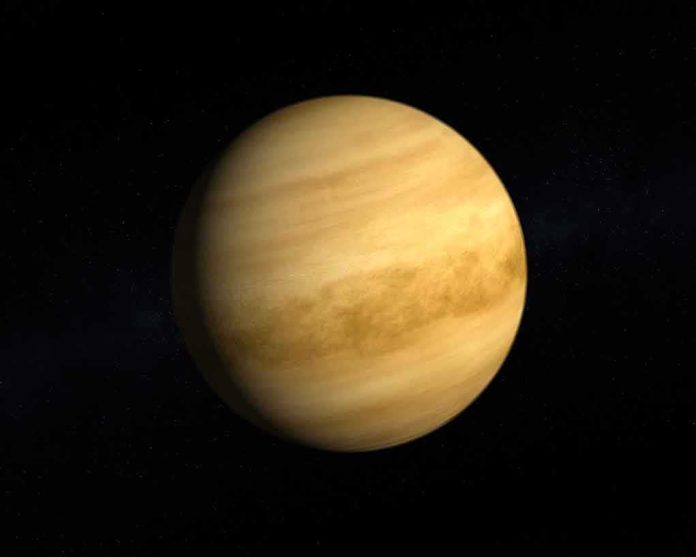
Astronomers caught a giant planet in the act of being born—and it is not even a million years old.
Story Snapshot
- Elias 2-24 b is the youngest confirmed planet on record, under one million years old.
- The planet is about the size of Jupiter and still sits inside its birth disk of gas and dust.
- The find came from reanalyzed data and follow-up imaging tied to a new study by a Chile-led team.
- The speed of its growth pressures models of how fast giant planets can form.
A record-setter inside a stellar nursery
NASA reports that astronomers confirmed Elias 2-24 b as the youngest known planet, with an age under one million years. The world orbits a very young star and is still embedded in the swirling birth material around it. That location matters. It puts the planet at the exact construction site where gas and dust clump, heat, and build a giant. The team identified the planet through targeted analysis of existing records and direct imaging methods refined for dusty, bright regions.
https://www.youtube.com/watch?v=hIbbMSQtH94
The group behind the confirmation published their study in The Astrophysical Journal Letters, led by Andrea Bernardi of Universidad Diego Portales, according to institutional reporting on the result. The planet appears similar in mass to Jupiter. That sets a clear test for formation ideas. If a Jupiter-scale world takes shape this fast, then the growth of a solid core and the pull-in of a thick gas envelope can happen on a short clock. That is a big clue about how common giants may be.
How they saw a baby planet in a blinding glare
The star’s disk once showed striking rings and gaps at different distances, a classic sign that a forming planet is sweeping paths through dust. Radio telescope work on this same system mapped those features years earlier, setting the stage for a planet search. To confirm the world, the team leaned on high-contrast imaging tools that block starlight and boost faint signals near the star. NASA notes the effort drew on agency-funded archives and follow-up views.
Newborn planets hide in plain sight. The dust glows. The star blazes. The planet’s heat fades with time. That makes the earliest window both best and hardest. Coronagraphs and careful data checks make the view possible. Researchers now have a point source where the models said a planet should be. The object’s position, brightness, and local disk signature line up with a protoplanet shaping its lane. That is the cleanest match to the data at hand.
Why this baby upends the planetary timeline
The planet’s extreme youth tightens the formation stopwatch. Many classroom charts put giant-planet growth on multi-million-year scales. Elias 2-24 b shows the job can finish far quicker, at least in some systems. That speed supports ideas where pebble-size grains feed a core fast, or where gas collapse jumps ahead once a threshold is met. For people who value proof over theory, that is the right sequence: measure first, then reshape the model to fit the facts.
BREAKING 🚨: Astronomers have found the youngest planet ever discovered
It's less than a million years old, called Elias 2-24 b pic.twitter.com/7cK9rGtoPk
— Latest in space (@latestinspace) September 17, 2026
The find also guides how to search. The next wins likely come from the same recipe: scan known disks, mine old data with new tools, and confirm with sharp imaging. NASA’s reporting ties this record to a wider push using ground observatories partnered with the agency and space-based follow-up. Future looks at Elias 2-24 b could sniff its atmosphere, time its motion in the disk, and weigh it with better precision. Each step will tune the planet’s age and mass and lock down how it grew.
What this means for our place in the galaxy
Giant planets shape their systems. They clear paths, toss comets inward, and can guard or grind rocky worlds. Seeing one so young, so fast, gives a clearer origin story. The same physics that built our own Jupiter may run on a tighter schedule than many assumed. That pushes a practical lesson beyond astronomy. Big claims should ride on clear measurement, repeated checks, and open data. This discovery followed that path—and earned the headline it carries.
Sources:
sciencedaily.com, science.focus.ua, milenioyems.cl, exoplanet.eu