
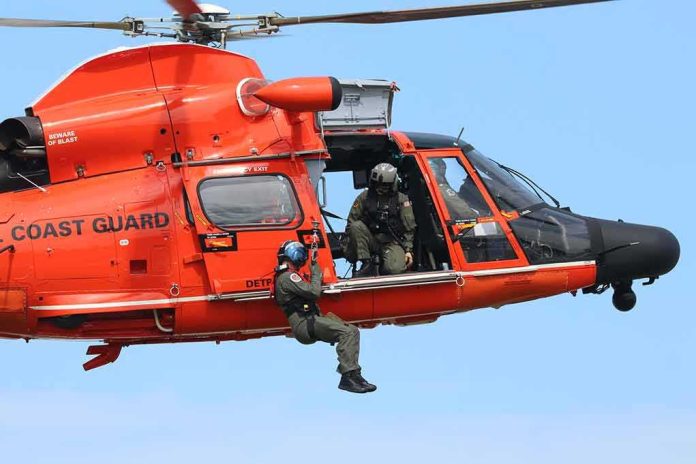
Search planes and cutters are sweeping seas off Nantucket after a Boston-bound jet with six people vanished from Federal Aviation Administration contact early Saturday, the U.S. Coast Guard says.
Story Snapshot
- The Coast Guard launched air and surface crews after contact was lost with a Gulfstream G100 from Bermuda to Boston.
- Officials said six people were on board when the aircraft went missing off Nantucket.
- The search follows the standard U.S. system where maritime rescues fall to the Coast Guard after Federal Aviation Administration alerts.
- No confirmed outcome has been reported; crews are still searching the area.
What Officials Confirmed About the Missing Flight
The U.S. Coast Guard said it launched aircraft and cutters after the Federal Aviation Administration reported losing contact with a Gulfstream G100 early Saturday. News outlets reported the jet left Bermuda and was bound for Boston when it went missing off Nantucket. The Coast Guard said six people were on board, which raised the stakes for a fast search in busy waters and fall weather. Officials have not announced any debris or survivors. Active search operations continue.
Reporters cited Coast Guard Northeast updates describing the search area as off the coast of Nantucket. The loss of contact happened in the early morning hours, but officials did not share a precise minute-by-minute timeline. The aircraft’s registration, operator, and passenger identities were not released in public reports. Outlets said they sought comment from the Federal Aviation Administration but had not published a separate agency statement. The Coast Guard remained the main public source early in the day.
Why The Coast Guard Leads This Maritime Search
Federal rules assign rescue leadership by location. When an aircraft is missing over water near the United States, the U.S. Coast Guard runs the search. The Federal Aviation Administration’s role is to issue alerts and share flight information so rescue teams can move quickly. This split is part of the National Search and Rescue Plan. The Coast Guard and the U.S. Air Force each run rescue centers for their regions, with the Coast Guard responsible for maritime missions.
The Federal Aviation Administration’s guidance explains that an alert notice signals local authorities and rescue centers to begin a search. Air traffic facilities pass details like the route, last known position, and fuel on board when they can. Those facts shape the first search box and the assets sent. Over the ocean, time matters because wind, currents, and waves can push debris and rafts far from the last radar hit. That is why air and surface crews launch fast.
How Searches Unfold Over Open Water
Rescue teams set search grids based on the last contact, likely speed, altitude, and drift. Aircraft scan from above while cutters and patrol boats work below. Crews look for oil sheens, floating gear, or emergency beacons. Over water, even a small error in the last known point can grow into a large search area within hours. Weather, daylight, and sea state can help or hurt. Early reports did not include wind or wave data for the area off Nantucket at the time.
Many ocean searches start with limited facts. A missing aircraft report can mean radio failure, instrument trouble, or worse. Rescue leaders plan for the worst and hope for the best. They add assets as they learn more. When a case starts near a hub like Boston, more aircraft and cutters may be close by. That can speed coverage. Newsrooms often repeat the first agency statements while they wait for updates, which is common in these early hours.
What This Says About Public Safety Systems
Events like this test the rescue network that people on both the right and left want to work well. The system depends on clear roles and quick handoffs between air traffic control and rescue centers. When it works, crews launch within minutes. When details lag, the search still starts, but the area is larger and the odds get harder. Saturday’s reports point to the process moving as designed, with the Coast Guard leading at sea after the Federal Aviation Administration alert.
"Coast Guard Launches Urgent Search Off Nantucket After Boston-Bound Medical Jet Carrying 6 People Vanishes"
➡️ Emergency rescue crews with the U.S. Coast Guard have launched an urgent search operation over open water off the coast of Nantucket after a twin-engine medical jet…
— BreakinNewz (@BreakinNewz01) October 3, 2026
People often ask why details are scarce at first. The reason is simple: safety comes before press. Crews focus on finding people, not filling in every blank. That can be frustrating in a time of distrust in government. But in search and rescue, the first job is to get eyes on the water and save lives. Officials will release more once facts are solid. For now, the confirmed news is the search itself, the route, the aircraft type, and the count of six aboard.
Sources:
facebook.com, wcvb.com, nbcboston.com, pinkpillbox.com, faa.gov