
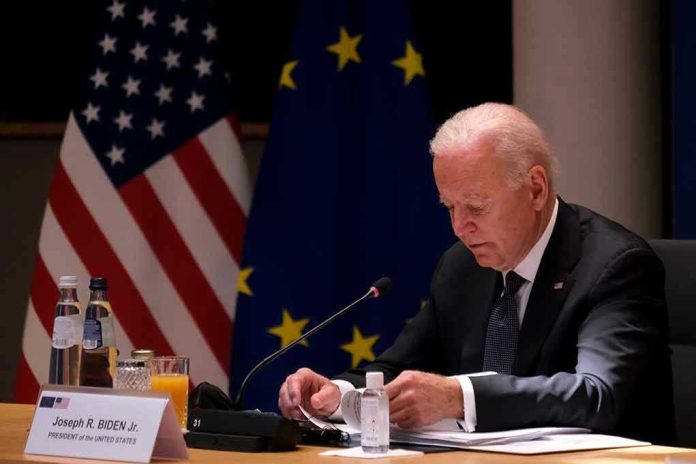
Joe Biden is fighting in court to keep 70 hours of his own recorded voice hidden from the American public, and the reason why raises questions that go far beyond a memoir project.
Story Snapshot
- Biden intends to intervene in litigation to block the Trump administration’s Department of Justice from releasing 70 hours of audio recordings he made with ghostwriter Mark Zwonitzer during interviews for his memoir.
- Special Counsel Robert Hur’s February 2024 report confirmed the recordings had “significant evidentiary value,” capturing Biden reading classified information nearly verbatim to an uncleared civilian on at least three occasions.
- Zwonitzer deleted many of those audio recordings in the weeks immediately following Hur’s appointment in January 2023, a timeline Hur himself flagged as deeply problematic.
- House Judiciary Committee Chairman Jim Jordan subpoenaed Zwonitzer in March 2024 after he failed to voluntarily produce recordings and transcripts referenced in the Hur report.
What Biden Shared, and With Whom
Between 2017 and the publication of his memoir, Biden sat for recorded interview sessions with ghostwriter Mark Zwonitzer, a private civilian with no security clearance. According to Special Counsel Robert Hur’s February 2024 report, Biden read classified information from his personal notebooks to Zwonitzer nearly verbatim, sometimes for an hour or more at a time, on at least three separate occasions. [5] The notebooks contained sensitive materials related to the Afghanistan troop surge and Situation Room deliberations. This was not a casual slip. It was a repeated pattern.
Hur’s report also documented a 2017 recording in which Biden referenced finding “all the classified stuff downstairs,” a statement the special counsel identified as among the most incriminating captured on tape. [5] That audio existed. Investigators found it. And it directly contradicts the notion that there is nothing of public interest on these recordings. Biden’s legal team has yet to produce a compelling factual argument for why 70 hours of his own voice, obtained lawfully by federal investigators, should remain sealed from the public he once served.
The Ghostwriter Deleted the Evidence, Then Claimed Innocent Reasons
Within weeks of Hur’s appointment as special counsel in January 2023, Zwonitzer deleted audio recordings from his computer. Hur testified that Zwonitzer “slid those files into his recycle bin.” [1] Zwonitzer later told investigators he deleted the recordings out of concern about potential hacking and to protect Biden’s privacy. [2] Hur’s report acknowledged these as “plausible, innocent reasons” and declined to prosecute, noting that Zwonitzer had preserved transcripts containing incriminating material and had not hidden his actions. [5] Whether you find that explanation convincing likely depends on whether you believe the timing was coincidental.
Investigators did recover audio Zwonitzer had unknowingly retained on his devices after receiving a subpoena. [2] That recovered audio, combined with whatever was preserved from the original production, forms the core of the 70 hours now at the center of this legal fight. The fact that some recordings survived despite deletion attempts makes Biden’s effort to block their release all the more conspicuous. If the content is benign, releasing it would put the matter to rest permanently. Blocking it does the opposite.
Congress Pushed, Biden Stonewalled, Now the Courts Decide
House Judiciary Committee Chairman Jim Jordan subpoenaed Zwonitzer in March 2024 after the ghostwriter failed to voluntarily hand over recordings and transcripts that Hur’s own report had already confirmed existed. [4] The subpoena came after Zwonitzer declined to cooperate fully with the committee’s document requests. Republicans on the committee were also scrutinizing Biden’s reported $8 million memoir deal as a potential motive for why classified information ended up in a book project at all. The subpoena was not a fishing expedition. The documents were already confirmed to exist by a sitting special counsel.
Biden Moves to Block Release of 70 Hours of Audio Recordings With Ghostwriter https://t.co/p6uykSoiyY
— Rachel Morse (@rm36863307) May 10, 2026
Now, with the Trump administration’s Department of Justice moving to release the recordings, Biden has announced his intention to intervene in litigation to stop it. [5] His team will almost certainly invoke executive privilege, the same doctrine Biden used in May 2024 to block Congress from accessing the audio of Hur’s interview with him directly. That privilege claim was enforced by then-Attorney General Merrick Garland’s Department of Justice. The current Department of Justice answers to different leadership, and the legal landscape has shifted accordingly. The argument that releasing these recordings serves no public interest is extraordinarily difficult to sustain when a sitting special counsel already told the country they captured a former president reading classified national security materials to an uncleared ghostwriter. The public has every reason to hear what was said.
Sources:
[1] Hur confirms Biden’s ghostwriter destroyed evidence after special …
[2] Biden’s ghostwriter deleted recordings, special counsel was told
[4] Chairman Jordan Subpoenas President Biden’s Ghostwriter
[5] [PDF] report-from-special-counsel-robert-k-hur-february-2024.pdf