
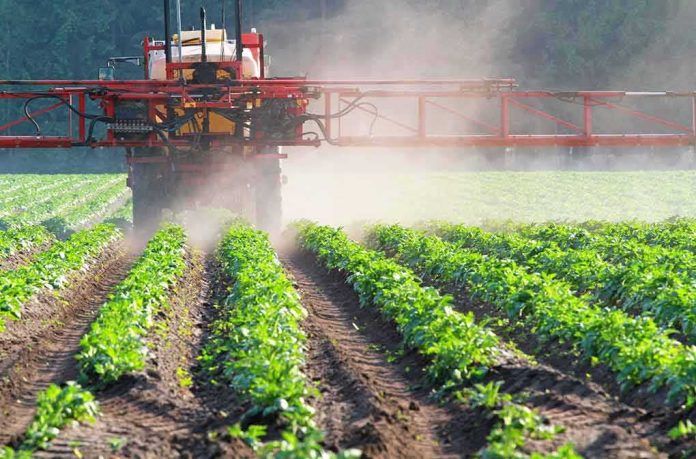
President Trump and the Department of Agriculture launched an $8 billion Harvest Fuel Relief program to help farmers hit by soaring diesel costs this harvest season.
Story Highlights
- USDA set aside $8 billion for one-time harvest payments to U.S. farmers
- President Trump tied the aid directly to high diesel costs during the 2026 harvest
- Farm Service Agency will run payments using a uniform formula for simplicity
- A separate diesel-tax action is projected to save about $640 million nationwide
What The Administration Announced And Why It Matters
United States Department of Agriculture said it will make $8 billion available for one-time payments to American farmers to offset higher input costs during the 2026 harvest. The department cited temporary market disruptions and rising fuel needs as the trigger for action. President Trump announced the effort at an event in Kansas and connected the support to surging diesel prices that strain harvest budgets and threaten yields if equipment sits idle during peak season.
United States Department of Agriculture stated the program draws authority from the Commodity Credit Corporation Charter Act and will be administered by the Farm Service Agency. That framework lets the department deliver aid quickly through existing county offices without seeking a new appropriation. The plan aims to keep combines rolling, prevent delayed harvest losses, and shore up working capital for family farms facing fuel sticker shock during a crucial window.
How Payments Will Be Calculated And Delivered
United States Department of Agriculture described a “simple, proportional” payment approach anchored to Farm Service Agency reported planted acres. The formula uses Economic Research Service cost-of-production estimates and World Agricultural Supply and Demand Estimates yields and prices to guide commodity-specific rates. Officials said commodity rates for major row crops would follow in November, with methods for other eligible commodities to be detailed after additional review of fuel-use data from producers.
United Press International reported that the Farm Service Agency will process payments, giving farmers a familiar channel and clear points of contact. The report also echoed the White House framing that diesel costs are the key pain point during harvest. While the announcement set the $8 billion ceiling and the structure, application dates and final per-acre rates were still pending at the time of the rollout, with details expected from the department soon.
Additional Diesel Tax Relief And Expected Savings
United States Department of Agriculture Secretary Brooke Rollins said earlier in October that a separate executive action on dyed diesel was expected to generate about $640 million in combined federal and state savings across roughly 224.6 million harvested acres. That measure is distinct from the $8 billion payment program. Together, the policy package seeks to lower fuel burdens now and provide direct cash support to stabilize farm operations through the end of harvest.
National Sorghum Producers thanks @POTUS , @SecRollins and Sen. Marshall for announcing $8 billion in U.S. Department of Agriculture Harvest Fuel Relief to help farmers manage rising fuel and input costs.
Payment rates are expected in November, with application details still… pic.twitter.com/qsUf8vxjlj
— National Sorghum Producers (@SorghumGrowers) October 20, 2026
United States Department of Agriculture emphasized that specialty-crop growers, ranchers, and fishermen could submit fuel-cost data to shape pending eligibility and rates. The department’s outreach signals an intent to reflect real fuel use across different operations, not just big row crops. One caveat remains: the agency had not yet published final rates or the application window at the time of the announcement, though it committed to releasing them soon to speed payments.
Why This Move Aligns With Conservative Priorities
President Trump’s team used standing Commodity Credit Corporation authority to act fast, cut red tape, and get help to the people who feed the nation. That approach limits bureaucratic delay and keeps farms operating without surrendering control to new, sprawling programs. Direct relief supports family farms, food security, and rural jobs while harvest is on the line. It also pushes back on inflation pain by targeting a core driver of costs: diesel at the pump for heavy equipment.
What Farmers Should Watch Next
Producers should watch for United States Department of Agriculture rate sheets in November, Farm Service Agency sign-up details, and any guidance for commodities beyond the major Title I crops. Farmers who operate in specialty crops or fisheries should prepare records on diesel usage to inform the department’s pending methods. Payment timing was not set at announcement, but officials signaled urgency to move funds. Keeping accurate acreage and cost data will help ensure fair, fast support when the portal opens.