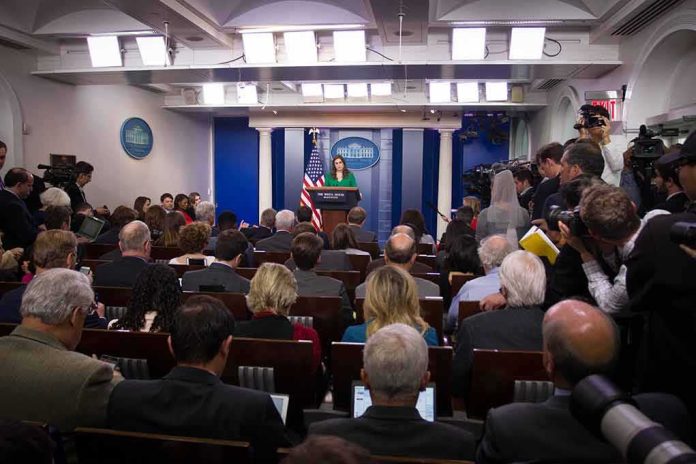
The White House followed through on President Trump’s stated media ban as MS NOW reporters were denied entry to the grounds Saturday morning.
Story Snapshot
- MS NOW says Secret Service denied its reporters access to the White House the day after Trump’s ban post.
- Trump publicly announced a ban on CNN, MS NOW, and Politico for “fake news,” calling it effective immediately.
- Prior court fights over press access create a mixed legal backdrop with limits and discretion noted.
- Press groups claim the move violates First Amendment principles and promise a fight.
What Happened: A Stated Ban Becomes a Physical Denial
MS NOW said its journalists were blocked from entering the White House grounds on Saturday morning, one day after President Trump posted that he was banning MS NOW, CNN, and Politico for what he called constant “fake news” coverage. Reporters need physical press credentials to enter, and access is controlled by the Secret Service at the gates. If credentials are flagged or revoked, entry stops at the door, which is what MS NOW reported occurred.
Trump’s post drew immediate attention because it targeted entire outlets, not a single reporter. Some outlets reported that journalists from the named organizations were still on the grounds shortly after the announcement, showing a lag between the post and enforcement. By Saturday, MS NOW reported actual denial, making the policy concrete at the gate. The outlet said it would take any steps needed to defend its rights in court if required.
The Rules in Play: Access Control Versus Viewpoint Neutrality
Courts have said the White House holds more control in tight, restricted spaces like the Oval Office and Air Force One. Pool access there is limited, and presidents have some discretion in selecting who goes in those confined areas. But once the White House opens general press facilities, courts have warned that denying access based on content or viewpoint crosses First Amendment lines. That tension sits at the center of the current clash.
The Associated Press sued in 2025 after the administration limited its access while pressing for a “Gulf of America” naming change. A federal judge found that move likely violated the First Amendment, but an appeals panel later gave the White House more leeway in small, nonpublic areas while litigation continued. That mixed record shapes expectations now and signals that both sides have legal arguments ready.
Process Questions: Where Is the Written Basis for MS NOW?
Saturday’s denial raises a key process question: what specific rule or credential standard triggered the block for MS NOW? Public reports do not identify a formal suspension notice, written violation, or credential revocation letter tied to the outlet. That gap could matter in court, where due process, notice, and clear standards often decide First Amendment access cases. The lack of a cited rule today may invite a fast legal challenge.
Press advocates argue viewpoint-based actions chill reporting and punish speech. The White House Correspondents’ Association said the Constitution’s press protections do not depend on whether a president likes an outlet’s coverage. They framed the ban as a direct threat to independent reporting that serves the public, not politicians. Expect coordinated statements, amicus briefs, and possible emergency motions if the denial persists.
Why This Matters to Readers: Accountability Without the Agenda
Conservatives have endured years of slanted coverage and double standards. Many are tired of media that smears faith, guns, borders, and energy independence. Trump’s post reflects that frustration. But the battlefield here is access rules that must stand up in court. If the government denies entry, it should cite a published standard and follow due process. That keeps accountability sharp and avoids feeding a victim narrative for activist outlets.
Clear rules also protect future conservative presidents. Today’s win at the gate can become tomorrow’s excuse for a progressive ban on pro-life or pro-Second Amendment media. The sure path is simple: enforce neutral standards, document the basis, and keep briefings open to tough questions from all sides. That approach starves bad actors of martyr status while keeping the people’s house focused on results—securing the border, lowering prices, and rebuilding American strength.
What to Watch Next: Paper Trail, Court Filings, and Pool Rotations
Watch for a written credential decision for MS NOW that names the rule, authorizes the action, and sets a duration. Look for legal filings seeking temporary relief. Track whether the denial applies to the entire grounds, the briefing room, or only small-space pools. Finally, monitor whether CNN and Politico face the same enforcement. Each step will show if this is a narrow standards case, a broader policy shift, or a flashpoint headed for fast judicial review.
Sources:
mediaite.com, bbc.com, nypost.com, axios.com, ap.org