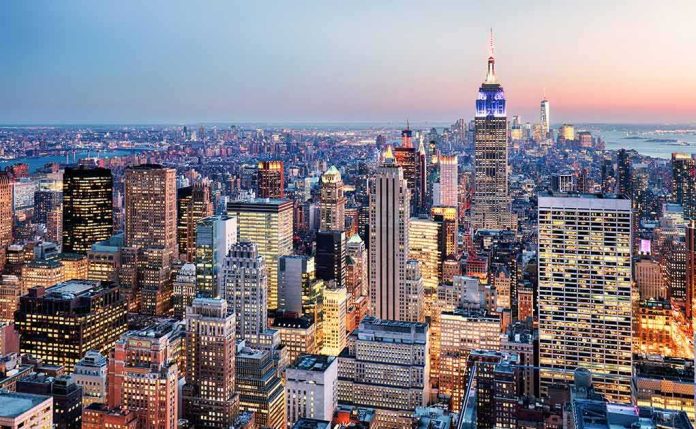
Two masked “love climbers” dangled from the Empire State Building’s needle with a peace banner and a proposal, but what really mattered that day was not romance — it was how close New York came to a security nightmare that nobody wants to talk about.
Story Snapshot
- A Russian daredevil couple free-climbed the Empire State Building spire nearly 1,450 feet above Manhattan
- They flew a “power of love” banner and got engaged before being taken into police custody
- New York City Police Department (NYPD) officers climbed ladders inside the spire to bring them down safely
- The pair now face serious felony charges and hard questions about security and common sense
A romantic stunt on a tower shaped by fear and memory
The Empire State Building is not just a pretty postcard. It is a symbol in a city that has lived through terror attacks, observation deck shootings, and street-level workplace violence near its doors. When two masked climbers crawled onto the needle with no safety gear, they did not step into a movie scene. They stepped into a security environment shaped by real blood and real funerals, where police and building staff have one job: keep thousands of ordinary people safe, every single day.
The couple, widely known online as Russian rooftoppers Angela Nikolau and Ivan, climbed out onto the 200-foot spire above the already tall skyscraper and clung to the structure near the anti-collision beacon almost 1,450 feet over midtown. They unfurled a banner with the slogan “When the power of love beats the love of power the world knows peace” and staged a proposal, kissing and posing for cameras while New Yorkers below watched in shock and confusion. That is not peaceful protest. That is a stunt that forces every pilot, cop, and engineer in the area to wonder if they are looking at a threat.
How police turned a viral stunt into a controlled rescue
While social media celebrated “Netflix daredevils,” NYPD Emergency Service Unit officers had to climb up inside the spire with hard hats and safety gear to guarantee that two strangers did not fall to their deaths in front of half of Manhattan. Bodycam video from the department shows officers slowly ascending ladder after ladder in a cramped, metal tunnel inside the needle, then edging out onto a tiny platform just below the climbers. They talk to the pair calmly, secure them, and guide them back down, turning a reckless stunt into a safe exit instead of a recovery operation.
That climb was not theatrical. It was work. It came after multiple 911 calls and alerts to air traffic controllers from pilots who saw people near an aviation beacon that exists to stop mid-air collisions. Every call like that shifts focus away from real emergencies. Every unnecessary rescue consumes manpower and taxpayer money. Urban climbers might talk about “freedom” and “art,” but they do not carry the burden when something goes wrong. Police and firefighters do.
Felony charges and the line between “art” and crime
Once the couple came down and were walked away in handcuffs, the story did not end with a kiss and a clever caption. NYPD spokespersons and charging documents show the pair facing felony counts of burglary, reckless endangerment, criminal mischief, and criminal trespass. Burglary here does not mean stealing jewelry. It means entering a restricted area with the intent to commit a crime. Reckless endangerment means creating a substantial risk of serious physical injury to others. These are not technicalities. They are the law’s way of saying, “Your thrill does not outweigh everyone else’s right to safety.”
Some reports lean hard into their “Skywalkers: A Love Story” fame and paint this as a poetic act, as if being featured in a documentary or having many followers turns illegal access into performance art. That framing dodges basic fairness. Average New Yorkers do not get to bypass locked hatches in landmark buildings to hang political or romantic banners. They would be arrested, charged, and likely mocked for risking others. Equal treatment under the law means fame should not offer a free pass.
Security questions the building still has not answered
That brings us to the quiet part: how did they get there? Law enforcement sources and early reporting suggest they may have slipped through a maintenance hatch near the top floors of the building, after bypassing a barricade system on an upper observation level. That exact access point remains officially “under investigation,” and the Empire State Building’s public statement focused on one message: the incident was “unauthorized,” it was “resolved,” and there was “no danger” to tenants or visitors. The building offered no clear explanation of the security failure or of any fix put in place.
Empire State Building climbers Ivan Beerkus and Angela Nikolau have been granted supervised release
— Trending Chat (@TrendingChats) July 2, 2026
From a conservative, common-sense view, that silence matters. This landmark draws millions of tourists a year. It operates in a city that knows what it means when bad actors test barriers. When a known pair of rooftoppers reach the top of the spire, hang a banner, and walk away famous, New Yorkers deserve more than “no danger.” They deserve to know what went wrong, how it was patched, and whether this kind of vulnerability exists in other towers across the skyline. Otherwise, we rely on luck and hero cops instead of design and discipline.
Urban climbing, copycats, and the cost of glamorizing risk
This stunt did not appear out of nowhere. For decades, illegal climbs of skyscrapers have mixed politics, ego, and daredevil branding. When the French climber nicknamed “Spiderman” scaled the New York Times building in 2008, a second copycat climber followed hours later, and both faced charges for reckless endangerment and criminal trespass. Media attention was huge. The pattern is clear: dramatic footage spreads fast, and there is always someone watching who wants to top it next time.
Urban climbers and some fans say this is about courage, art, and messages like climate or peace. Yet even editors inside climbing culture have said flatly, “We can’t celebrate it because it is dangerous—and it’s illegal”. That is the sober view this Empire State Building case demands. A banner about love does not reduce the risk of a fall, a loose bolt, or a panicked crowd on the streets below. A romantic proposal does not magically lower the stakes for pilots or police. When we glamorize the stunt and barely mention the crimes, we invite the next pair to push higher and risk more.
Sources:
facebook.com, cnn.com, cbsnews.com, youtube.com, nbcnews.com, usatoday.com, instagram.com