
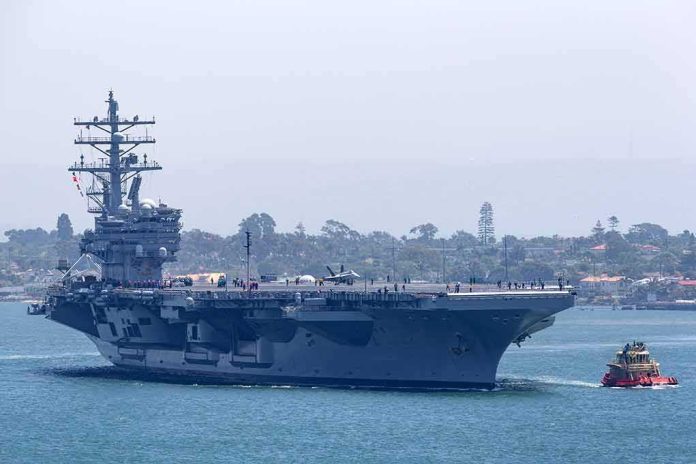
After a grueling stretch of 265 straight days at sea, the USS Abraham Lincoln finally returned to San Diego, ending one of the longest modern carrier deployments linked to the war with Iran.
Story Highlights
- The carrier came home after more than 10 months at sea, with emotional reunions on the pier.
- The crew spent a record 265 consecutive days underway without a port visit, according to multiple outlets.
- Leaders tied the extended mission to operations supporting the war with Iran and regional security.
- Officials acknowledged severe strain during the deployment, including eight suicide attempts in the strike group.
Homecoming After One of the Longest Modern Deployments
Reporters in San Diego documented the USS Abraham Lincoln entering the bay and mooring as families watched and cheered. The Associated Press and National Public Radio described sailors pouring off the ship after more than 10 months away, with parents meeting babies born during the cruise. Several outlets said the total deployment lasted about 321 to 322 days, placing it among the longest since the end of the Cold War. Small differences in the day count appeared across outlets.
Defense leaders marked the return on the pier. Coverage quoted Defense Secretary Pete Hegseth telling the crew he had twice signed orders that extended the deployment, then welcoming them home. Media reports tied the mission to U.S. operations against Iran and to broader security tasks in the Middle East. The Los Angeles Times quoted a senior commander who called the cruise “one of the most operationally intense and consequential of the modern era”.
Record 265 Days Underway Without a Port Call
Multiple newsrooms reported the same striking figure: 265 straight days at sea without a liberty port, described as a modern record for a U.S. carrier. That record refers to continuous days underway, not the overall length. ABC News and regional papers emphasized that the total cruise, at about 321 days, ranked as the second-longest since the Cold War era. The dual framing—record streak at sea, near-record overall—explains why headlines varied but still aligned on the scale of the mission.
The long stretch at sea came with human costs. ABC News and local coverage cited Navy confirmation that there were eight suicide attempts within the Lincoln strike group during the deployment. Separate reports described hardship concerns, including strain on crew and ship systems, though not all details were backed by formal Navy documents in the public record. Those accounts fueled questions about how repeated extensions affect readiness, morale, and families waiting at home.
Why This Matters Beyond One Ship
Analysts say carrier cruises have been getting longer and less predictable since 2023, as crises expanded and the fleet tried to cover more missions. Research from the Royal United Services Institute noted that most recent deployments have exceeded the Navy’s informal seven-month norm, with several running nine months or more. The Lincoln’s experience fits that larger trend, which affects training cycles, maintenance windows, and the lives of the sailors who keep the ships ready.
USS Abraham Lincoln returns to San Diego after 322 days at sea; Pete Hegseth honors crew amid concerns over conditionshttps://t.co/OTvPPenb7T
— Hindustan Times (@htTweets) October 9, 2026
The sight of families holding signs on the pier carried a simple message: people bear the load when policy meets reality. Conservatives see proof that extended wars and global tasks stretch the force thin. Liberals see stress on service members and families who lack a say in extension orders. Many across the spectrum share a core view: leaders should plan missions and resources so Americans in uniform are not asked to carry preventable burdens for months on end.
Sources:
zerohedge.com, apnews.com, ocregister.com, fox35orlando.com, irishnews.com, nbcconnecticut.com, crow.house.gov