
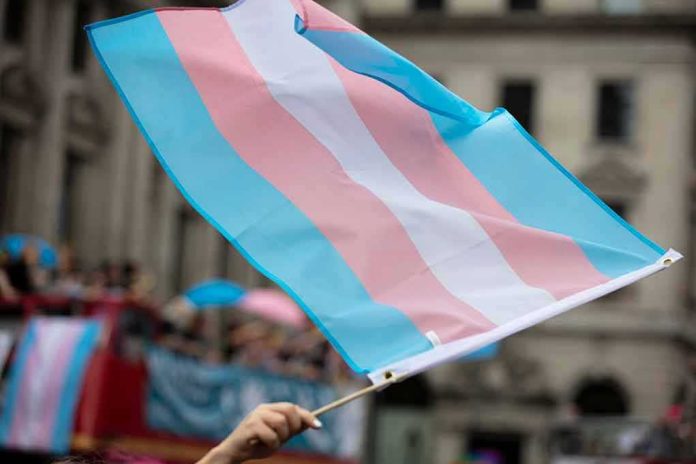
The nation’s most prominent gay Republican organization just told transgender Americans they are no longer part of the club.
Quick Take
- Log Cabin Republicans’ board voted to drop transgender advocacy and rebrand itself as an “LGB advocacy organization.”
- President Ross Hemminger says the change followed “significant discussion” with members and reflects a focus on “sexual orientation and conservative values.”
- The shift comes as Gallup polling shows Republican support for same-sex marriage sliding from 55% in 2022 to just 37% today.
- Critics call the move an abandonment of trans allies; the group insists it is not “anti-trans” but a “win for children and common-sense.”
A 50-Year-Old Group Rewrites Its Mission Statement
Log Cabin Republicans announced Thursday, August 21, that its board of directors voted to strip transgender issues from its platform. The group, which has spent decades representing gay conservatives inside the Republican Party, now describes itself simply as an “LGB advocacy organization”. The timing lands just ahead of the group’s 50th anniversary, a milestone that makes the reversal even more striking.
Hemminger explained the board acted “after significant discussion with our membership” to “refine Log Cabin Republicans’ national advocacy focus to concentrate specifically on issues of sexual orientation and conservative values”. He and the group’s own website material describe the decision as neither hostile nor reactionary, but the group’s transgender archive page still felt the need to state plainly, “This decision is not ‘anti-trans.’ It is a historic and critical win for children and common-sense”.
Why Now? The Numbers Tell Part of the Story
The reversal did not happen in a vacuum. Gallup polling shows Republican support for legal same-sex marriage cratering from 55% in 2022 to 37% this year, a level not seen in over a decade. Support for the broader idea that gay and lesbian relations are “morally acceptable” among Republicans has also dropped, with Gallup pegging it at just 35% in its most recent survey. Only 5% of Republicans now say changing one’s gender is morally acceptable.
Those numbers explain a lot about why an organization built to sell gay conservatism to a skeptical party might choose to narrow its focus rather than fight uphill on two fronts at once. Defending same-sex marriage inside a party that has cooled on it is hard enough. Defending medical transition for minors, women’s sports policy, and school curriculum fights on top of that is a much steeper climb, and Log Cabin’s leadership appears to have decided it isn’t one worth taking anymore.
Not Everyone Inside the Movement Agrees
The backlash was immediate and personal. Commentary from LGBTQ outlets accused the group of “pulling the ladder of progress and support” up behind itself after benefiting from decades of coalition-building with trans advocates. Wikipedia’s summary of the organization notes that LCR previously argued transgender people, alongside gay, lesbian, and bisexual people, deserved protection from workplace and housing discrimination and the right to adopt.
That history matters because it shows this wasn’t always the group’s position. A 2024 interview with Log Cabin Republicans members at a Pridefest event captured a very different tone, with one member saying plainly, “we’re not against the trans community,” and noting, “many of us have trans members within the Log Cabin Republicans.” That same interview described the group’s mission as fighting “for your rights within the Republican Party,” not for a narrower slice of it.
A Familiar Pattern in Movement Politics
This isn’t the first time a rights movement has split over who gets included when the political winds shift. Coalition-building between gay, lesbian, and transgender advocates has produced friction going back to the 1970s, especially when one faction judges another’s cause too politically costly to defend. Log Cabin’s move fits that pattern: an advocacy group under pressure narrows its mission to whatever issue set is likeliest to preserve its access, its donors, and its credibility with a party base that has grown far less sympathetic than it was even four years ago.
Whether that bet pays off is an open question. Overall American support for same-sex marriage has also slipped from a 2022 peak of 71% down to 65%, even as Democrats and independents hold steady. If the broader cultural mood keeps cooling, Log Cabin may find that trimming its platform buys only temporary shelter inside a party still working out how far its tolerance extends.
Log Cabin Republicans, a leading group for gay conservatives, abandons transgender advocacyhttps://t.co/NSxRryjg0W
— HomoGenius 🏳️🌈🏳️🌈🏳️🌈 (@HomoGenius3) August 23, 2026
What’s clear is that a group founded to prove gay conservatism and Republican loyalty could coexist has now drawn a harder line than it ever has before, betting its future on a smaller, more defensible piece of the coalition it once claimed to represent in full.
Sources:
cnn.com, yahoo.com, nytimes.com, news.gallup.com, logcabin.org, nbcnews.com