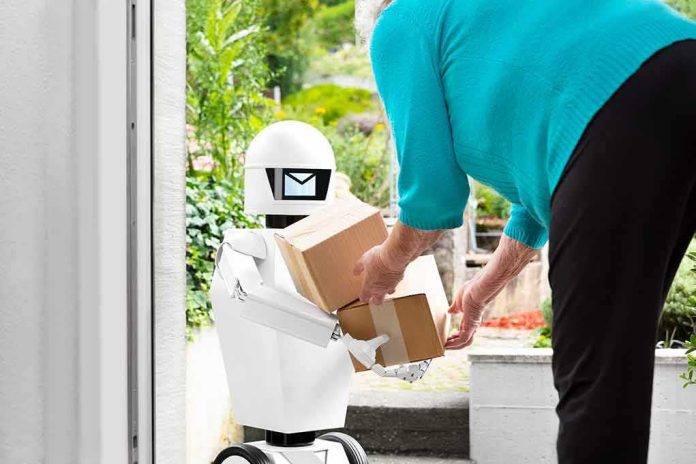
Bill Gates wants companies to pay the same payroll tax when a robot does a worker’s job, and that simple line could redraw the map for jobs, budgets, and business strategy overnight.
Story Snapshot
- Gates calls for payroll tax parity: human or robot, same rate.
- He argues the tax would fund retraining and safety nets.
- Media confirm he renewed the push in late 2026.
- Industry and economists warn the idea could hurt growth.
Gates’s core move: level payroll taxes between people and machines
Bill Gates told The New York Times that firms should pay the same Federal Insurance Contributions Act (FICA) payroll tax whether a task is done by a person or a robot. He framed the unit as “a unit of labor,” not a body with arms, to avoid word games. If a warehouse swaps ten pickers for automated systems, the firm still owes the payroll tax that would have been paid on that labor’s output. He argues this keeps the tax base stable and slows panic firing.
Business Insider reported his aim as simple: stop the tax code from nudging bosses to replace workers and keep money flowing to benefits and retraining. Gates links the idea to a clear imbalance. Wages face payroll taxes every payday. New machines can be expensed or depreciated and can lower the tax bill. That gap makes automation cheaper than it looks and humans more costly than they are. Gate’s fix is parity at the point of work performed.
What would the money do: bridge time, not freeze progress
Gates does not pitch a freeze on technology. He pitches time and tools. He says a modest tax on automated labor would raise funds to retrain workers, strengthen the safety net, and cushion local shocks. He also pairs the tax with a suite of rules like “human-reserved” jobs in areas where dignity, judgment, or safety demand a person in the loop. Multiple outlets reported this package as part of his 2026 push, not a throwaway sound bite.
Fortune captured the intended effect: slow a rush away from people, fund the transition, and remove a bias in the current code that rewards capital over payroll. That can matter most in sectors with thin margins, where a small tax tilt decides whether a manager keeps a crew or buys software that slices headcount. Gates is not asking robots to file a W-2. He is asking firms to pay the same levy on the work output either way.
Why critics bristle: growth, definitions, and flight risks
Economists and industry groups warn that a robot tax could backfire. The Information Technology and Innovation Foundation argues it would slow productivity, wages, and gross domestic product. Their case says past waves of automation expanded output and did not reduce total jobs in the long run. They see a “robot tax” as a panic button that blocks gains and punishes investment. That is a serious claim that many business owners will find persuasive when margins are tight.
Bill Gates says if a company fires a worker and puts a robot in that job, the robot should pay the same FICA tax the human paid.
Active workers fund retirees, and replacing the worker should not be a way to skip the pension bill.
"Society gets to decide. Just because the… pic.twitter.com/oPri9GrZW6
— Rohan Paul (@rohanpaul_ai) October 1, 2026
Manufacturing media say firms already oppose the idea because it could chill factory upgrades and squeeze competitiveness in global markets. A law review adds a thorny point: there is no agreed definition of a robot. Is a spreadsheet macro a robot? What about a forklift with sensors? Without crisp lines, a new tax becomes a compliance fight, not a policy win. These objections land hard with conservative readers who value clear rules, growth, and staying power in the world market.
What the facts support today: a principle, not a bill
Coverage from major outlets confirms that Gates renewed this idea in late summer and fall of 2026, tying it to payroll parity and worker support. The record does not show a draft bill, rate schedule, or a fine-grained enforcement plan. That is a gap. It is also normal at this stage. Big tax changes often begin as a clean principle that committees and Treasury later turn into definitions and thresholds. The prudence test is whether the final design is simple, neutral, and hard to game.
Common-sense guardrails can make or break this. One path is to target the employer, not the machine, using payroll-equivalent assessments tied to documented headcount cuts from specific automation deployments. That would align with Gates’s “unit of labor” framing while avoiding a dictionary fight over “robot.” Another is a sunset clause and public reporting, so voters see if the levy raised revenue, slowed layoffs, and funded real training—not bureaucracy. Conservative instincts around accountability and clarity fit well here.
The bottom line for workers, owners, and taxpayers
Gates points at a tax gap that every payroll manager knows: people trigger payroll taxes, machines do not. If leaders ignore that, the base that funds Social Security and Medicare keeps shrinking as software grows. If leaders overreact, they strangle the very productivity that pays for those programs. The wise course splits the difference. Keep innovation, close loopholes that bias against work, and require proof that any new levy helps people move to better jobs, not just tread water.
Sources:
insiderpaper.com, finance.yahoo.com, abcnews.com, tradersunion.com, ground.news, fortune.com