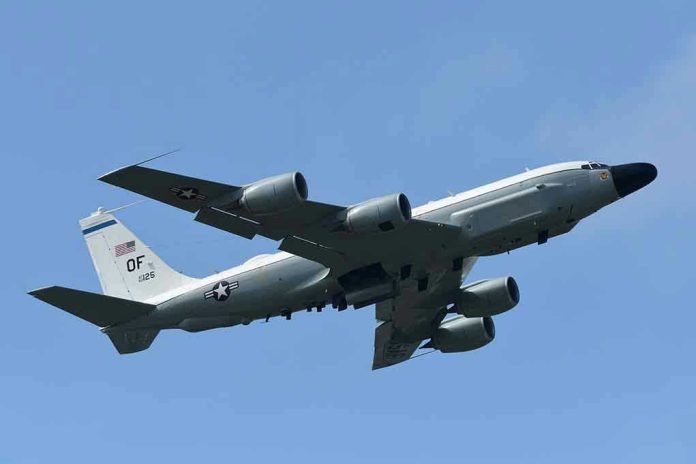
The United States just committed $2 billion to breathe new life into two of the most iconic warbirds in military history, but the real story isn’t about nostalgia—it’s about America preparing for threats that could stretch decades into the future.
Story Highlights
- Air Force awards Boeing $2.04 billion to re-engine and test two B-52H bombers with modern Rolls-Royce F130 engines
- Current TF33 engines from the 1960s face obsolescence crisis, becoming unsustainable by 2030
- Testing phase runs through 2033, paving way for full fleet upgrade of 76 aircraft extending service to 2050s
- Integration with new radar systems creates B-52J variant with enhanced nuclear and conventional capabilities
When Old Engines Threaten National Security
The B-52H Stratofortress faces a critical vulnerability that has nothing to do with enemy missiles. Eight Pratt & Whitney TF33 engines, designed in the 1960s, power each bomber. These workhorses suffer from a fatal flaw in modern warfare: their manufacturing base has largely disappeared. Parts become scarcer each year, maintenance grows exponentially more expensive, and by 2030, keeping them airworthy becomes practically impossible.
The December 23, 2025 contract award to Boeing Defense Systems represents more than routine maintenance. This $2.04 billion investment tackles the post-Critical Design Review development phase, focusing on two test aircraft that will validate whether America’s strategic bomber fleet can survive another three decades of service. The work spans four locations: Oklahoma City, San Antonio, Seattle, and Indianapolis.
Commercial Technology Meets Strategic Warfare
Rolls-Royce F130 engines bring commercial aviation reliability to military operations. These engines match the size, weight, and thrust characteristics of their predecessors while delivering superior fuel efficiency and electrical power generation. The enhanced electrical capacity proves crucial for powering advanced radar systems and future weapons platforms that current B-52s cannot support.
The engine replacement program builds upon Rolls-Royce’s September 2022 contract worth $2.6 billion for the F130 powerplants themselves. Boeing’s role involves integrating these engines with new struts, nacelles, electrical systems, and cockpit displays. The combination creates the B-52J variant, representing the most significant upgrade in the bomber’s six-decade history.
Testing Phase Sets Stage for Fleet Transformation
Two B-52H aircraft will undergo complete transformation by May 31, 2033. These test platforms validate not only engine performance but integration with Advanced Electronically Scanned Array radar systems currently undergoing flight testing. The radar component reaches production by early 2027, with initial operational capability planned for twelve aircraft before decade’s end.
Success in this testing phase unlocks re-engining for the remaining 74 bombers in Air Force Global Strike Command’s inventory. Each upgraded aircraft gains extended range, longer loiter times, and enhanced reliability for both nuclear deterrence and conventional strike missions. The improvements position the B-52 fleet for operations through the 2050s, making these bombers potentially century-old platforms still defending American interests.
Strategic Investment in Deterrence Capability
This modernization effort reflects sound conservative principles: maximizing return on existing investments rather than pursuing costly new platforms. The B-52’s airframe design remains fundamentally sound, requiring only propulsion and electronics upgrades to maintain relevance against emerging threats. Replacing the entire fleet would cost hundreds of billions and take decades.
Boeing’s workforce across multiple states benefits from this sustained investment in American defense manufacturing. Port San Antonio in Texas serves as a key modification site, supporting local employment while strengthening the defense industrial base. The program demonstrates how military spending can simultaneously enhance national security and provide economic benefits to American communities.
Sources:
USAF Awards Boeing $2B Contract for B-52 Re-Engining Program
Boeing Awarded $2 Billion Contract for B-52 Engine Replacement
Boeing B-52 Bomber Modernization US Air Force
Boeing B-52 Port San Antonio Pentagon Contract
Boeing to Re-Engine B-52 Fleet to Extend Service Life
The Legendary B-52 Gets a New Lease on Life