A “small, red, shiny” object at 3,000 feet is the kind of mystery that turns a routine airline landing into a national argument about who really controls the skies.
Story Snapshot
- United Airlines Flight 1980, a Boeing 737 inbound to San Diego, reportedly struck an object around 3,000 feet during approach.
- Air traffic control audio circulating online captures a pilot report after landing, but the pilot also signaled uncertainty about what the object actually was.
- No public, definitive confirmation in the available reporting ties the event to an identified drone operator, a specific device, or verified damage.
- The case spotlights a basic security problem: controlled airspace is only as safe as the enforcement that backs it up.
What the crew reportedly experienced on approach into San Diego
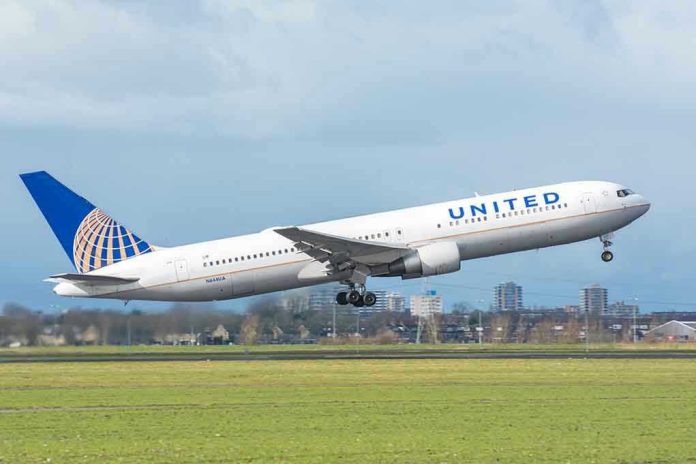
United Airlines Flight 1980 reportedly descended toward San Diego International Airport on a Wednesday afternoon when something struck the aircraft at roughly 3,000 feet. The account gained traction because air traffic control audio spread online, with the pilot later describing the object as small, red, and shiny. That description matters: it suggests a visual impression rather than a positive identification, and it frames the event as a near-real-time safety report, not a finished investigation.
The story’s most consequential detail is also its most frustrating one: public information, as summarized in the reporting, left the event unconfirmed by aviation authorities at the time. That gap creates a vacuum social media loves to fill. A confirmed drone strike would point toward reckless or criminal behavior near an airport. An unconfirmed “unknown object” could be anything from debris to a balloon to a drone. Precision matters because policy follows headlines, not footnotes.
Unconfirmed does not mean unimportant, but it does change the conclusions
Air safety runs on disciplined language. Pilots report what they saw, what they felt, and what instruments show; investigators later decide what happened. The circulating audio reportedly captures a pilot doing the first part—flagging an impact and offering a description—while also admitting uncertainty about identification. That’s not a weakness; it’s professionalism. The problem for the public is that a viral clip can sound like a verdict even when it is only the opening statement.
San Diego’s airspace environment makes the altitude detail especially nerve-wracking. An aircraft at 3,000 feet on approach sits in a high-workload phase: configuration changes, checklist flow, speed control, and constant spacing with other traffic. Small objects look smaller at closing speeds, and impact happens faster than interpretation. Even when nothing catastrophic follows, a strike report triggers inspections, documentation, and follow-up—real costs paid by airlines and passengers, and real risk borne by the crew.
Why drones near airports remain a conservative “order and consequences” issue
Americans like freedom, but aviation is one arena where freedom requires hard boundaries. Controlled airspace exists because the consequences of chaos fall on innocent people: families on a flight, neighborhoods under a glide path, and first responders who would deal with the aftermath. When someone flies an unmanned aircraft near a commercial approach corridor, it’s not “innovation”; it’s gambling with other people’s lives. Common sense says enforcement should target the behavior, not punish compliant hobbyists.
Confirmed collisions between commercial airliners and drones remain relatively rare compared with the volume of reported sightings, but rarity isn’t comfort. One preventable incident is enough to justify focused deterrence, especially near airports. The tougher question is capability: detection, attribution, and response. A rule that can’t be enforced is just a suggestion. If the public sees a pattern of “reported” drone encounters without operator identification, trust erodes, and demands grow for heavy-handed restrictions that could miss the real culprits.
The real vulnerability: attribution in a sky full of cheap hardware
Modern drones can be purchased quickly, flown briefly, and discarded. That reality collides with an accountability system designed for tail numbers, flight plans, and licensed operators. If the object in this case was a drone, the most important unanswered question becomes: who flew it, and how would authorities prove it? Tracking and identification tools exist, but coverage and adoption vary. Without reliable attribution, consequences fall unevenly, and responsible operators get lumped in with people who treat runways like playgrounds.
Practical solutions do not require reinventing aviation. Airports need layered detection, clear protocols with local law enforcement, and fast pathways to preserve evidence when a report comes in. Regulators need rules that are simple enough for ordinary people to follow and strict enough to punish the small number who won’t. Families don’t care whether a strike was caused by a drone, a balloon, or debris; they care that professionals can identify it quickly and stop the next one.
United Airlines flight reportedly hits drone at 3,000 feet over San Diegohttps://t.co/6UHJ8JSaU3
— Bodoxstocks (@bodoxstocks) April 29, 2026
The San Diego report should be read as a warning label, not a finished narrative. A pilot report and a viral clip can spotlight risk, but they can’t substitute for confirmed findings from the FAA or the airline. Until authorities verify what struck the aircraft, the responsible stance is skepticism paired with urgency: demand better enforcement and better attribution, and resist the lazy temptation to treat every “reported drone strike” as proven fact. Airspace safety deserves both seriousness and accuracy.
Sources:
United Airlines Flight 1980 reportedly hit by drone above San Diego; scary ATC audio surfaces
Unmanned Aircraft Systems (Drones)