
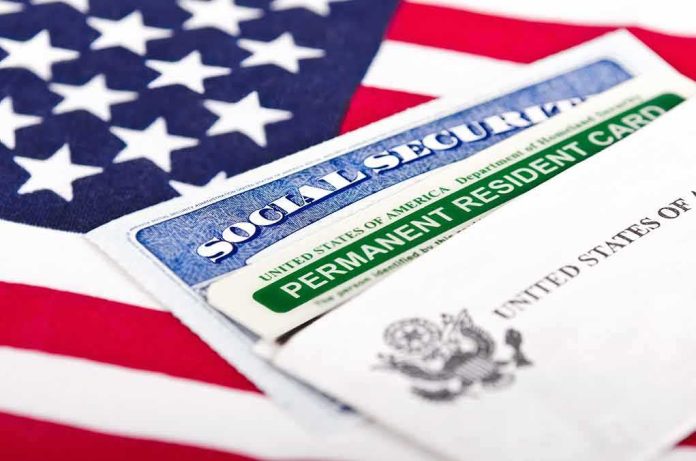
Vice President JD Vance triggered a sweeping freeze on green-card sponsorships for major tech firms after federal investigators alleged abuse of work visa programs tied to recent layoffs.
Story Snapshot
- The Labor Department halted PERM processing for Microsoft, Adobe, and six large IT services firms.
- Vance said Microsoft cut thousands of U.S. jobs while seeking visas and green cards for foreign workers.
- Nine elite universities face probes over alleged misuse of exchange-visitor visas.
- The move fits years of warnings that H-1B and PERM are vulnerable to fraud and wage harm.
Administration Orders PERM Freeze for Named Companies
The Department of Labor stopped accepting or processing permanent labor certification applications, known as PERM, from Microsoft, Adobe, Cognizant, Infosys, Tata, Wipro, HCL, and Capgemini. Labor Secretary Keith Sonderling said the agency would not take new or pending PERM cases for these firms while investigations proceed. The suspension blocks a key step in employment-based green cards and signals a broad crackdown on suspected manipulation of hiring rules that are meant to protect U.S. workers.
Vice President JD Vance said an anti-fraud effort found patterns linking layoffs to visa use. Vance singled out Microsoft, alleging the company dismissed roughly 6,000 American employees while continuing to receive H-1B approvals and file PERM cases, which he framed as undercutting domestic wages and jobs. The administration described the action as targeting abuses that let firms source cheaper labor abroad while reducing opportunities for qualified U.S. applicants seeking similar roles.
Universities Face Scrutiny Over Exchange-Visitor Visas
The administration also opened investigations into nine universities over alleged misuse of exchange-visitor visas to cut labor costs. Institutions named by officials include Harvard, Yale, Stanford, Brown, the University of Pittsburgh, the University of California, Davis, the California Institute of Technology, Arizona State University, and the Massachusetts Institute of Technology. Officials said the probes aim to determine whether programs meant for cultural and educational exchange were used to fill jobs below market wages.
These university probes expand the focus beyond tech outsourcing and into higher education’s role in labor pipelines. The administration’s message links both sectors to a shared concern: programs built to add talent may be used to skirt fair hiring rules. Federal officials said the investigations will assess compliance and, if needed, lead to further enforcement steps designed to restore a level field for U.S. workers and lawful participants.
Why This Crackdown Matters Across Political Lines
Government auditors and immigration agencies have warned for years that H-1B and PERM can be misused. A Department of Labor inspector general report called the programs highly susceptible to fraud, and a United States Citizenship and Immigration Services fraud review found a significant rate of violations in H-1B petitions. The administration’s action follows that record and asserts that stronger policing is needed to stop wage undercutting and paper-only recruitment that disadvantages U.S. applicants.
The Trump administration has suspended Microsoft, Adobe and six major IT firms from the U.S. Department of Labor’s Permanent Labor Certification (PERM) program, temporarily blocking the companies from having new or pending PERM applications processed. The move was announced… pic.twitter.com/7XxboZS5iz
— Plugtvkenya (@Plugtv_kenya) October 8, 2026
Supporters see this as a needed correction to protect American jobs and restore faith that the rules mean something. Critics of past practice on both left and right have argued that elites in government and industry shaped the system to favor big employers, consultants, and middlemen. The new suspensions and probes tell workers one clear thing: Washington is finally testing whether powerful institutions followed the law, and if not, consequences will follow.
What Changes for Workers, Firms, and Students Now
For the named companies, PERM cases will not move forward during the suspension, delaying green-card timelines for affected employees and constraining staffing plans. For U.S. workers, the administration says tighter enforcement should open more fair-shot hiring and reduce pressure on wages. For universities, the inquiries bring new compliance risks around exchange-visitor programs and could force rewrites of training and hiring practices tied to research and campus jobs.
Officials framed the moves as part of a broader campaign to align visa use with the law’s original purpose: to add needed skills without displacing Americans. The White House said past loopholes, lax screening, and aggressive tactics by some employers and intermediaries distorted the labor market. By freezing suspect PERM pipelines and probing campus programs, the administration aims to reset norms so that talent programs serve the country’s interests, not just those of the well-connected.
Sources:
twitchy.com, news18.com, cnn.com, lawcommentary.com, local12.com, bhaskarenglish.in, foxbusiness.com, newindianexpress.com, i-9intelligence.com, spectrumlocalnews.com