When five people die at a house of worship while officials insist “the system worked,” it raises the same haunting question from left and right: if this is success, what does failure look like?
Story Snapshot
- Two heavily armed teenagers killed three men at San Diego’s largest mosque before dying of apparent self-inflicted gunshot wounds.[1][2]
- Police are treating the massacre as a possible hate crime, citing the Islamic Center location and early anti-Islam writings reports.[1][4]
- Officials praised a slain security guard as a hero whose actions likely saved children and worshippers.[2]
- The case spotlights familiar frustrations: warnings missed, motives politicized, and communities doubting whether government really protects them.
What Officials Say Happened At The Islamic Center
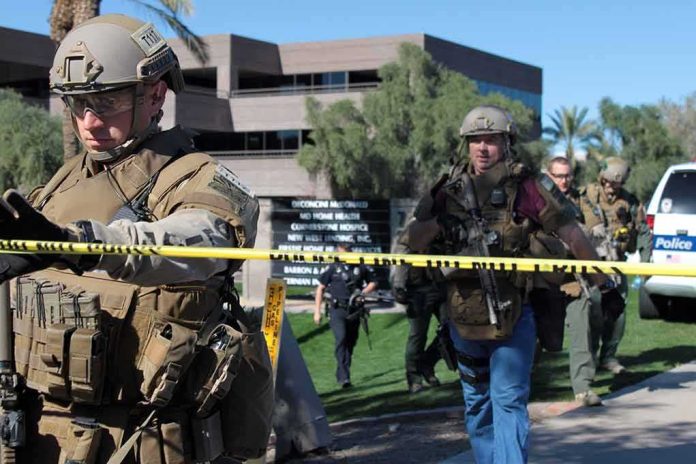
San Diego police say that late Monday morning, dispatchers received 911 calls reporting an active shooter at the Islamic Center of San Diego, the county’s largest mosque complex.[1] Officers arrived within roughly four minutes and immediately found three adult men shot dead outside the building.[1][3] Authorities say two teenage suspects, ages seventeen and eighteen, then fled in a vehicle, fired more rounds nearby, and were later discovered dead in a car from apparent self-inflicted gunshot wounds.[1][2][3]
Officials have identified the dead as three adult male victims and the two teen attackers, for a total of five fatalities.[1][3] One victim was a security guard employed by the mosque, who police say confronted the attackers and likely prevented additional bloodshed.[2] Officers and tactical teams swept the mosque and its adjacent Islamic school, evacuating children and staff and declaring that there was no ongoing threat once the suspects were located and confirmed dead.[1][3]
Early Hate Crime Framing And What Investigators Actually Know
San Diego Police Chief Scott Wahl told reporters that “because of the Islamic Center location, we are considering this a hate crime until it’s not,” framing the attack from the outset as potentially motivated by anti-Muslim bias.[1][4] Federal Bureau of Investigation (FBI) officials joined the case and described the work as an ongoing, multi-agency investigation into motive, planning, and possible accomplices.[4] Authorities emphasized that their hate crime language remains provisional until they complete a detailed review of evidence and communications.[1][4]
Reporters and law enforcement sources have pointed to writings left behind by the teens, with national coverage saying investigators found anti-Islamic materials in their vehicle.[2] Officials have not yet publicly released those documents or a full history of the suspects, and they continue to stress that motive has not been definitively established.[1][4] That blend of early labeling and withheld detail fuels the familiar cycle where many citizens either accept the first official narrative or suspect they are not getting the whole truth.
Warnings, Response Time, And The Sense Government Keeps Missing Red Flags
Police say that hours before the shooting, a mother called to report that her teenage son was a runaway and possibly suicidal, and that he might have access to a firearm.[2][4] That call, now linked to one of the suspects, has already become a flashpoint in public debate about whether overworked officers and fragmented mental health systems can act meaningfully on such warnings.[2][4] Authorities have not detailed what follow-up occurred between that call and the late-morning attack.
Officials understandably highlight what went right: swift arrival, coordinated response, and an evacuation that kept children from being harmed.[1][3] Yet families watching another school-adjacent shooting unfold see a pattern where the system looks reactive, not preventive. They hear after-action praise for “quick response” more often than candid explanations of why deeply troubled, armed teenagers repeatedly reach the point of mass violence despite prior warning signs and years of political promises.
Heroism, Grief, And Growing Distrust Across The Political Spectrum
San Diego leaders and faith representatives have praised the slain security guard, saying his confrontation with the attackers was “heroic” and likely saved lives by slowing the assault and buying time for police.[2] The imam of the Islamic Center has condemned what he described as “unprecedented” levels of hate and intolerance directed at Muslims and other minorities, arguing that this climate makes houses of worship feel like targets. Local and state officials have issued statements of outrage and solidarity with the Muslim community.[3]
San Diego Mayor Todd Gloria just got confronted to his face after the Islamic Center shooting, and the anger in that moment said everything.A protester went off, blaming Gloria’s leadership directly and demanding to know why Muslim residents kept warning city officials while… pic.twitter.com/qI6gWGVVw3
— ⁿᵉʷˢ Barron Trump 🇺🇸 (@BarronTNews_) May 19, 2026
For many Americans, those statements now sound painfully familiar: promises that “hate has no home here,” vows to support victims, and then a return to business as usual once the cameras leave. Conservatives see another failure of basic security and crime prevention; liberals see another community of color exposed to rising hate and easy access to guns. Both sides notice that government institutions were warned, reacted late, and then quickly shifted to carefully lawyered talking points about hate crime statutes and jurisdiction while ordinary people bury their dead.
Why This Case Feeds Broader Fears About Direction Of The Country
This San Diego attack lands in an America already polarized and weary of institutional spin. Each high-profile shooting at a church, synagogue, mosque, school, or shopping center is followed by investigations that take months, while elected officials recycle the same rhetoric about “unacceptable” violence.[1] Citizens who still believe in the country’s founding promise of equal protection under the law watch elite security details and fortified government buildings while everyday congregations hire underpaid guards who die trying to hold the line.
The still-unsettled question of motive here matters not only for legal charges, but for whether people trust that authorities will tell the full story even if it reflects badly on policy, policing, or political narratives.[1][4] When officials classify a case as a potential hate crime “until it is not,” yet leave key evidence sealed and systemic failures unaddressed, they deepen the sense that the system protects itself first. For a growing share of Americans on both left and right, that is the deeper wound underneath the headlines from San Diego.
Sources:
[1] Web – San Diego shooting: 5 dead in mosque attack; anti-Islam … – LA Times
[2] Web – Suspects killed in Islamic Center of San Diego shooting | KTVU FOX 2
[3] Web – Mayor Bass Releases Statement on Deadly Attack at Islamic Center …
[4] YouTube – Mayor, Imam speak at press conference with Police, FBI