A guillotine sat in the back of a pickup truck just steps from the U.S. Capitol, and police say it was fully real.
Story Snapshot
- Capitol Police found a guillotine in a pickup truck illegally parked near the Capitol on August 25, 2026.
- The driver, 35-year-old Philan-Tam-Duy Le of Julian, California, was arrested for carrying a dangerous weapon.
- An affidavit says Le told officers the device was “the real deal.”
- Le pleaded not guilty in court the next day, and investigators still don’t know why he drove it to Washington.
Truck Spotted Near the Capitol Complex
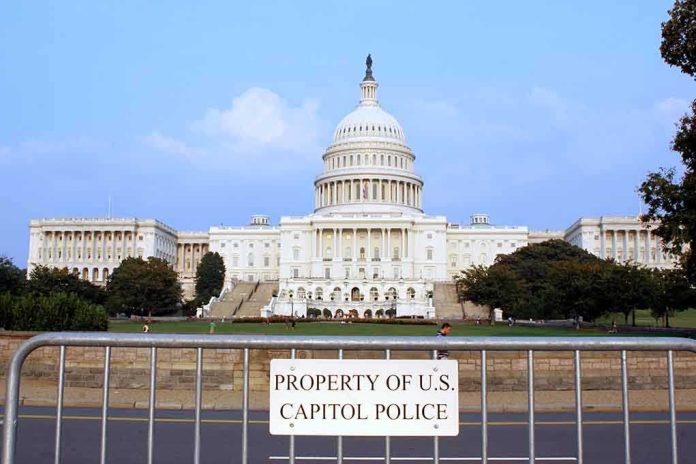
United States Capitol Police say officers noticed the pickup truck around 3:00 p.m. on Tuesday, August 25. It was illegally parked on the 100 block of East Capitol Street, close to both the Capitol and the Supreme Court. Officers looked in the truck bed and saw a full-size guillotine. Police seized the device and arrested the driver on the spot for carrying a dangerous weapon.
Police identified the driver as Philan-Tam-Duy Le, 35, of Julian, California, a small town in San Diego County. News outlets, including CNN and The Washington Post, confirmed the same name and hometown. Photos released by police showed the guillotine clearly sitting in the open truck bed, in plain view of anyone walking by on the busy Capitol-area street.
Suspect Told Police the Blade Was Real
Court paperwork gives a glimpse into what happened during the arrest. According to The Hill, an affidavit filed in D.C. Superior Court says officers asked Le if the guillotine actually worked. He answered, “Yeah, it’s the real deal man.” That quote is now part of the official case record, though the full affidavit and case number have not been made public.
Police have not released a forensic report confirming exactly how the blade was built or whether it could be used to hurt someone. What is documented is the arrest itself, the charge, and Le’s own words describing the device as functional. No engineering inspection or chain-of-custody paperwork appears in the public record so far.
Charge and Court Appearance
Capitol Police charged Le with one count of carrying a dangerous weapon. CNN, Fox News, and several other outlets reported the same charge. Le appeared in court the day after his arrest, on Wednesday, and pleaded not guilty, according to online court records reviewed by CNN. The case is now moving through the D.C. court system, though further hearing dates have not been widely reported.
Investigators Still Searching for a Motive
Reporters from multiple outlets, including the Los Angeles Times and Police1, say investigators have not determined why Le drove a guillotine across the country and parked it near Congress. Family members told local San Diego news that Le may have intended some kind of protest, but no formal statement from him or his lawyer has confirmed that explanation. The motive remains an open question in the investigation.
Police arrest a California man after finding a guillotine near the US Capitol https://t.co/C4n6iDEK3n
— SheepDog Society LLC (@SDSLLC_USA) August 26, 2026
The scene understandably drew heavy attention given its location. A guillotine parked between the Capitol and the Supreme Court is the kind of image that grabs headlines fast, and it did, with coverage from CNN, Fox News, The Washington Post, and The Telegraph all within a day. That kind of coverage can make the visual shock of the object overshadow the narrower legal question at the center of the case: whether one man broke a specific weapons law.
Why Security Near the Capitol Stays on Edge
Law enforcement agencies near Congress have long treated unusual objects with caution, and the legal definition of a “dangerous weapon” can be broad. Courts have found that even objects not normally considered weapons can qualify if they create fear of danger. That legal standard, combined with the Capitol’s history as a target for threats, means police often act quickly on anything unfamiliar, symbolic, or unexplained parked near the building.
For now, the facts on record are straightforward. Police found a guillotine, arrested the driver, and he is fighting the charge in court. Whether the device was meant as protest art, a political statement, or something else entirely is a question the legal process, not the initial police report, will eventually have to answer.
Sources:
facebook.com, latimes.com, 6abc.com, uscp.gov