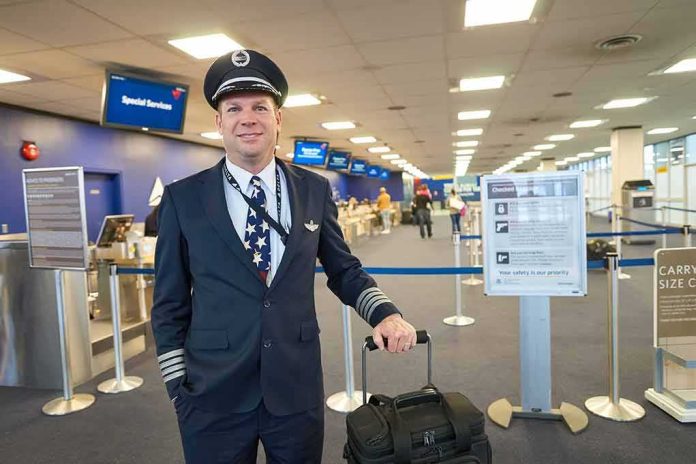
A commercial airline pilot allegedly flew hundreds of passengers while high on hard drugs, then landed with a suitcase packed with more than 70,000 ecstasy pills.
Story Snapshot
- Indonesian officers say a Malaysia Airlines pilot arrived in Jakarta with over 26 kilograms of ecstasy and meth in his luggage.
- Officials report his urine test was positive for methamphetamine, cocaine, and ecstasy after he flew a passenger flight.
- Authorities say the pilot admitted he was paid to act as a drug courier and had smuggled drugs on earlier trips.
- The case highlights deep worries about safety, corruption, and trust in global aviation and border controls.
Pilot Arrested After Landing With Suitcase Full of Drugs
Indonesian customs officers at Jakarta’s Soekarno-Hatta International Airport say they spotted a suspicious suitcase during X-ray screening in the international arrivals area. The bag was later picked up by a 39-year-old Malaysian man identified only by the initials MS, who officials say had just flown in as a Malaysia Airlines pilot on flight MH727 from Kuala Lumpur. Officers took him and the suitcase to an inspection room, where they say they found 14 packages loaded with ecstasy tablets and a separate methamphetamine package.
Police and customs officials told reporters the haul contained more than 70,000 ecstasy pills, weighing about 26 kilograms, plus methamphetamine. Photos and video from the press event show rows of plastic-wrapped bricks laid out on tables, which officers say came from the pilot’s suitcase. At a joint news conference, Indonesia’s director of narcotics crimes said the pilot was named a suspect, arrested, and detained while narcotics investigators took over the case. Officials warned that such a large shipment points to an organized trafficking network, not a one-off mistake.
Alleged Drug Use While Flying and Claims of a Smuggling Network
Indonesian customs and police officials say a urine test on the pilot came back positive for methamphetamine, cocaine, and ecstasy. One customs officer told reporters this meant that “at the time of the flight, he was under the influence,” raising chilling questions about passenger safety on that trip. Authorities further told media that during questioning the pilot admitted he was promised about 50,000 Malaysian ringgit, roughly 11,000 to 12,000 US dollars, to carry the suitcase to Jakarta for someone else.
Indonesian narcotics officials also say the pilot told them this was not his first time moving drugs. According to their account, he claimed to have previously delivered methamphetamine to Sabah in Malaysia and later transported about seven kilograms of methamphetamine to Jakarta. Officials described him as a “courier” working for a larger syndicate, though they did not publicly name any higher-ups. For now, the public record is based on statements from customs and police; full court documents and independent forensic reports have not yet been released, so many details still rest on official briefings.
Airline Response, Death Penalty Risk, and Bigger Questions About Trust
Malaysia Airlines has said it will cooperate fully with Indonesian investigators and that it takes the allegations seriously. The company has held back from detailed public comment while the case is still under investigation, but this incident clearly shakes trust in airline screening and internal controls. Many travelers already worry that big institutions—whether airlines, regulators, or governments—protect their own first and the public second. A pilot allegedly flying while high on hard drugs only feeds that fear.
Malaysia Airlines 737 pilot arrested at Jakarta ’s international airport for smuggling more than 26 kilograms (57 pounds) of ecstasy and a package of methamphetamine in his luggage.
The case was uncovered late Tuesday when customs officers inspecting baggage at the international… pic.twitter.com/UVSoBCcZA4
— Breaking Aviation News & Videos (@aviationbrk) July 31, 2026
Indonesia has some of the toughest drug laws in the world, and officials say the pilot could face the death penalty if convicted of trafficking this quantity of illegal narcotics. That prospect will likely stir debate across Southeast Asia and beyond. On one side, many people see harsh punishment as the only way to push back against powerful drug syndicates that profit while ordinary families pay the price. On the other, some worry that such cases show how systems focus on dramatic busts, not the deeper corruption that lets this kind of operation reach the cockpit of a commercial jet.
Deep-State Fears and Global Systems That Feel Rigged
This case hits nerves that many Americans already feel about their own leaders and institutions. If a pilot at a major national airline can allegedly get high on meth and cocaine, then carry tens of thousands of ecstasy pills through an international hub, people naturally wonder what else slips through the cracks. It looks like another example where large systems—airlines, airport security, international law enforcement—failed until luck and one sharp-eyed customs officer stopped a catastrophe at the last minute.
Conservatives who worry about lax borders, globalist elites, and weak enforcement see this as proof that international travel and trade can hide major crime, while bureaucrats talk more about climate rules and public relations than real security. Liberals who worry about growing inequality and deep-state style corruption can look at this story and see a different angle: a global drug market that reaches into respectable jobs, with money and power protecting those higher up the chain while one courier takes the fall. Both sides can agree on one thing: the public is too often the last to learn when the systems meant to keep them safe have failed.
Sources:
reddit.com, apnews.com, washingtonpost.com, straitstimes.com, youtube.com