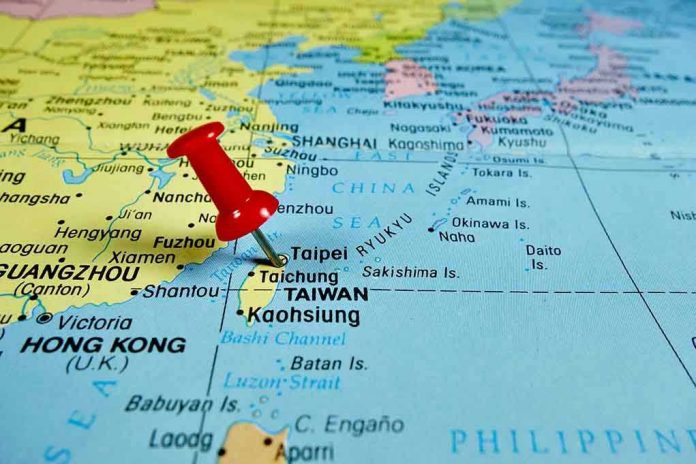
A plan sold as “burden relief” for Okinawa now risks turning America’s closest Marine foothold to Taiwan into a longer, slower commute.
Quick Take
- The 2006 U.S.-Japan realignment plan envisioned moving about 9,000 Marines off Okinawa, including roughly 5,000 to Guam.
- China’s pressure on Taiwan has changed the math: distance and response time matter more than old political bargains.
- Marine Corps leaders and Atlantic Council analysts argue Guam sits too far away to do the most urgent jobs in a crisis.
- Japan has already spent heavily on Guam facilities, yet the move has barely started beyond a small advance unit.
- The fight now is less about maps and more about whether deterrence stays credible when seconds count.
Okinawa’s leverage is geography, and geography does not negotiate
Okinawa’s value to U.S. strategy is simple: it sits close enough to matter when a Taiwan scenario moves from “headline” to “hour-by-hour.” Analysts tracking the Marine Corps’ “stand-in forces” concept argue that dispersal and speed beat bulk and distance, especially inside an adversary missile envelope. Pull thousands of Marines off Okinawa and you trade proximity for paperwork, while Beijing keeps the same short flight paths and the same timelines.
The relocation plan itself is not new. Washington and Tokyo signed the Defense Policy Review Initiative roadmap in the mid-2000s, built around shifting forces from Okinawa to Guam and other locations while keeping a sizable Marine presence in Japan. That compromise tried to answer Okinawan anger over noise, accidents, and crime while preserving the alliance. Two decades later, the Indo-Pacific’s threat picture looks nothing like the one negotiators faced then.
The 2006 deal runs into 2026 realities: Taiwan timelines punish distance
Atlantic Council analysts put the critique bluntly: moving Marines away from Okinawa would benefit China because it weakens the most immediate U.S. posture near a likely flashpoint. Their recommendation to retain around 5,000 Marines on Okinawa highlights a practical deterrence principle familiar to any homeowner: the alarm that reaches you fastest is the one that helps you. Guam may be safer from some threats, but it is also farther from the front.
Marine Corps Commandant Gen. Eric Smith has voiced the same operational doubt: Guam is too distant for the tasks that matter in the opening days of a conflict. That statement lands because it aligns with common sense and conservative priorities: defend forward, minimize uncertainty, and avoid betting American lives on optimistic timelines. A deterrent works when the other side believes you can act immediately, not after a redeployment plan clears committee review.
The “base burden” problem is real, but strategy cannot run on wishful thinking
Okinawa carries an outsized share of U.S. basing in Japan, and locals have complained for decades about the concentration. Marine Corps Air Station Futenma, squeezed into the city of Ginowan, became the symbol of the dilemma: important to operations, unpopular on the ground, and politically radioactive in Tokyo. The proposed replacement at Henoko in Nago has faced years of legal and protest battles, dragging out a solution that satisfies no one.
That history tempts politicians to treat any movement of Marines as progress by definition. That’s the trap. Moving units just to say you moved them, while leaving mission requirements unchanged, produces the worst of both worlds: less readiness and the same grievances. Okinawans still live with ongoing construction and uncertainty; Guam absorbs the planning churn; and American commanders inherit a posture designed for a quieter decade.
Guam spending and slow execution expose an alliance coordination gap
Japan has invested heavily in Guam-related facilities tied to the relocation framework, including reported spending in the hundreds of billions of yen. Yet the visible movement has been modest, highlighted by an advance element of roughly 100 logistics personnel relocating in late 2024. The Marine Corps has described the relocation as “situation-dependent,” language that signals a military truth: you do not hollow out forward posture when the region’s risk curve points up.
That mismatch—money spent, movement stalled, messaging carefully hedged—creates political friction. Tokyo wants burden reduction; Okinawa wants relief; Washington wants credible deterrence; commanders want options. The U.S. should not pretend the old agreement can run on autopilot. Conservative realism says alliances work when expectations stay aligned with the threat, and the threat is not a theoretical seminar anymore.
The quiet pivot: Force Design keeps key Marines on Okinawa
The Marine Corps’ Force Design updates have signaled a partial course correction. A plan that once envisioned shifting major elements to Guam now looks less certain, with reporting indicating continued emphasis on keeping key units under III Marine Expeditionary Force in Okinawa. That matters because Force Design is not a press strategy; it’s how the Corps intends to fight. If the concept demands stand-in forces close to contested areas, Okinawa is hard to replace.
Critics may call this an American “take-back” after Japan funded construction, and that complaint deserves respectful hearing. The stronger answer is to renegotiate honestly rather than drift. The U.S. can pursue noise reduction, training dispersion, and smarter use of facilities without sacrificing the forward edge. Deterrence and local dignity do not have to be enemies, but they do require adult tradeoffs instead of slogans.
What comes next: keep deterrence credible while treating Okinawa as an ally, not a landfill
A serious path forward starts with clarity: define which missions require Okinawa-based Marines, keep those forces forward, and shift what can move without damaging response time. Leaders should also recognize the moral component: Okinawa is not just a chess square, and Americans should not dismiss legitimate quality-of-life complaints. Better safety practices and transparent accountability match conservative values as much as readiness does.
Experts warn moving Marines away from Okinawa would play into China’s hands https://t.co/LRJBDtzbv1
— Jeff_Schogol (@JSchogol73030) February 9, 2026
The open question is whether Washington and Tokyo update a 20-year-old roadmap before Beijing tests it. China benefits most when U.S. posture becomes predictable, slow, and politically tangled. Keeping a meaningful Marine presence on Okinawa—while pursuing real burden mitigation—signals the opposite: America intends to stay fast, close, and hard to surprise, which is the entire point of deterrence in the first place.
Sources:
https://www.japan-press.co.jp/s/news/index.php?id=16098
https://en.wikipedia.org/wiki/Relocation_of_Marine_Corps_Air_Station_Futenma
https://taskandpurpose.com/news/marines-okinawa-china-2026/