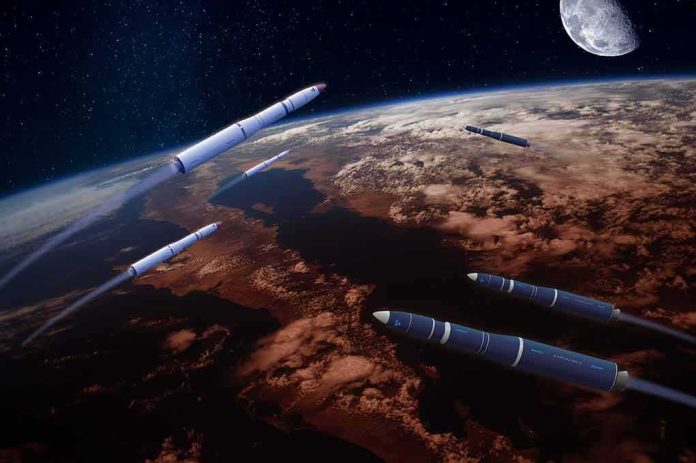
SpaceX’s Falcon 9 lifted off from Vandenberg Space Force Base and placed 24 Starlink satellites into low-Earth orbit with clockwork precision.
Story Snapshot
- Falcon 9 launched 24 Starlink satellites from Vandenberg’s SLC-4E pad
- Liftoff occurred April 20, 2024, after a prior day’s pad abort
- First stage nailed a drone ship landing in the Pacific Ocean
- Satellite deployment came about an hour after launch
Launch facts that set the tone
SpaceX launched a Falcon 9 from Space Launch Complex 4 East at Vandenberg Space Force Base, sending 24 Starlink satellites to low-Earth orbit. The mission followed SpaceX’s standard West Coast profile for polar deployments. SpaceX’s mission page identified the payload count and pad, anchoring the core details. This flight added one more batch to the ever-growing broadband constellation that now blankets high latitudes with stronger coverage footprints and more frequent passes for users on land and sea.
The countdown reached zero without drama on launch day, but only after a scrub the previous day. Controllers had halted at liftoff due to engine pressure behavior during Merlin startup, a known scenario that automated checks are built to catch. The next attempt proceeded smoothly. The first stage arced downrange toward a landing on the drone ship Of Course I Still Love You, stationed hundreds of miles out in the Pacific to capture returning boosters for reuse on future flights.
Rocket reuse as a repeatable system
The booster flying this mission, identified in coverage as 1082 on its twenty-third flight, underscored how reuse has moved from novelty to routine. SpaceX’s cadence rests on recovering, refurbishing, and re-flying hardware with short turnarounds. That model squeezes cost, speeds schedules, and builds a deep flight history for each core. Conservative values favor this kind of discipline: measure, test, reuse, and let performance—not press releases—earn trust through results that deliver again and again.
Second stage events matched the well-known Starlink playbook. After main engine cutoff and stage separation, the upper stage steered to orbit, coasted, and performed a short circularization burn. Deployment came a little over an hour after liftoff, releasing the flat-packed satellites to drift apart and begin raising their orbits. The sequence is not flashy. It is a factory floor in space, turning a complex ballet into a steady, reliable service run that feeds an expanding network.
Why this single launch matters
Adding 24 satellites is not just a number. Each batch improves capacity, reduces latency on busy routes, and adds resilience when spacecraft age out or deorbit. Maritime users, rural homes, and mobile edge teams all benefit when links get denser and handoffs smoother. The launch also marked another click in Falcon 9’s running tally, with coverage placing it as the 667th Falcon 9 orbital launch and one of a striking number of Falcon 9 missions in 2024—a sign of industrial strength, not luck.
WATCH LIVE: SpaceX Falcon 9 launches 27 Starlink satellites from California
Follow @AmerivoxReport for more updates pic.twitter.com/HbU4Il4K77
— Amerivox Report (@AmerivoxReport) September 6, 2026
Vandenberg’s role continues to grow in this story. The base provides polar access that complements East Coast flights, giving SpaceX a flexible map of ground tracks. Federal range policy and safety systems make these operations repeatable without adding red tape that chokes innovation, a balance that keeps America competitive in launch services while guarding public safety and national assets. When government sets clear rules and industry executes with rigor, the result looks like this launch: safe, on target, and productive.