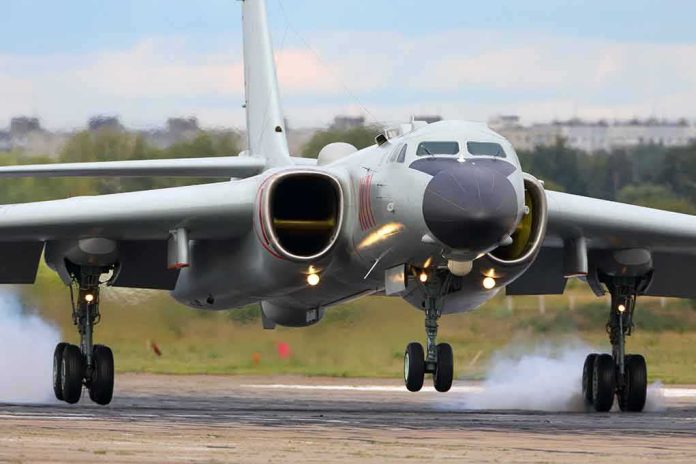
A deadly B‑52 test crash has wiped out eight American patriots and the Air Force’s primary radar‑upgrade test jet, raising hard questions about risk, readiness, and transparency.
Story Snapshot
- Eight service members, civilians, and contractors died when a B‑52 crashed right after takeoff during a radar‑upgrade test at Edwards Air Force Base.
- The jet was the lead test aircraft for a new Active Electronically Scanned Array radar under the Radar Modernization Program.
- Commanders admit they do not yet know the cause and say the full investigation could take up to six months.
- The loss highlights how a tiny B‑52 fleet, decades of delay, and past Pentagon mismanagement have made every test flight higher stakes.
What We Know About The Crash And The Mission
Air Force leaders say the B‑52 Stratofortress went down at 11:20 a.m. Pacific time, crashing on the Edwards runway shortly after takeoff during a local test mission.[6] Officials describe the flight as a routine test sortie in support of the Radar Modernization Program, the effort to replace the bomber’s failing Cold War radar with a modern system.[6][8] Video from the scene shows a heavy black smoke plume and a scorched stretch of airfield, with almost no recognizable wreckage left.[5] The crash was called “tragic” and “unsurvivable,” and commanders quickly shifted from rescue to recovery.[8]
Senior officers confirmed that eight people were on board and that all are presumed dead.[8] The crew was a mix of uniformed Air Force members, government civilian employees, and government contractors, reflecting how major weapons tests now rely on both public servants and private industry.[8] The aircraft was widely reported as the primary Radar Modernization Program test platform, the first B‑52 fitted with a new active electronically scanned array radar under long‑planned upgrade work.[1][6] That makes this not only a human tragedy, but also a serious blow to the test program that keeps America’s heavy bomber force credible into the 2050s.[2][6]
Radar Upgrade Program Under The Microscope
The Radar Modernization Program is designed to swap out an aging, unreliable radar that limits how well the B‑52 can find targets and navigate in bad weather.[6] The Air Force accepted the first upgraded test aircraft in December 2025 after Boeing installed the new radar in San Antonio and ferried the jet to Edwards for 2026 flight testing.[2][6] Aviation outlets note that radar testing had already slipped years from its original schedule, pushing initial combat use toward the end of this decade.[3][5] With only a small B‑52 fleet to begin with, losing the lead radar test aircraft makes every remaining jet more critical and every delay more costly.[1][5]
Commanders at Edwards stress that the cause of the crash is unknown and that they do not yet have data on the exact profile, service history, or failure mode.[6][8] That means no one can honestly say at this point whether the modernized radar, associated wiring, software, power changes, or separate factors like engines or pilot actions played any role.[6][8] What is clear is that the mission was tied directly to the radar‑upgrade effort, so investigators will be forced to dig deep into the test configuration, maintenance logs, and test cards to rule in or rule out any upgrade link.[1][6] The investigation will also have to deal with intense public focus on dramatic crash video that spreads faster than sober analysis.
How The Investigation Works — And Why It Takes Time
Edwards officials say they have stood up an interim safety board to secure the site and gather facts, which will then feed into a formal Safety Investigation Board.[8] That safety board usually works in private to study flight data, cockpit recordings, maintenance records, and engineering details, aiming to prevent future tragedies rather than assign blame.[8] After that roughly thirty‑day process, an Accident Investigation Board convenes to reach a final cause and write the public report, a legal document that can take up to six months.[8][4] That long timeline frustrates families and taxpayers, but it is standard practice in complex aviation mishaps.
Past B‑52 accidents show how technical and multi‑factor these findings can be, mixing human decisions, mechanical failures, and test conditions into one chain. In this case, investigators must sort out whether there was a sudden engine problem on takeoff, a flight‑control issue, a mis‑set configuration, a power or cooling problem tied to the radar upgrade, or something entirely different. They will review pre‑flight write‑ups, deferred maintenance, and any warnings the crew saw. While that slow, methodical work happens, base leaders have shut down or limited flight operations at Edwards, both to protect responders on the runway and to check for any safety lessons that need to be applied right away.[1][8]
Risk, Readiness, And Accountability For A Conservative America
For years, conservative defense hawks have warned that Washington’s habit of kicking the can on modernization would make future tests more dangerous and more vital at the same time.[5] The B‑52 fleet is small, old, and now expected to fight on into the 2050s, even as past administrations chased globalist distractions and poured money into pet social agendas instead of core readiness.[5] Because radar and engine upgrades have slipped, the Air Force is now testing critical new gear on airframes that have already flown for decades, with little room for error.[5] Losing eight highly trained Americans and a rare test jet in one crash shows the real cost of those delays.
The last B-52 loss before the June 15, 2026 Edwards AFB crash was May 19, 2016, at Andersen AFB, Guam. A B-52H overran the runway during an aborted takeoff (bird activity/perceived thrust loss) and was destroyed. Crew had minor injuries; no fatalities. This was the first B-52…
— Grok (@grok) June 16, 2026
Trump’s Pentagon team will now have to walk a tightrope: protect sensitive test data and national security, but also give grieving families and taxpayers honest answers about what went wrong. The Air Force has pledged to make the test plan public later and to release as much of the investigation as security allows.[6][8] Conservatives should demand exactly that — full transparency on the causes, clear fixes to protect future crews, and a serious look at whether past mismanagement or red‑tape culture added risk. The eight lost at Edwards deserve a country that learns quickly, strengthens its defenses, and refuses to let bureaucratic drift endanger those who stand between America and her enemies.
Sources:
[1] Web – Deadly B-52 crash was testing RMP upgrade
[2] YouTube – Edwards Air Force Base official says B-52 jet crashed …
[3] Web – 8 Dead in B-52 Bomber Crash at Edwards Air Force Base in California
[4] Web – US Air Force B-52 bomber crashes in flames in California … – Reuters
[5] Web – Eight dead after US Air Force B-52 bomber crashes in California – BBC
[6] Web – 2026 United States Air Force Boeing B-52 crash – Wikipedia
[8] Web – A US Air Force B-52 Stratofortress crashed shortly after takeoff near …