As Vladimir Putin and Xi Jinping stage a lavish signing ceremony in Beijing, Americans are watching a rival authoritarian bloc harden its challenge to U.S. leadership and the dollar.
Story Snapshot
- Xi Jinping rolled out full red‑carpet, military‑honor treatment for Vladimir Putin, underscoring a tightly choreographed show of strategic unity in Beijing.
- Chinese and Russian state events featured a welcome in Tiananmen Square, Great Hall of the People ceremonies, and a live signing session broadcast worldwide.
- Coverage and prior visits highlight how Beijing and Moscow use summit pageantry to signal resistance to American influence and the U.S.‑led order.
- For U.S. conservatives, the spectacle is a reminder that weak past policies on energy, debt, and defense helped fuel this axis—one the Trump administration must now counter.
Beijing’s Red-Carpet Signal: A Rival Bloc on Full Display
Chinese and Russian media showcased Vladimir Putin’s latest visit to Beijing as a highly formal state occasion, complete with a red carpet reception, military honor guard, and choreographed ceremonies in the Chinese capital. South China Morning Post reporting describes Putin’s arrival as a formal red‑carpet event, with a greeting from Chinese Foreign Minister Wang Yi and the clear framing of an official state visit, not an informal drop‑in. This visit was noted as Putin’s twenty‑fifth trip to China, underlining long‑running ties between the two regimes.[2]
Video packages from multiple outlets confirm that Chinese President Xi Jinping hosted a full ceremonial welcome for Putin at the Great Hall of the People in Beijing, including marching troops, national anthems, and leaders reviewing the guard.[1][4] Additional footage documents a formal airport reception with a red carpet and Chinese officials lining the tarmac to greet the Russian leader before he traveled into the city.[3] Taken together, these synchronized images send a clear message: Beijing intends the world to see Moscow as a valued strategic partner, not a pariah.[1][3][4]
The Signing Ceremony: Choreographed Unity, Opaque Commitments
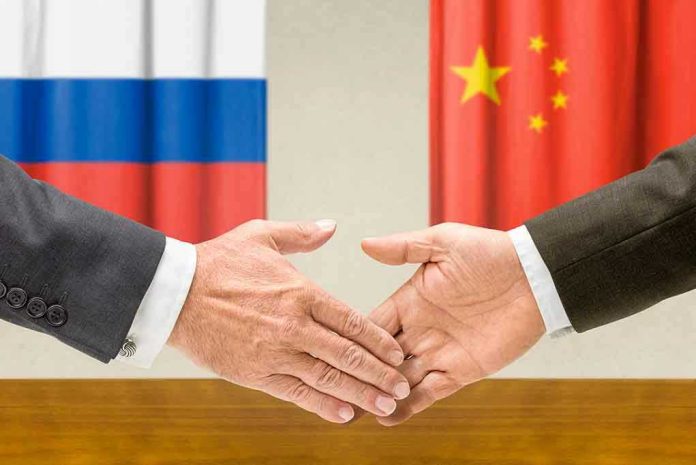
The live signing ceremony, promoted as “Putin and Xi speak at signing ceremony in China,” placed both leaders side by side as they presided over agreements and delivered remarks in Beijing. While available material confirms the public staging of a signing event and speeches, it does not provide a full, authenticated transcript or detailed list of every document endorsed. That lack of textual clarity means observers can verify the optics of unity, but only partially verify the specific economic, technological, or military commitments that may hide behind the handshake photos.[1][4]
Previous reporting on earlier summits between Xi and Putin helps illuminate the likely themes behind the latest Beijing spectacle, even if the new documents are not yet fully published. Past meetings featured emphasis on expanded energy trade, Russian gas pipelines into China, and deliberate moves to use Chinese currency instead of the United States dollar in bilateral deals, paired with joint statements complaining about what they call “American dominance” and seeking a world less led by the United States.[4] That context suggests the 2026 ceremony continues a pattern: use pageantry to market a slow but steady attempt to chip away at U.S. economic and geopolitical leadership.[4]
What Xi and Putin’s Pageantry Means for American Conservatives
For American readers who believe in a strong, sovereign United States, these Beijing images are not just foreign theater; they are the predictable outcome of years of weak Western energy policy, runaway debt, and muddled foreign priorities. Chinese and Russian officials can stage these shows in part because past American leaders allowed dependence on foreign supply chains, undermined domestic energy production, and tolerated chronic trade imbalances. As Washington argued over woke agendas and bureaucratic expansion, Beijing and Moscow quietly deepened ties, filled power vacuums, and worked to undercut the dollar’s central role.[2][4]
President Xi Jinping held a welcome ceremony for Russian President Vladimir Putin, who is on a state visit to China.#ChinaRussia pic.twitter.com/S2kQMxS1la
— ChinaConsulateDubai (@CGPRCinDubai) May 20, 2026
Under the current Trump administration, the challenge is twofold: confront this Russia‑China axis without stumbling into endless foreign entanglements, and rebuild American strength at home so that hostile regimes cannot ignore or bypass U.S. power. That means secure borders, affordable energy from American sources, and trade policies that stop subsidizing adversaries’ militaries through our own consumption. It also means guarding the Constitution and national sovereignty against global institutions that often look the other way while authoritarian leaders stage grand spectacles designed to normalize their partnership against the United States.[2][4]
Sources:
[1] YouTube – FULL CEREMONY: Red Carpet For Friend! Vladimir Putin …
[2] Web – Russian leader Vladimir Putin arrives in China just days …
[3] YouTube – Putin Receives Full State Welcome Upon Arrival in Beijing
[4] YouTube – China’s Xi holds welcome ceremony for Russia’s Putin in …