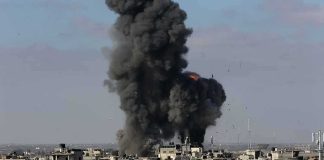
Trump’s warning that Iran could be “taken out” by Tuesday has turned stalled backchannel diplomacy into a ticking clock with global oil, U.S. troops, and civilian lives in the balance.
Quick Take
- President Trump publicly escalated pressure on Tehran, tying potential U.S. strikes to a fast-approaching Tuesday deadline.
- Indirect talks reportedly run through Pakistan, Egypt, and Turkey, with no clear breakthrough described so far.
- The Strait of Hormuz sits at the center of the dispute, with shipping access and energy prices vulnerable to disruption.
- Reporting indicates Trump referenced targets like power plants and bridges, raising concerns about infrastructure and civilian fallout.
Trump’s Tuesday Deadline Puts Diplomacy on a Short Fuse
President Donald Trump has issued a stark warning that the “entire” country of Iran could be “taken out” as soon as Tuesday if Tehran does not accept a peace deal with Washington. The reporting describes indirect negotiations conducted through intermediaries including Pakistan, Egypt, and Turkey, aimed at securing a ceasefire and reopening access through the Strait of Hormuz. So far, the available accounts indicate the talks have not produced a publicly visible breakthrough.
From a governance standpoint, the immediate takeaway is how quickly foreign policy can pivot from negotiation to military coercion when deadlines are attached to public ultimatums. Trump’s framing also signals a familiar approach from his earlier years: pressure first, diplomacy second, and an insistence that adversaries respond to U.S. timelines. That posture resonates with voters who prioritize deterrence and national security, but it also compresses decision-making room for allies, mediators, and Congress.
Why the Strait of Hormuz Matters to Americans Paying the Bills
The Strait of Hormuz is a strategic chokepoint for global energy shipping, and the reporting ties the ceasefire push to reopening or securing passage through that corridor. Even without a shot fired, uncertainty around Hormuz can ripple into higher oil prices, higher shipping costs, and inflation pressure that lands on U.S. households. For Americans already angry about years of high costs, this is the kind of overseas flashpoint that can quickly show up at the pump.
The political challenge is that voters often hear “foreign crisis” and assume another open-ended commitment is being prepared behind closed doors. Conservatives who favor a strong military frequently still want clear objectives, an exit strategy, and burden-sharing from allies—especially after decades of expensive conflicts. Liberals skeptical of military force tend to focus on humanitarian risk and escalation. The common ground is distrust: many Americans suspect Washington’s incentives don’t match the public interest.
Infrastructure Targeting Raises the Stakes Beyond the IRGC
One of the most consequential details in the reporting is the mention of potential strikes tied to critical infrastructure such as power plants and bridges. When leaders talk this way, it signals a willingness to impose costs that extend beyond military units like the Islamic Revolutionary Guard Corps (IRGC). The strategic logic is coercion—make continuation of the conflict unbearable—yet the practical effect can be broader suffering and longer-term regional instability, which can create new security problems later.
Because the available material is limited, it is not fully clear what specific military options are under consideration, what legal framework the administration is citing, or what constraints are being communicated privately to intermediaries. That uncertainty matters: markets move on uncertainty, allies hedge on uncertainty, and adversaries may misread uncertainty. The reporting also suggests an atmosphere of active operations, including U.S. Air Force involvement in rescues, which implies real risk to U.S. personnel if conflict widens.
What Congress—and the Public—Will Want Answered Next
With Republicans controlling both chambers, Trump has more room to shape policy, yet major escalation still raises questions lawmakers will face from constituents. Americans across the spectrum want to know the objective: Is the goal a limited strike to deter the IRGC, a deal to secure maritime access, or something closer to regime-level pressure? They also want to know the cost, the timeline, and how the administration plans to avoid dragging the country into another long conflict.
The deeper political significance is less about partisan talking points and more about institutional trust. When administrations rely on urgency and dramatic warnings, critics interpret it as manufacturing consent, while supporters interpret it as overdue strength after years of drift. Either way, the public’s baseline assumption is that “the system” protects itself first. If the administration wants durable support, clear evidence, defined aims, and transparent limits will matter as much as the threat itself.
Sources:
iran-war-trump-deadline-power-plants-bridges-ceasefire-push-air-force-rescue