
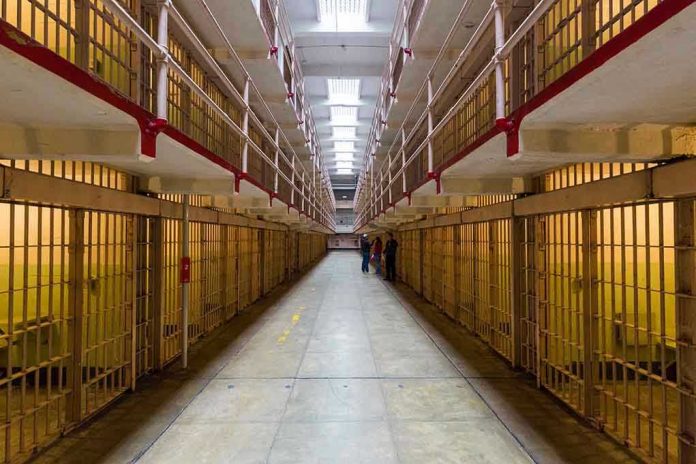
Trump’s new push to revive Alcatraz as a “state-of-the-art” federal prison is forcing conservatives to ask a familiar question: will Washington deliver real law-and-order, or just burn taxpayer dollars on a symbolic headline?
Quick Take
- The White House FY2027 budget request includes $152 million to start rebuilding Alcatraz into a modern high-security prison.
- The proposal follows Trump’s earlier directive to federal agencies to reopen and expand Alcatraz for “ruthless and violent offenders.”
- Alcatraz is currently run by the National Park Service as a major tourist site, meaning a transfer would trigger legal, political, and local economic fights.
- Early estimates put the total rebuilding cost around $2 billion, raising concerns about fiscal discipline and long-term operating costs.
$152 Million Request Puts “The Rock” Back on Washington’s Agenda
The White House included $152 million in its fiscal year 2027 budget proposal to begin rebuilding Alcatraz Island into a high-security federal prison. The money is described as first-year funding for a project that would ultimately require far more investment if it moves forward. The proposal remains non-binding until Congress appropriates funds, which means lawmakers—not press releases—will decide whether “The Rock” becomes a prison again.
https://www.youtube.com/post/UgkxQk-kOl-W4YNDSfQ8b2l3SoJmhnY82Ua7
President Donald Trump previously directed the Bureau of Prisons and the Department of Justice to pursue reopening a “substantially enlarged and rebuilt” Alcatraz. That directive leaned into the administration’s tougher stance on violent crime and the political appeal of an iconic facility built for hard cases. The immediate issue for voters is whether the budget request represents a practical correction to public safety failures or a costly detour from more scalable crime solutions.
Alcatraz’s History Is the Fiscal Warning Label Conservatives Notice First
Alcatraz operated as a federal penitentiary from 1934 to 1963 and became famous for its island isolation, frigid water, and strong currents. The facility ultimately shut down, with closure tied to excessive operating costs; it was later associated with a 1969 end-date as the prison era fully gave way to new uses. That history matters because rebuilding is not just a construction challenge—it signals a return to a model that previously strained federal budgets.
Today, Alcatraz is overseen by the National Park Service and functions as a major San Francisco tourist destination. Any serious plan to convert it back into an active prison would likely require federal coordination and political negotiations over control of the site. Conservatives who value limited government and responsible spending will focus on basic questions: who pays, who runs it, and what happens if operating costs again balloon far beyond comparable facilities.
Congress Holds the Checkbook, and That’s Where the Fight Will Get Real
Because the $152 million appears in a budget proposal, Congress remains the key gatekeeper. Appropriators will weigh the request against competing federal priorities and existing prison capacity needs. The Bureau of Prisons would be central to any build-out, but lawmakers will also have to address the disruption to a National Park Service property and the likely pushback from local interests dependent on tourism. Until those hurdles are resolved, no ground breaks and no cells open.
Political reactions are already sharpening, including high-profile criticism from Democrats in California. The fact that opponents are ridiculing the proposal does not by itself prove it is unworkable, but it does signal an expensive, high-visibility fight ahead. For conservative voters, the standard should be practical outcomes: if Washington asks for new money, it should present a clear operational plan, realistic cost controls, and a measurable public-safety payoff.
Law-and-Order Messaging Meets the Reality of Overreach and Overspending
Trump’s supporters broadly expect tougher prosecution of violent criminals and secure detention for the worst offenders. Reopening Alcatraz matches that message, but the scale of spending invites skepticism—especially as estimates for the overall project have been described as reaching roughly $2 billion. Fiscal conservatives who watched years of overspending will demand safeguards before accepting another large federal build project, even one wrapped in “tough-on-crime” branding.
The administration’s strongest argument is straightforward: if violent crime and prison capacity pressures are real, the federal government should prioritize secure facilities that protect the public. The counterargument is equally conservative: symbolism cannot replace competence, and a historic island site that once closed for cost reasons could become another long-running federal money pit. With the request now public, the next test is whether Congress forces hard numbers and real accountability.
Sources:
Trump requested $152 million to rebuild Alcatraz prison closed in 1969
Trump seeks $152 million to reopen Alcatraz as active prison