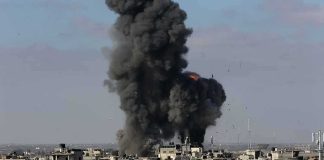
President Trump is promising Americans the Iran campaign won’t become another endless Middle East war—while his own public messaging is fueling questions about how, exactly, this operation ends.
Quick Take
- Operation Epic Fury began in late March 2026, targeting Iran’s nuclear program, missile forces, proxy networks, and naval capabilities in coordination with Israel and Saudi Arabia.
- Trump publicly projected a 4–5 week timeline, while also saying the U.S. could sustain operations “far longer,” adding to mission-creep concerns.
- Pentagon leaders framed the effort as finite and distinct from Iraq and Afghanistan, but declined to commit to a firm end date.
- Four U.S. service members were reported killed in Kuwait as of March 2, underscoring real costs even in a limited campaign.
Operation Epic Fury’s stated targets and allied coordination
The White House described Operation Epic Fury as a focused military campaign aimed at dismantling Iran’s nuclear infrastructure, degrading its ballistic missile arsenal, disrupting proxy terror networks, and reducing Iranian naval capabilities. U.S. forces are operating in partnership with regional allies, including Israel and Saudi Arabia, signaling a broad alignment against Tehran’s military reach. Administration messaging casts the operation as the end result of failed diplomacy and violated “red lines,” not an open-ended nation-building mission.
Pentagon and presidential statements emphasized urgency and necessity, pointing to claims that Iran posed an imminent threat to U.S. security and to allies. Public reporting also described a major blow to Iran’s leadership, including the deaths of the supreme leader and senior leadership during the opening phase of operations. Those battlefield outcomes may change Iran’s command-and-control calculus, but they do not automatically define an end state, which remains the key question for Americans skeptical of long wars.
Time limits promised—then complicated by “forever” rhetoric
President Trump publicly projected that the Iran operation would run about four to five weeks, while also stating the United States could extend it “far longer than that” if needed. That dual message—short timeline paired with an explicit ability to stretch—matters because modern military campaigns often expand once objectives evolve or new threats emerge. For voters who backed Trump to avoid open-ended conflicts, the difference between “can” and “will” is the entire debate.
Criticism intensified after Trump posted that the U.S. has a “virtually unlimited” supply of munitions and that wars can be fought “forever.” Progressive outlets highlighted the contradiction, and foreign-policy analysts questioned whether the claim matches earlier cautions from military leadership about munitions capacity. The most defensible conclusion from the available reporting is not that a forever war is inevitable, but that mixed signals create political risk and weaken public confidence in clear limits.
The Pentagon’s message: “not Iraq,” but still no firm exit criteria
Defense Secretary Pete Hegseth sought to draw a bright line between Epic Fury and the post‑9/11 era, arguing the U.S. is “finishing” a conflict Iran started and rejecting the “endless wars” label. At the same time, he did not commit to a definitive timeline in public remarks. Gen. Dan Caine described the objectives as “difficult and gritty work,” language that suggests sustained operations rather than a quick, symbolic strike package.
Human costs and constitutional tensions around war powers
WUSF reported that four American service members were killed in Kuwait as of March 2, a reminder that even “limited” operations can spill into broader risk across the region. For conservatives who prioritize strong national defense and accountable government, that reality heightens the importance of clearly stated objectives, measurable benchmarks, and transparency with the public. A disciplined strategy can protect U.S. interests without drifting into the kind of blank-check commitments that taxpayers and military families have carried before.
Congressional Republicans cited in official messaging praised the operation as necessary to protect Americans and disrupt Iran’s nuclear and missile ambitions. The durability of that support may hinge on whether the administration defines what “success” looks like and communicates it consistently. Americans who remember how quickly “temporary” actions became decade-long deployments are likely to keep pressing for clarity—especially when presidential rhetoric swings between “won’t be forever” and “we can do forever.”
Sources:
https://www.wusf.org/2026-03-02/trump-defends-iran-strikes-offers-objectives-for-military-operation
https://responsiblestatecraft.org/trump-stockpiles-iran/