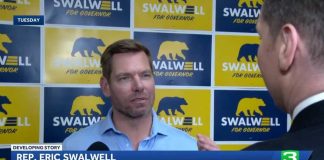
A campaign can survive a rumor, but it rarely survives the moment a candidate denies an allegation while simultaneously confessing to “mistakes” at home.
Quick Take
- Rep. Eric Swalwell, running for California governor, faces sexual assault allegations from a former staffer describing two incidents years apart.
- Swalwell calls the claims “flat false,” while his attorney moved quickly with a cease-and-desist aimed at online amplification.
- Endorsements reportedly started falling away fast, a political signal that party allies fear the story more than they trust the defense.
- The political damage turns on a familiar contradiction: “believe survivors” rhetoric colliding with deny-and-lawyer-up reality.
A denial, a cease-and-desist, and the speed of modern scandal
Eric Swalwell’s 2026 run for California governor hit the kind of turbulence that doesn’t wait for court filings or police reports. A former staffer, unnamed publicly, alleges Swalwell sexually assaulted her twice, once in 2019 and again in 2024, describing intoxication and an inability to consent. Swalwell denies it. His lawyer escalated with cease-and-desist warnings tied to “unverified” allegations circulating online, turning a political headache into a public brawl.
The sequencing matters because politics runs on momentum, not footnotes. Rumors swirled first, then a legal threat, then the detailed reporting that makes voters picture scenes and timelines. In these cases, the public rarely separates “unverified” from “untrue.” They only separate “I can live with this” from “I can’t.” That distinction is why campaigns obsess over the first 48 hours—and why Swalwell’s response now defines him more than any policy platform.
The allegations hinge on consent, intoxication, and corroboration claims
The former staffer’s account centers on two alleged encounters: one in 2019 while she worked for Swalwell, another after a 2024 charity gala. Reporting describes the accuser saying she was too intoxicated to consent and points to text messages reviewed by journalists, along with people aware of her account at the time. No police report has been described in the research summary, which limits what outsiders can verify, but it doesn’t eliminate political consequences.
Swalwell’s denial is categorical, and categorical denials can be either truthful clarity or strategic necessity. His background as a former prosecutor adds a layer: voters expect precision from prosecutors, not fuzzy language. That expectation cuts both ways. If facts later back him up, the early legal posture looks like discipline. If facts later undermine him, the same posture looks like intimidation. Public trust turns on which version reality supports, not which side posts first.
The “mistakes” apology created a second storyline he can’t control
Swalwell posted a video statement denying the assaults while apologizing to his wife for unspecified “mistakes.” That phrasing may have aimed to separate private marital issues from public allegations, but politics doesn’t grant neat compartments. Voters hear “mistakes” and immediately ask: mistakes like what, and why mention them now? The apology gives critics room to argue he effectively admitted character problems while denying specific acts, a mix that rarely calms a scandal.
From a common-sense, conservative-values perspective, the standard should stay consistent: allegations deserve a serious hearing, evidence should matter, due process should not vanish because the accused wears a red or blue jersey. At the same time, public office is not a courtroom. Parties and endorsers make risk decisions, not verdicts. Swalwell’s own party built years of messaging around believing accusers; that messaging now boomerangs as his allies decide whether to apply it evenly.
Endorsement withdrawals signal the real threat: institutional abandonment
Endorsements reportedly started dropping in quick succession, including prominent Democrats and organized labor support. That move rarely reflects certainty about guilt; it reflects certainty about exposure. Endorsers care about winning and reputational spillover. If they believe a candidate can’t survive the next headline cycle, they cut loose early to avoid being filmed defending the indefensible later. In practical terms, that’s how a campaign “implodes” even before ballots are cast.
Swalwell’s team also faces the classic staffing problem: insiders know whether the internal story is stable. When allegations involve workplace power dynamics—boss and staffer—campaign staff calculate their own future careers. If they suspect more claims could emerge, they quietly exit. If they think the story is bogus and will collapse, they might stay and fight. The public usually learns which it is by watching who resigns and who doubles down.
Why timing near an election supercharges everything
Election timing breeds two competing assumptions that both can be true: bad actors sometimes weaponize accusations, and real victims sometimes wait because they fear disbelief, retaliation, or career destruction. This case carries that tension openly. The accuser remains unnamed in the reporting described, and the lack of a police report leaves gaps. Yet the mention of texts and contemporaneous awareness adds the kind of detail that makes a story stick with voters.
The smartest voter question is not “Who do I like?” but “What can be checked?” Campaigns that want credibility typically ask for an independent process: an investigation, a review, cooperation with any inquiry, and a disciplined message that doesn’t shift. Campaigns that want only victory typically attack the motives of accusers and lean on legal threats. Swalwell’s cease-and-desist strategy might deter reckless rumors, but it can also look like an attempt to chill speech when the public demands transparency.
The broader lesson: slogans don’t survive contact with real allegations
The “believe survivors” era trained many voters to treat accusations as presumptive truth, then politics immediately taught them the exception clause: unless the accused is on your team. That double standard corrodes institutions faster than any single scandal. A fair standard looks boring but works: treat accusations as serious, demand evidence where possible, avoid smears, and protect due process while recognizing that political leadership is a trust, not an entitlement.
Believe Survivors? Swalwell Ripped for Denying Assault Claims, Then Apologizing to Wife for ‘Mistakes’ https://t.co/wrAU4zMC97
— 🍊🍊🍊PatriotPureblood🍊🍊🍊 (@PatriotPureblo1) April 11, 2026
Swalwell’s future hinges on what additional corroboration emerges, whether more accusers go on record, and whether investigators or journalists can verify the key claims. The immediate reality is simpler: his denial didn’t close the story; it opened two. One story asks whether he committed assault. The other asks whether a movement built on moral certainty can tolerate uncertainty when the target is one of its own.
Sources:
https://www.ktvu.com/news/eric-swalwell-denies-new-sexual-assault-allegations
https://www.kiro7.com/news/politics/allies-yank-support/UX7UMUCMMM6KPAF73JUPRWYD6E/