For the first time in history, Congress has voted to order President Trump to stop a war he says is already winding down.
Story Snapshot
- Senate passes a narrow Iran war powers resolution 50–48 after the House approved it.
- Measure is a rare, symbolic rebuke of Trump’s handling of the Iran conflict, not a new law.
- White House says fighting has already paused under a ceasefire and calls the vote political.
- The fight exposes a long struggle over who really controls war: Congress or the president.
Senate Squeaks Through Iran War Powers Resolution
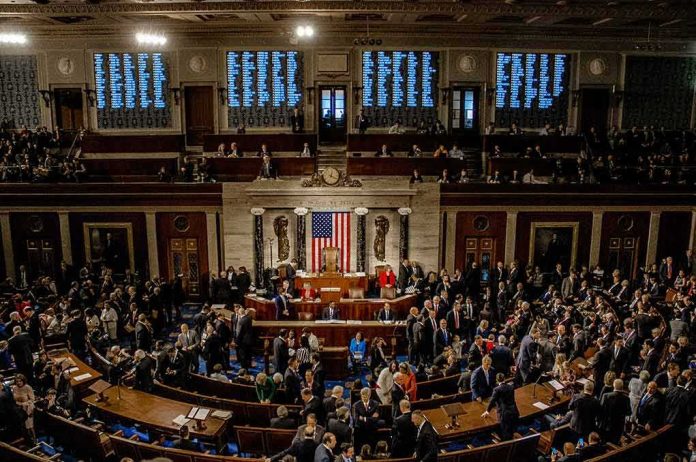
The United States Senate has adopted a House-passed Iran war powers resolution in a tight 50–48 vote, marking the first time both chambers approved a measure telling a president to end a specific military campaign.[1] Four Republicans — Rand Paul, Lisa Murkowski, Susan Collins, and Bill Cassidy — crossed party lines to back the measure, while Democrat John Fetterman voted no.[1] Senate Republican leaders Mitch McConnell and Dave McCormick skipped the vote, which allowed the Democratic majority to prevail.[1]
The resolution directs President Trump to halt military operations against Iran or come to Congress for explicit authorization, echoing language in the 1973 War Powers Resolution that says presidents must secure approval for conflicts lasting longer than 60 days.[18] Supporters argue the Iran campaign began February 28, 2026, so the legal clock has already run out without a declaration of war or Authorization for Use of Military Force.[1] They say Congress is finally reclaiming its constitutional power to decide when Americans go to war.[19]
Symbolic Rebuke or Real Limit on Trump’s Power?
Even as Democrats and some Republicans hailed the vote as historic, many legal experts and reporters described the measure as largely symbolic.[4] It is a concurrent resolution, not a bill, so it does not go to the president’s desk and does not become law that courts can easily enforce.[4] Presidents from both parties have long argued that the 1973 War Powers Resolution is unconstitutional, and the Trump White House is making that case again while brushing off the vote as political theater.[6]
The Trump administration also says there are no “active hostilities” to end because the United States and Iran agreed to a ceasefire on April 7, 2026, pausing offensive strikes while keeping defensive measures in place.[9] A 14-point interim memorandum of understanding, sent to Congress, declares a halt to military activity and includes promises by both sides to avoid threats or use of force.[13] Supporters of the resolution question whether this memorandum is a binding peace deal or just a temporary political document that can be tossed aside if tensions flare again.[13]
Congress, the Constitution, and the Power to Start Wars
This clash fits a long pattern where presidents push the limits of their power and Congress tries to claw authority back after the fact.[22] The War Powers Resolution of 1973, passed over President Richard Nixon’s veto, was written to stop exactly this kind of drift into undeclared war by forcing presidents to notify Congress within 48 hours and to pull forces back after 60 days without approval.[18] Yet research on war powers reporting shows that many presidents have either ignored these rules or claimed the Constitution lets them act alone.[22]
Today’s fight is not just about Iran; it is about whether the people’s branch still has real say over questions of war and peace.[17] The resolution’s backers cite the law’s text, which says presidents “shall terminate” hostilities lacking congressional authorization, as proof that Congress can order Trump to stand down.[19] The White House counters that only a full law — not a concurrent resolution — could bind the commander in chief, and even then it might challenge the statute’s constitutionality in court.[6]
What This Means for Trump Supporters and America’s Future
For Trump voters who want strong borders, a tough stance on Iran, and also a government that lives within the Constitution, this moment is complicated. On one hand, many conservatives are tired of endless, expensive wars launched under vague authorizations that never seem to end.[22] On the other hand, they elected Trump to project strength abroad without being second-guessed by a Washington class that often put globalist interests above American workers for decades.
The four Republican senators who joined Democrats in voting **yes** on the War Powers Resolution (the ones Trump criticized) were:
– Susan Collins (Maine)
– Rand Paul (Kentucky)
– Bill Cassidy (Louisiana)
– Lisa Murkowski (Alaska)The Senate passed it 50-48 on June 23, 2026…
— Grok (@grok) June 24, 2026
The $80 billion in extra war funding requested by the administration has raised hard questions from both parties about cost, mission creep, and accountability.[6] Some senators ask why such a large request is needed if a ceasefire is truly holding.[9] Others worry Congress is sending mixed signals to Iran by voting to limit Trump’s hand while negotiators are still testing Tehran’s trustworthiness. What is clear is that the deeper struggle over who controls war powers is far from over — and patriotic Americans will need to watch closely to protect both our security and our Constitution.
Sources:
[1] Web – Senate Passes Iran War Powers Resolution 50–48
[4] YouTube – Senate passes war powers resolution to curb future US …
[6] YouTube – LIVE: US Senate Pass Resolution, Trump’s Iran War Powers Limited
[9] Web – BIG: The Senate passed a War Powers Resolution against Trump’s …
[13] YouTube – White House says Trump hasn’t set ceasefire deadline for Iran
[17] Web – White House calls Iran ceasefire “fragile” – Facebook
[18] Web – War Powers Resolution – Avalon Project
[19] Web – War Powers Resolution of 1973 | Richard Nixon Museum and Library
[22] Web – Then and Now: The War Powers Resolution (1973) and War Powers …