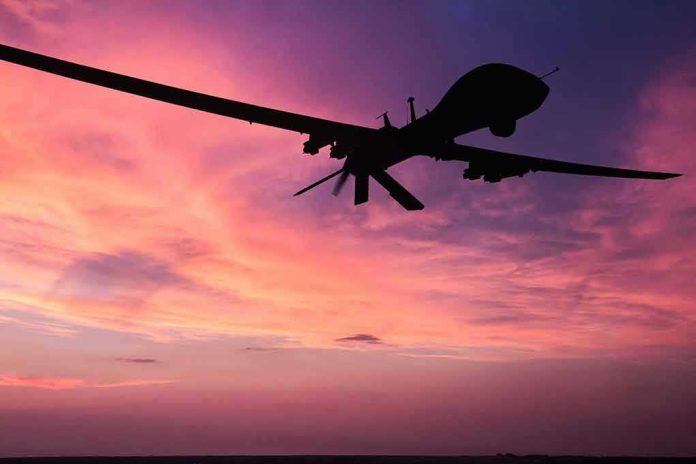
A cartel drone breach forced the federal government to shut down the skies over a major American city—then quietly reopen them hours later after officials said the threat was “neutralized.”
Quick Take
- The FAA imposed a sweeping temporary flight restriction over El Paso and nearby southern New Mexico late Feb. 10, stopping commercial, cargo, private, and emergency flights.
- U.S. Transportation Secretary Sean Duffy said Mexican cartel drones breached U.S. airspace and the Department of War disabled them, allowing the FAA to lift the closure Feb. 11.
- Local leaders said they received little warning and warned the shutdown affected medevac and public-safety aviation, not just airline travel.
- The incident highlights how cartel technology can disrupt daily life on the U.S. side of the border—and how federal action can sideline local officials.
FAA’s El Paso shutdown showed how fast border threats can hit home
The FAA issued a temporary flight restriction late Feb. 10 at 11:30 p.m. MST, abruptly closing airspace over El Paso, Texas, and parts of southern New Mexico that include El Paso International Airport. Reports described the restriction as halting all aircraft operations—commercial, cargo, general aviation, and emergency flights—because civilian authorities could not guarantee safe separation amid a security incident. By early Feb. 11, travelers faced cancellations and diversions as officials sought clarity.
For residents, the alarming part was not just the delay at the terminal. El Paso is the 23rd largest U.S. city, anchored by critical infrastructure and a constant rhythm of cross-country travel, freight, and emergency medical flights. When the federal government turns off that airspace switch, the ripple effects land immediately on families, hospitals, and first responders. The breadth of the restriction also suggested officials were dealing with more than a routine military exercise.
Cartel drones, military operations, and a rapid federal reversal
U.S. Transportation Secretary Sean Duffy later confirmed the key detail: Mexican cartel drones breached U.S. airspace near the border, prompting a response that involved the Department of War. Duffy said the drones were disabled and that the FAA and DOW determined there was no ongoing threat to commercial travel, allowing the FAA to rescind the restriction and restore normal flight operations on Feb. 11.
Two narratives ran side by side in early reporting: one emphasized a cartel drone incursion, while another stressed that Defense Department drone operations based around Fort Bliss and Biggs Army Airfield were central to the safety concern that triggered the FAA action. Those explanations are not mutually exclusive. A cartel drone breach colliding with sensitive military activity would be exactly the kind of scenario that forces regulators to choose maximum caution for civilian aircraft.
Local officials say the communication breakdown created public-safety risk
El Paso’s local leadership and members of Congress reacted with frustration, largely because of the process rather than the goal of protecting air travelers. City officials and the El Paso International Airport worked to inform airlines and the public, while some leaders said the community received little notice about what was happening. Mayor Renard Johnson criticized the lack of coordination, arguing that grounding emergency aviation—such as medical flights—creates its own public-safety hazards.
Members of the local congressional delegation also pushed for answers. Rep. Veronica Escobar criticized what she described as a lack of notice and urged the restriction be lifted, while Rep. Tony Gonzales said there was no broader security threat to the community and pointed to a prior airspace restriction in Hudspeth County in November 2025 that was resolved through federal coordination. The bipartisan nature of the complaints underscored that basic transparency is not a partisan demand.
A rare post-9/11 style airspace move raises bigger accountability questions
Industry sources cited in reporting described the El Paso shutdown as unusually sweeping, with one noting it had not happened since the period after 9/11 in terms of grounding everything, including law enforcement and medevac flights. The restricted area was described as a 10-nautical-mile radius around the airport extending up to 17,000 feet, impacting nearby areas like Santa Teresa, New Mexico, while excluding Mexican airspace.
The FAA’s rapid reversal—moving from a 10-day closure notice to a same-day reopening—will likely intensify demands for clearer protocols when federal agencies act over major population centers. The reporting leaves unresolved questions, including how local emergency planners are supposed to adapt when airspace changes arrive with minimal explanation, and what measures will prevent cartel drones from forcing similar disruptions elsewhere. Limited public detail about the operation itself means the public is being asked to accept reassurance without much transparency.
Sources:
FAA Grounds All Flights to and from El Paso Until Feb. 20
El Paso airspace closed by FAA