
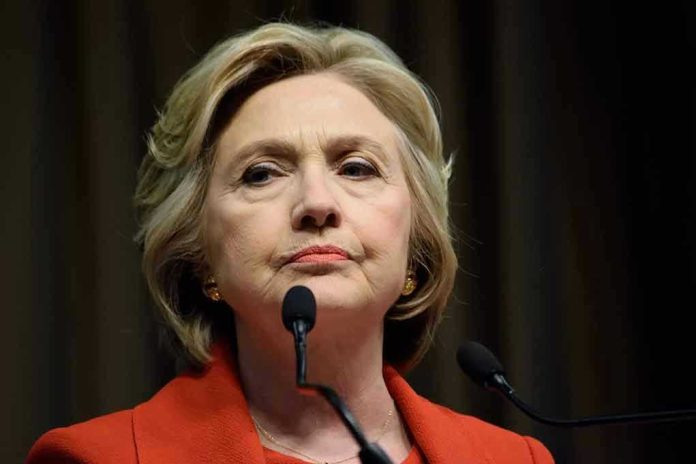
Hillary Clinton moderated a women’s rights panel at the Munich Security Conference and featured Rep. Sarah McBride, America’s first openly transgender member of Congress, sparking a firestorm of conservative criticism framing the event as a fundamental contradiction of biological womanhood.
Story Snapshot
- Former Secretary of State Hillary Clinton moderated a panel titled “Girls Just Want to Have Fundamental Rights” at the Munich Security Conference on February 14, 2026, featuring Rep. Sarah McBride as a speaker
- Conservative media outlets erupted with accusations of “woke hypocrisy,” claiming a biological male was lecturing on women’s rights, while neutral sources reported it as a standard advocacy partnership
- McBride attended privately during a partial government shutdown that canceled official congressional travel, with Clinton praising her as a “gender rights champion” facing organized threats
- The panel addressed global rollback of women’s rights including abortion restrictions and countries exiting the Istanbul Convention on violence against women
- The controversy reveals deepening cultural divides over whether transgender women belong in spaces designated for advancing women’s rights and protections
When Women’s Rights Meets Gender Identity Politics
The Munich Security Conference panel brought together Clinton, a decades-long advocate who declared “Women’s rights are human rights” at the 1995 Beijing conference, with McBride, who made history entering Congress in January 2025 after serving in Delaware’s state senate. The panel’s title referenced Cyndi Lauper’s iconic anthem while addressing serious threats to reproductive rights, anti-violence protections, and gender equality worldwide. McBride co-sponsored the Women’s Health Protection Act and championed Delaware’s paid family leave law. Yet conservative outlets viewed her presence as invalidating the very concept of women-specific advocacy, arguing biological sex matters when defending female-specific rights.
The Conservative Outrage Machine Mobilizes
Right-leaning media platforms like Gateway Pundit and Next News Network deployed inflammatory language, referring to McBride as “a man pretending to be a woman” and framing the panel as undermining genuine women’s advocacy. These outlets positioned the event as evidence of progressive hypocrisy, suggesting Clinton betrayed biological women by elevating a transgender voice on sex-based rights issues. The Washington Examiner, by contrast, reported the event factually without controversy, noting McBride’s office confirmed her attendance and describing it simply as a partnership on girls’ rights. This split reflects America’s broader cultural war over gender identity versus biological sex in policy and advocacy spaces.
Political Context and Strategic Timing
The panel occurred during a partial U.S. government shutdown triggered by Department of Homeland Security funding lapses, which canceled official congressional travel. McBride attended privately, demonstrating commitment to the cause despite domestic political chaos. The timing also followed Trump’s Executive Order 14183 banning transgender individuals from military service, which McBride publicly opposed on January 8, 2026. Clinton’s decision to platform McBride signals progressive Democrats’ determination to merge LGBTQ+ advocacy with women’s rights, refusing conservative demands to separate them. This strategic positioning energizes the Democratic base while handing Republicans attack lines portraying liberals as abandoning biological reality for ideological purity.
Global Rights Rollback Takes Center Stage
Beyond the transgender controversy, panelists addressed substantive threats to women worldwide. Binaifer Nowrojee of Open Society Foundations discussed geopolitical shifts including Russian influence on countries exiting the Istanbul Convention, which combats violence against women. A European parliamentarian named Neil identified coordinated think tank networks systematically undermining gender rights legislation. The panel highlighted how anti-abortion movements, attacks on reproductive healthcare access, and organized opposition threaten gains won over decades. McBride herself spoke about facing escalating threats as a visible transgender official, connecting her experience to broader patterns of intimidation against rights advocates. These discussions reveal how culture war battles distract from coordinated assaults on concrete protections.
What This Reveals About America’s Gender Divide
The clash over McBride’s participation exposes irreconcilable worldviews on sex and gender. Progressives view transgender women as women, making McBride’s advocacy for reproductive rights and safety from violence entirely consistent with women’s liberation. They see inclusion as strengthening coalitions against patriarchal rollback. Conservatives argue biological reality cannot be wished away, insisting women-specific issues require women-specific voices, and that gender identity ideology erases sex-based analysis of oppression. This isn’t abstract philosophy but shapes policy on sports, prisons, healthcare, and legal definitions. The Munich panel became a proxy battle because it forced the question: can movements claiming to defend women simultaneously reject biological sex as a meaningful category? Common sense suggests rights advocacy requires honest acknowledgment of biological realities while respecting individual dignity, a nuance lost when politics demands absolute positions. The controversy will persist because both sides believe surrendering ground threatens fundamental truths about human nature and justice.
Sources:
Munich Security Conference 2026 Agenda