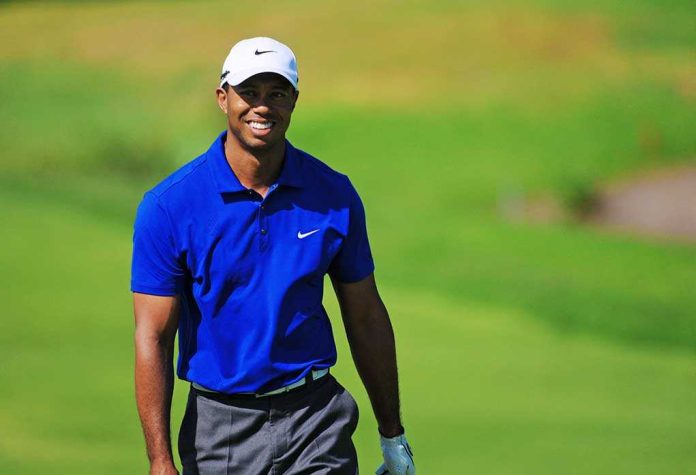
Tiger Woods refuses to close the door on competitive golf, even as his 50-year-old body wages war against a seventh back surgery and a timeline that seems designed for failure.
Story Snapshot
- Woods won’t rule out competing in the 2026 Masters despite disc replacement surgery in October 2025
- The five-time Masters champion can hit full shots but inconsistently, with his lower back still sore four months post-surgery
- Woods missed all of 2025 after rupturing his Achilles tendon and undergoing spinal surgery
- Now 50 and eligible for PGA Tour Champions, he’s considering using a cart on the senior circuit while maintaining his refusal to do so on the PGA Tour
- His potential Ryder Cup captaincy for 2027 remains undecided as he focuses on tour restructuring and physical recovery
The One-Word Answer That Keeps Hope Alive
When reporters pressed Woods at the Genesis Invitational about whether the Masters was off the table, he delivered a simple “No” with a slight smile. That single syllable carries enormous weight for a man who hasn’t competed since July 2024 and spent an entire calendar year without playing a single tournament. The compressed timeline—less than two months until Augusta—makes this response either remarkably optimistic or stubbornly delusional, depending on your perspective. Woods added he’s “trying” to come back, acknowledging the disc replacement has been challenging while his Achilles tendon, ruptured in March 2025, no longer limits him.
The Physical Reality Behind the Determination
Woods can hit full golf shots during training, but consistency and quality remain elusive. His lower back soreness persists after the October surgery, his seventh known back procedure. He compared his recovery to Will Zalatoris, who underwent similar disc replacement surgery, but acknowledged that age makes everything slower. At 50, Woods faces a recovery equation fundamentally different from his 2022 Masters comeback, when he competed just 14 months after a catastrophic car accident. That return focused on orthopedic injury; spinal surgery presents more complex challenges with age-related complications that don’t respond to sheer willpower.
The Champions Tour Cart Compromise
Woods turned 50 in December 2025, unlocking eligibility for the PGA Tour Champions circuit. He’s openly considering using a cart on the senior tour, something he categorically refuses to do on the PGA Tour. This distinction reveals Woods’ complicated relationship with competitive integrity and practical necessity. He maintains that walking is fundamental to PGA Tour competition, a principle that seems almost quaint given his physical limitations. The Champions Tour represents a potential compromise that preserves his competitive identity while acknowledging bodily reality. This pragmatism contrasts sharply with his Masters aspirations, where no such accommodations exist.
The Administrative Power Player
Woods isn’t merely recovering; he’s reshaping professional golf from boardrooms. As a PGA Tour policy board member and vice chairman of PGA Tour Enterprises’ board of directors, he’s heavily involved in restructuring the tour’s competitive calendar. Discussions include potentially moving signature events like Riviera and Torrey Pines to August, changes that ripple through the entire professional golf ecosystem. This administrative influence explains why he hasn’t committed to Ryder Cup captaincy for 2027 at Adare Manor, citing time constraints from tour restructuring work. His dual roles as Genesis Invitational host and policy influencer position him similarly to Jack Nicklaus at the Memorial and Arnold Palmer at Bay Hill—legacy figures who transcend playing careers.
The Declining Performance Trajectory
Woods’ 2024 Masters performance provides sobering context for his comeback ambitions. He finished 16-over par with a 304 score, his highest 72-hole total at Augusta. This marked a significant decline from his 2022 Masters return, when he made the cut and demonstrated competitive viability despite obvious physical limitations. The cumulative toll of multiple surgeries, advancing age, and now an Achilles injury category distinct from his chronic back issues suggests broader physical vulnerability. His record 24 consecutive Masters cuts testifies to past dominance, but past performance guarantees nothing when competing against both opponents and your own deteriorating body.
Tiger Woods eyes Masters return, future Ryder Cup captain role amid back surgery rehab https://t.co/z5xFOxDf5H #FoxNews F TW
— Ron Reid (@RonReid77818913) February 18, 2026
The Legacy Calculation
Woods faces a calculation that transcends competitive golf. His decisions about Masters participation and Ryder Cup captaincy define his professional identity for the remainder of his career. A successful Masters return extends his competitive window and reinforces his comeback narrative; continued absence accelerates his transition to administrative and mentorship roles. The economic stakes matter too—Masters viewership and sponsorship value correlate directly with his participation, while his Champions Tour involvement could legitimize and popularize the senior circuit. Woods’ influence over professional golf now extends beyond his playing ability to his institutional power and commercial magnetism. That reality makes every public statement about his physical condition a strategic communication rather than simple health update.
Sources:
Tiger Woods Masters 2026 playing – CBS Sports
Tiger Woods rule return year Masters – ESPN
Tiger Woods 2026 Masters Augusta Genesis Invitational Riviera back surgery – LA Times
Tiger Woods doesnt rule out possible return at Masters – Golf Channel
Tiger Woods is not ruling out a return to the Masters Ryder Cup captaincy also uncertain – PGA Tour