
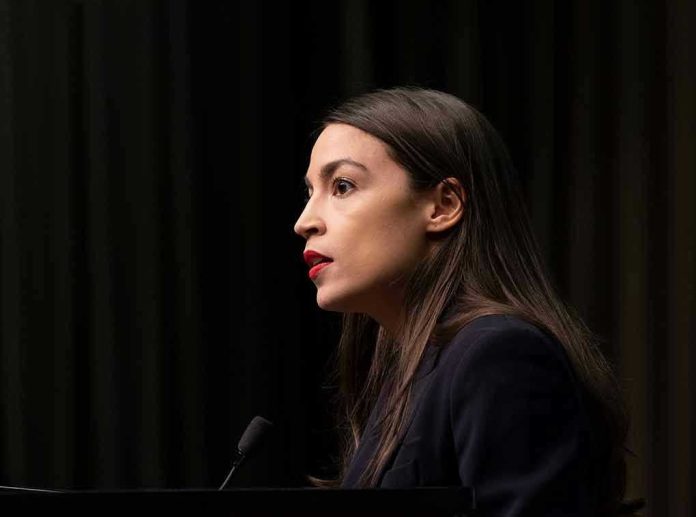
Democrats may be flirting with a 2028 nominee whose far-left brand could hand Republicans a ready-made contrast campaign.
Story Snapshot
- Reports say Rep. Alexandria Ocasio-Cortez’s team has been preparing two possible 2028 tracks: a presidential run or a New York Senate primary against Sen. Chuck Schumer.
- AOC’s 2025 travel schedule and town halls, including stops upstate, appear designed to expand her appeal beyond deep-blue urban strongholds.
- Democrats are still sorting through post-2024 losses and a widening split between progressives and moderates, with New York as a potential flashpoint.
- All the movement is preparatory: no formal announcement, and key offices have declined to comment.
AOC’s 2028 “Two-Track” Planning Signals a Democratic Identity Fight
Axios reported in September 2025 that Ocasio-Cortez’s advisers were actively preparing for two very different 2028 scenarios: entering a Democratic presidential primary or challenging Schumer for his Senate seat. The reporting described a strategy built around national visibility and a tested small-dollar fundraising operation, while keeping options open. That matters because it highlights a party still unsure whether it wants a sharper progressive turn or a more conventional, coalition-first approach.
NBC coverage following the Axios report framed the dynamic as “old guard vs. new blood,” a theme that resonates with Democratic voters who want generational change but also alarms leaders who prioritize protecting incumbents and maintaining Senate stability. A serious New York primary would not just be a personality clash; it would be a contest over message discipline, campaign priorities, and what Democrats think they must become to win again nationally after recent setbacks.
The 2025 “Fighting Oligarchy” Tour and Upstate Town Halls Build the Case
Reporting tied AOC’s rising 2028 speculation to her 2025 activity: traveling widely, partnering with Bernie Sanders on a “Fighting Oligarchy” tour, and holding events intended to broaden her reach. Organizers and allies have portrayed the travel as movement-building—an effort to meet voters in places where progressives often struggle. AOC also held upstate New York town halls, signaling she is at least testing a statewide footprint that would be essential in any Senate bid.
One of the clearest facts in the coverage is that AOC’s operation has become heavily digital and audience-driven. Axios cited analysis describing major digital spending that translated into rapid donor growth and an enormous online following. From a campaign mechanics standpoint, that model can reduce reliance on traditional big donors and party power brokers. From a governance standpoint, it can also incentivize attention-grabbing messaging—because online fundraising rewards the sharpest contrasts and fastest outrage cycles.
Schumer, Party Leadership, and the Risk of a Fractured New York Primary
A potential primary against Schumer would put Democratic leadership directly in the crosshairs. Schumer represents the institutional wing that values seniority, committee power, and backroom coalition management. AOC represents a populist-progressive wing that argues the party’s establishment has tolerated failed priorities and cultural activism while everyday costs climb. The available reporting does not show a declared matchup, but it does show the ingredients for a bruising contest that could drain money and attention.
NBC’s reporting also pointed to broader intra-party tensions, including disputes over endorsements and factional battles that have played out in New York politics. Those details underscore a practical reality: a high-profile AOC-versus-establishment fight would not occur in a vacuum. It would influence donor behavior, activist turnout, and local candidate alignment across the state. For Republicans, a divided opponent often matters as much as the nominee’s ideology.
Why Conservatives See “Contrast Politics” Coming—Even Without a Formal Announcement
The most aggressive claim circulating in conservative commentary is that AOC atop the Democratic ticket would be a political “lottery” for the GOP. The hard evidence in the underlying reporting is narrower: her team is preparing, her profile is expanding, and the Democratic coalition is split. Still, the contrast is easy to understand. AOC is closely associated with priorities like the Green New Deal-era climate agenda, Medicare for All-style expansion, and past calls aligned with abolishing ICE.
For a conservative audience watching the Trump administration focus on border enforcement, inflation discipline, and rolling back progressive cultural mandates, the political stakes are straightforward: Democrats elevating a prominent democratic-socialist figure would sharpen a choice about the size of government and the direction of the country. That said, the current record remains incomplete. As of the latest reporting cited here, there is no official candidacy, no declared challenge to Schumer, and no confirmed 2028 platform.
The Morning Briefing: GOP Will Hit the Lottery if AOC Is Dems' 2028 Nomineehttps://t.co/XaVuGN9iye
— PJ Media Updates (@PJMediaUpdates) February 17, 2026
Voters should treat the 2028 chatter as what it is—early maneuvering, not a decided outcome—while still recognizing what the maneuvering reveals. AOC’s preparations suggest Democrats are seriously considering whether activist energy and online fundraising can replace the old model of cautious triangulation. Republicans, meanwhile, will watch for signs that Democrats choose a nominee who amplifies culture-war fights and maximal government promises—because that would likely shape campaign messaging, turnout strategies, and the national debate well before 2028 arrives.
Sources:
https://www.axios.com/2025/09/19/aoc-2028-democrats-president-senate
https://www.aol.com/articles/aoc-other-2028-democratic-hopefuls-183048178.html