Prosecutors say a 50-year-old driver hit 117 mph in a street race, killed two teen girls, and now faces two murder charges.
Story Snapshot
- Prosecutors charged Terry Lamar Easter with two counts of murder after a Victorville crash
- Authorities say Easter drove about 117 mph and fled the scene after the impact
- Five people were arrested in connection with the hit-and-run investigation, officials said
- The case uses California’s implied malice murder theory in extreme driving deaths
Prosecutors Detail Charges After Fatal Victorville Crash
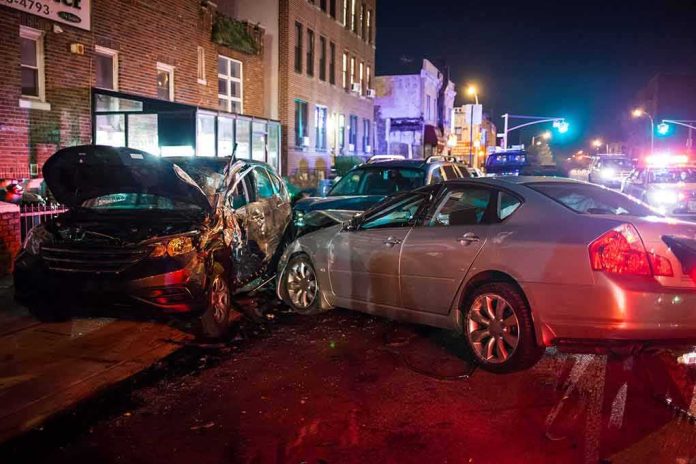
San Bernardino County prosecutors charged Terry Lamar Easter of Apple Valley with two counts of murder in the Aug. 14 Victorville crash that killed two high school seniors. Officials said the collision happened during an illegal street race and led to a multi-vehicle wreck. Prosecutors allege Easter’s speed and choices showed a conscious disregard for life. The charges go beyond negligence and aim at second-degree murder under California law, which allows it in extreme driving deaths.
Investigators said Easter’s car was moving at about 117 miles per hour before it struck the teens’ Acura. Authorities also said he fled after the crash. The speed figure anchors the case for implied malice and helps explain why prosecutors chose murder counts instead of only manslaughter. While a judge and jury will decide guilt, the filing signals how seriously the state treats racing cases that end in death, especially when officers cite extreme speed and flight.
Broader Legal Context: Implied Malice in Driving Deaths
California courts have long allowed second-degree murder charges in fatal driving cases when defendants act with implied malice. That standard rests on awareness that the conduct endangers life and a decision to do it anyway. The California Supreme Court’s People v. Watson decision set the foundation. Later rulings have reaffirmed that prosecutors can pursue murder in street racing or similarly risky driving, depending on the facts in each case.
This legal path does not make every deadly crash a murder case. Prosecutors still must show more than carelessness. They must show the driver knew the danger and ignored it. Recent appellate decisions describe facts that can meet that test, such as very high speeds, racing, prior warnings, or fleeing. The Easter filing fits that pattern, with officials citing the alleged 117 miles per hour and the claim that he left the scene after the crash, which can support malice arguments.
Community Impact and Enforcement Actions
The victims, both teenage best friends, died at the scene, according to local reports. Their deaths sparked grief and anger in Victorville, where residents have complained about reckless driving. The California Highway Patrol and local agencies increased attention on street racing in the High Desert in recent years. In this case, authorities said five people were arrested in connection with the hit-and-run investigation, showing the wider net police cast after deadly racing events.
The San Bernardino County DA’s Office has charged Terry Lamar Easter, 50, of Apple Valley, with two counts of murder after an alleged street-racing crash in Victorville killed two teenage best friends, ages 16 and 17.
Easter allegedly reached 117 mph, had his 8-year-old child in… pic.twitter.com/c0MnPKt6S5
— San Bernardino County District Attorney's Office (@sbcountyda) August 28, 2026
Families and neighbors often ask why racing keeps happening on public roads. Police point to late-night meetups, social media hype, and stretches of wide roads with light traffic. Prosecutors note that past penalties for racing deaths were sometimes limited, which may blunt deterrence. The murder charges here reflect a tougher stance, using tools already on the books. The aim is simple: make clear that racing on city streets can bring the gravest criminal consequences when lives are lost.
Sources:
nypost.com, abc7.com, paininthepass.info