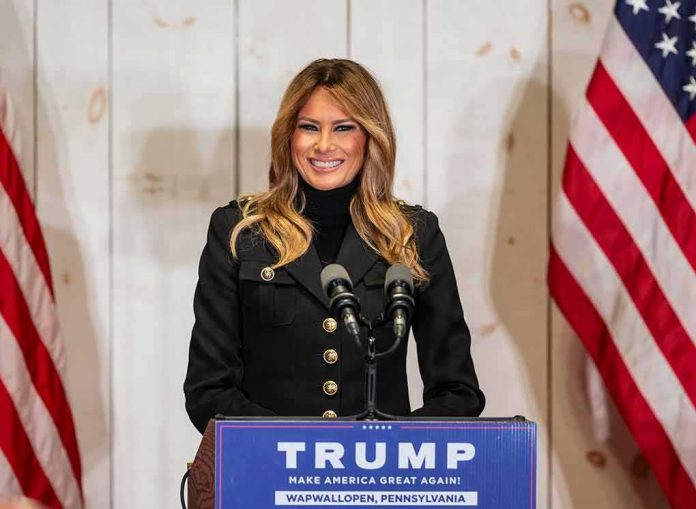
As war drags on and Washington feels broken, Melania Trump’s quiet child-rescue mission shows both what is possible and how much power still sits in the hands of a small circle of elites.
Story Snapshot
- Melania Trump has helped arrange multiple transfers of Ukrainian and Russian children back to their families during the Russia-Ukraine war.
- The White House says she and a personal representative are working directly with both governments to identify and reunite displaced children.
- Reports from Reuters and Ukrainian officials credit her role in at least four or five reunification rounds, returning around 30 children.
- Her adviser Mark Beckman says she is working “directly” with senior officials in Moscow and Kyiv, raising new questions about unelected influence in foreign policy.
Melania Trump’s child reunification mission
Since October 2025, U.S. First Lady Melania Trump has led a humanitarian push to reunite children separated by the Russia-Ukraine war. In speeches and written statements, she says her goal is simple: help get abducted or displaced kids back to their parents and guardians. White House briefings describe at least four rounds of reunification, with groups of eight, seven, six, and then five children returned from Russian-held territory to families in Ukraine or Russia. This effort runs alongside President Trump’s “America First” agenda, yet focuses on a deeply global human problem.
The clearest early milestone came when Melania Trump announced that eight Ukrainian children were reunited with their families within 24 hours after months of talks with Russian President Vladimir Putin. She said Putin replied to her letter and that together they opened a “channel of communication” about the children’s welfare. Her office reported that her personal representative had been working directly with Putin’s team on case details, while she raised the issue in public speeches and private messages. That mix of soft power and back-channel contact is unusual for a first lady and has drawn both praise and unease.
Evidence of direct work with Russia and Ukraine
White House statements now say plainly that Melania Trump and her representative “remain engaged in ongoing work with Russia and Ukraine” to identify and reunify displaced children. She has described herself as “actively engaged” and told reporters that talks with Putin’s team continue as they seek more returns. Reuters and other outlets report that, by early 2026, about fifteen children had been repatriated in the first phase of the effort, with later briefings lifting the total to roughly thirty. Ukrainian child-rights officials have called her a “key partner” in negotiations to bring kids back from Russia and occupied areas.
At the same time, Russian presidential commissioner for children’s rights Maria Lvova-Belova publicly thanked Melania Trump for her “steadfast dedication” when six more children were cleared to return, five to Ukraine and one to Russia. That announcement came from both Washington and Moscow and marked the third time the first lady was credited with arranging such transfers. The White House’s July 2026 update described a fifth reunification round, involving five more children, and repeated that Melania and her representative are still working with both governments. Taken together, these statements support the claim that she is directly involved in ongoing, multi-step reunification efforts.
Beckman’s claim and the deep-state worry
Senior adviser Mark Beckman went a step further in a Newsmax interview, saying Melania Trump and her team are working “directly with senior government officials in both Russia and Ukraine” on these cases. He framed her as one of the “most consequential first ladies,” pointing to what he described as five reunifications and 33 children helped overall. Beckman’s praise plays into a familiar Washington pattern: complex, multi-country operations get boiled down to a story about one influential personality, not about systems, laws, or public oversight.
For many Americans, this raises mixed feelings. On one hand, the idea of any adult helping war-torn children home cuts across politics and matches core values of family, safety, and mercy. On the other hand, the main evidence comes from official White House messaging, soft media coverage, and statements by foreign officials who have their own agendas. There are no public case files, transfer logs, or detailed records showing exactly who did what in each child’s journey. In a time when people on both the right and left worry about a “deep state” of unaccountable elites, that gap in transparency feeds distrust.
Why this matters beyond Melania
The Russia-Ukraine war has reportedly seen nearly 20,000 Ukrainian children taken to Russia, with only a fraction returned so far. Against that scale, any successful reunification is good news, but it also shows how limited elite-driven efforts remain. Melania Trump’s mission proves that one well-connected figure can move the needle, at least for dozens of kids. Yet it also underlines a deeper problem: if saving children depends on personal channels between a first lady and a foreign strongman, then regular people have almost no control over outcomes.
This is what many frustrated citizens now see as the core issue. Conservatives blame years of globalist deals, weak borders, and endless wars. Liberals blame hardline nationalism, cuts to social support, and growing inequality. Both sides increasingly agree that the federal government serves itself and its own inner circle first. The Melania child-rescue story fits that pattern in a bittersweet way. It shows compassion and real gains for some families, while reminding us that major life-and-death decisions still rest in the hands of a few powerful people trading letters and private calls behind closed doors.
Sources:
youtube.com, whitehouse.gov, reuters.com, abcnews4.com, nypost.com, kyivindependent.com, aljazeera.com, pbs.org