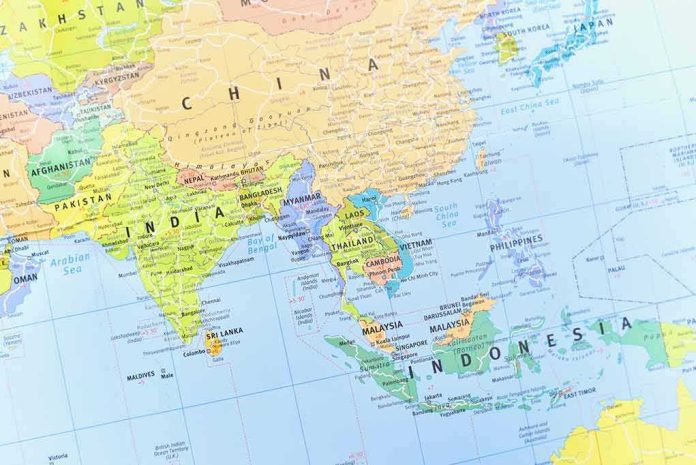
China’s coast guard blasted a Philippine government ship with a water cannon and nearly rammed it near a disputed South China Sea reef, the latest act of aggression against a nation Washington is treaty-bound to defend.
Story Snapshot
- Philippine Coast Guard says a Chinese ship came within seven meters of the BRP Datu Paduhinog before blasting it with a water cannon.
- The attack happened near Scarborough Shoal, a reef the Philippines says sits inside its own economic waters.
- China has repeated this same aggressive playbook for years, including a 2025 incident where a Chinese warship rammed its own coast guard ship.
- The United States briefly sent warships to the area after a past collision, underscoring the stakes for an American ally.
Chinese Coast Guard Blasts Philippine Ship Near Disputed Reef
The Philippine Coast Guard said Friday that a Chinese vessel pulled a “reckless” maneuver near Scarborough Shoal. The ship closed to within seven meters of the BRP Datu Paduhinog before firing its water cannon directly at the Philippine crew. Manila says the vessel was carrying out a lawful patrol mission in waters it claims as its own.
Beijing tells a different story. Its coast guard claims it merely “monitored and blocked” two Philippine vessels that had “intruded” into the area despite repeated warnings, language China has used almost word-for-word in past incidents. The shoal, known to Filipinos as Bajo de Masinloc, sits about 200 nautical miles from Luzon, well within what international law generally treats as the Philippines’ economic zone.
A Years-Long Pattern of Harassment at Scarborough Shoal
This is not an isolated flare-up. Chinese ships have fired water cannons at Philippine vessels repeatedly since at least 2014, and the confrontations have grown more frequent and more violent since 2023. In April 2024, three Chinese cutters rammed a Philippine supply boat and blasted it with eight separate water cannon strikes in a single encounter.
By December 2024, China’s coast guard was sideswiping Philippine patrol boats outright, backed by naval vessels standing nearby. In September 2025, Beijing even declared a new “nature reserve” over the shoal, a move Manila protested as another land grab dressed up in bureaucratic language.
Beijing’s Own Ships Have Collided Chasing Manila’s Vessels
China’s aggressive tactics have occasionally backfired on its own fleet. In August 2025, a Chinese coast guard ship chasing the Philippine vessel BRP Suluan collided with a Chinese Navy warship, damaging both while trying to force the smaller Philippine boat out of the area. The incident showed how reckless these blocking maneuvers have become, even by Beijing’s own standards.
The collision was serious enough that the United States sent two warships to the shoal shortly afterward, a clear signal that Washington was watching closely and standing by its treaty commitments to the Philippines. China’s coast guard has also claimed, separately, that it rescued a foreign crew near the shoal, showing Beijing wants to frame itself as a responsible actor even as it escalates confrontations.
A China Coast Guard (CCG) vessel fired a water cannon at a Philippine #fisheries vessel delivering fuel subsidies to Filipino fishermen at Panatag (Scarborough) Shoal on Thursday, the Philippine Coast Guard (PCG) said. https://t.co/lUgzrX3le3
— UBC Oceans (also found at ubcoceans.bsky.social) (@UBCoceans) July 24, 2026
Filipino fishermen have paid the highest price in this dispute. In 2023, three fishermen died after their boat collided with a vessel near the shoal, a tragedy that predates the current wave of water cannon attacks but underscores what is at stake for ordinary people caught between two nations’ territorial claims.
Why This Matters for America
The Philippines is a longtime American treaty ally, and Communist China’s bullying in these waters is not just a regional squabble. It is a test of whether Beijing believes it can push around American partners without consequence. President Trump’s administration has made clear that weakness invites more aggression, and allies who see Washington waver will look elsewhere for protection.
Conservatives have long warned that appeasing an authoritarian regime only encourages more provocations, whether in Taiwan, Hong Kong, or now the open water near Scarborough Shoal. Every water cannon blast and every reckless near-collision is a reminder that Beijing tests boundaries when it thinks nobody is watching closely enough to respond.
Sources:
aljazeera.com, bbc.com, cnn.com, reuters.com, france24.com, youtube.com, srnnews.com