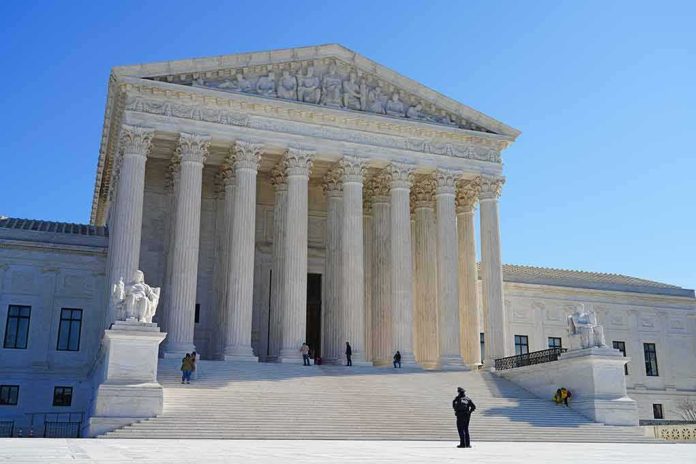
The Supreme Court said schools can keep women’s sports for biological females under Title IX, resetting the legal ground for fairness in competition.
Story Highlights
- The Supreme Court upheld Idaho and West Virginia laws keeping women’s teams for biological females.
- The majority said Title IX permits sex-separated teams defined by biological sex.
- The Court found no Equal Protection violation in maintaining female-only teams.
- The ruling likely affects similar laws in over two dozen states.
What The Court Decided And Why It Matters
The Supreme Court ruled on June 30, 2026, that Idaho and West Virginia can define women’s and girls’ sports by biological sex without violating Title IX or the Constitution. Justice Brett Kavanaugh wrote that Title IX allows separate sports teams for men and women defined by biological sex, and that approach protects equal opportunity for female athletes. The ruling reverses lower court decisions that had favored transgender students who challenged the bans, marking a clear shift in the legal landscape.
The Court also held that the states did not violate the Equal Protection Clause by keeping female teams limited to biological females. The majority cited inherent physical differences between males and females relevant to performance, and said equal opportunity often requires separate teams for girls and women. The states argued during oral arguments that these laws preserve women’s sports for women, a position the Court found consistent with Title IX and constitutional principles.
How Far The Ruling Reaches Across The Country
More than two dozen Republican-led states have passed similar protections for female sports since 2020. The decision is expected to extend to many of those laws, giving school districts and athletic associations clearer rules to follow. Reporters noted the Court overturned earlier rulings that blocked parts of these laws, which signals that sex-based team definitions now have firm legal support at the national level, even as some lawsuits in other states may continue on narrower grounds.
Media outlets and advocacy groups framed the ruling in very different ways. Some emphasized that the bans bar transgender girls and women, while others highlighted the stated goal of fairness for female athletes. Liberal justices dissented and warned of constitutional concerns, which will likely fuel ongoing public debate. But the controlling law from the Court now endorses sex-based team eligibility for schools under Title IX and the Equal Protection Clause.
What Schools, Parents, And Athletes Should Expect Next
School districts in Idaho and West Virginia can continue enforcing these laws, and officials in other states with similar statutes will likely proceed with confidence. Athletic directors may update handbooks, eligibility forms, and training to match the Court’s guidance on sex-separated teams. Because the Court grounded its reasoning in Title IX and equal protection, compliance now aligns both with federal law and state policy, reducing confusion that followed earlier, conflicting lower court rulings.
Some questions may remain where local rules differ or where pending cases raise unique facts. Outlets reported that lawsuits in a few states could probe specific policies or processes even after this decision. Still, the main takeaway is firm: schools may protect a level playing field for girls and women by using biological sex to set team eligibility. For families, coaches, and female athletes who felt sidelined by shifting rules, this ruling provides a clear, nationwide standard anchored in federal law.
Sources:
reason.com, osvnews.com, aljazeera.com