One small flag at a grave in Arlington is just decoration; a quarter-million of them, planted by hand in a single evening, is a nation whispering, “We gave up our yesterdays for your tomorrows.”
Story Snapshot
- Each Memorial Day, nearly 1,500 Old Guard soldiers place about 250,000 flags at every grave in Arlington National Cemetery.
- The entire “Flags In” mission, covering more than 600 acres of sacred ground, finishes in roughly four hours.[3][4]
- Every flag stands exactly one boot length from the headstone, aligned with military precision to honor each fallen service member.[1][3]
- The tradition reflects conservative values of duty, sacrifice, and gratitude that hold a free country together.[1][3][5]
The Night Arlington Turns Into a Sea of Flags
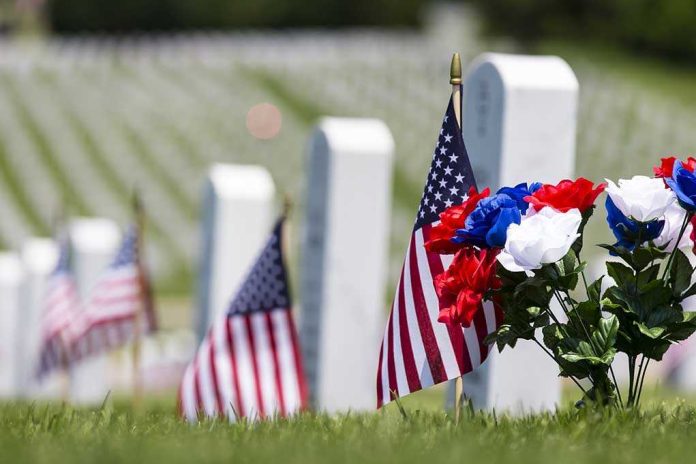
On the Thursday before Memorial Day, Arlington National Cemetery transforms from a quiet slope of white marble into a sea of red, white, and blue. Soldiers of the United States Army 3rd Infantry Regiment, known as the Old Guard, fan out across the hills with one mission: place a flag at every single grave, along every row of columbarium courts and niche walls, roughly 250,000 flags in all.[3] By nightfall, nearly every patch of grass holds a story.
Arlington officials describe the operation in unforgiving numbers: nearly 1,500 soldiers, approximately 250,000 small American flags, about four hours to complete the task.[3][4][5] Media crews capture the visual shock of it: endless rows of stones, each anchored by a single flag, the cemetery suddenly looking less like a graveyard and more like a disciplined formation still on duty.[2] The math is staggering, but the point is not arithmetic. The point is that no one rests there anonymously.
The Old Guard’s Unyielding Standard of Honor
The Old Guard is not a public-relations extra; it is the United States Army’s official ceremonial unit, responsible for the Tomb of the Unknown Soldier, state funerals, and escorting fallen service members home.[3][5] During “Flags In,” every available soldier participates, from seasoned noncommissioned officers to brand-new privates, because the ritual is not optional pageantry. It is, by design, a hands-on lesson in what military service really costs, one grave at a time.[3] That is a profoundly conservative approach to memory: learn by doing, not by hashtag.
Each soldier receives a rucksack of flags and a simple rule that leaves no room for sloppiness. At every headstone, the soldier stops, squares their shoulders, and places the flag precisely one boot length in front of the stone, centered.[1][3] The motion repeats hundreds of times per soldier, but never as a casual flick of the wrist. Reporters describe troops pausing to read the names, the wars, the ages etched in stone, sometimes tracing dates with their fingertips before moving on.[2] Respect is not abstract; it is measured in calloused hands and quiet seconds.
From 1948 to Today: A Tradition That Refuses to Thin Out
The tradition took shape after 1948, when the Army designated the 3rd Infantry Regiment as its permanent ceremonial unit at Arlington.[3] Since then, “Flags In” has grown with the cemetery itself. Earlier accounts spoke of more than 250,000 flags placed in under four hours; more recent counts mention over 260,000 graves, each receiving a flag.[1] That creep in numbers is not a rounding error; it is a roll call of added sacrifice, new stones etched with dates from Iraq, Afghanistan, and far less-known deployments.
The cemetery’s own description stresses that the mission is comprehensive: headstones, columbarium rows, niche walls, every individual laid to rest.[3][5] Local outlets echo the same image year after year: more than a thousand soldiers walking the lines, working section by section to ensure no grave is skipped, no row left bare.[2] Media numbers may differ slightly from official figures, but they all converge on the same reality. The job is overwhelmingly large, and they still insist on doing it one grave at a time rather than outsourcing honor to a drone flyover or a graphic on a screen.
“We Gave Up Our Yesterdays” and What It Demands of Us
The phrase “We gave up our yesterdays for your tomorrows” captures the moral center of Memorial Day better than any three-day-weekend advertisement. Those who lie under Arlington’s hills did not vote themselves into hero status; they went where their country sent them and never came back. The Old Guard’s yearly march through the cemetery reminds living Americans that freedom is not a streaming subscription. It is a bill paid, in full, in advance, by people who never got to grow old.
First Sergeant Kosovare Fain carries her daughter as she and fellow soldiers from the U.S. Army 3d Infantry Regiment, known as The Old Guard, place flags in advance of Memorial Day at Arlington National Cemetery. More photos of the week: https://t.co/MWbxJvhiAN 📸 Matt McClain pic.twitter.com/n88FPVTnXC
— Reuters Pictures (@reuterspictures) May 23, 2026
Conservative instincts about duty, gratitude, and national memory line up neatly with what happens at “Flags In.” The act refuses to treat service members as interchangeable casualties in a spreadsheet. It treats them as individuals whose names matter. A culture that forgets that, and that reduces Memorial Day to grill smoke and discount codes, drifts toward decadence. A culture that remembers, one flag and one name at a time, has a chance to stay worthy of the sacrifice that secured its tomorrows.[1][3][5]
Sources:
[1] Web – How 250000 Flags Transform Arlington Each Memorial Day
[2] Web – SEE IT: 250,000 flags placed at Arlington National Cemetery ahead …
[3] Web – Flags In – Arlington National Cemetery
[4] YouTube – 250,000 flags placed in Arlington National Cemetery for Memorial Day
[5] Web – Army’s Old Guard honors thousands of fallen heroes at Arlington …