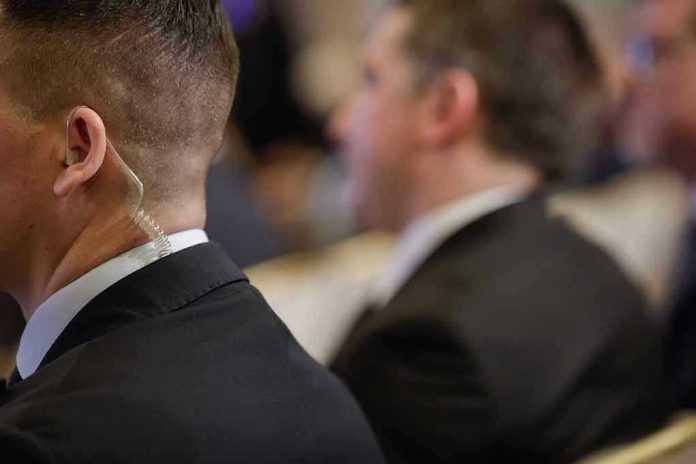
A government security badge stops looking like a symbol of trust the moment it shows up in someone else’s pay-per-view bedroom.
Story Snapshot
- A report alleges adult content creator Brittney Jones posted explicit OnlyFans videos involving a U.S. Secret Service agent.
- The agent remains unnamed, and no timeline or official statement appears in the available reporting.
- The story’s power comes from the collision of two worlds: private monetized sex content and public national-security expectations.
- With only one primary outlet reporting, the facts remain thin and the uncertainty remains high.
When a Secret Service Reputation Meets the OnlyFans Economy
The core allegation is simple and explosive: Brittney Jones, described as a sex content creator, posted graphic videos on OnlyFans depicting sex acts with a Secret Service agent. One detail makes it uniquely combustible for Americans who still believe public service should mean something beyond a paycheck: the Secret Service exists to protect national leaders and maintain public confidence. When that uniform gets pulled into commercialized explicit content, the damage doesn’t stay private—it spreads to the agency’s credibility.
"Lives a Double Life" – Sex Content Creator Posted Graphic Videos of Sex Acts with Secret Service Agent on OnlyFans… Developing | The Gateway Pundit | by Cristina Laila https://t.co/GJFuScopU1
— Gayle (@MesaWall) April 19, 2026
The available reporting leaves major blanks. No date of filming or posting appears. No agent identity appears. No confirmation from the Secret Service appears. No quoted statement appears from Jones, the agent, or agency leadership. That absence matters because viral scandal thrives on snapshots, not verified timelines. A developing story can be true, exaggerated, or partially wrong; readers should treat it like a smoke alarm, not a courtroom verdict, until corroboration arrives.
What “Double Life” Really Means for Federal Security Work
The phrase “double life” sells headlines because it taps an old fear: that the person guarding the door is also secretly leaving it unlocked. The allegation isn’t merely about sex; it’s about judgment and vulnerability. Federal protective work depends on discretion, discipline, and a reputation that discourages intimidation, bribery, and blackmail. A commercially distributed explicit video can create leverage points. Even if no law breaks, the appearance of compromised judgment can become its own operational risk.
American common sense draws a line between legal private conduct and conduct that predictably harms your employer’s mission. Conservatives tend to support freedom in private life while also demanding standards for those who carry authority on the public’s behalf. That’s not prudishness; it’s stewardship. A Secret Service agent isn’t a random office worker. The job sits close to power, travel, access, and sensitive environments. Those realities make “personal choices” more consequential than the same choices would be elsewhere.
Why the Missing Details Matter More Than the Salacious Ones
One-source stories force a discipline that most internet outrage refuses to practice: separate what’s alleged from what’s known. The reporting available here names Jones and describes explicit material on OnlyFans involving a Secret Service agent, but it does not establish where the agent worked, whether any official resources were used, whether the agent was identifiable, or whether any agency policy was violated. Each missing piece changes what accountability should look like and what punishment, if any, would be justified.
Those unknowns also shape the biggest question: national security exposure. If the agent appears identifiable, wears anything suggesting official status, or discloses details—locations, travel patterns, security routines—that becomes more than embarrassing. If the agent remains unidentifiable and the content contains no operational hints, the threat shifts toward reputational harm and potential susceptibility to coercion rather than direct compromise. The public deserves facts, not vibes, because the remedy depends on what actually occurred.
How Agencies Typically Respond When Private Misconduct Goes Public
Agencies built on trust rarely litigate their personnel discipline in public, which is why scandals feel like they vanish behind a curtain. A plausible response pattern, if leadership treats the allegation as credible, starts internally: identify the employee, verify the content, then evaluate policy violations such as conduct unbecoming, misuse of position, security clearance implications, or conflicts with professional standards. Even without criminal charges, administrative actions can range from counseling to termination.
The Secret Service also lives under a microscope because its failures become national stories. Public patience runs out fast when an agency tasked with protecting presidents looks sloppy in any area—fitness, travel behavior, communications, or personal conduct. Even if this allegation ends up limited to poor judgment by one individual, the agency may still face calls for tighter standards, clearer guidance on monetized adult content, and more aggressive training on vulnerability to blackmail or coercion.
What Readers Should Watch Next Before Drawing Conclusions
Developing stories either mature into documented cases or collapse under their own lack of evidence. The public should watch for a few concrete signals: an on-the-record Secret Service statement, confirmation that an internal review exists, or follow-up reporting that establishes dates, identity, and how the content was verified. Without those, the story remains a serious allegation rather than a settled fact pattern. Discipline should follow proof, not the internet’s appetite for spectacle.
The cultural lesson is uncomfortable but clear: the adult content economy turns private acts into permanent products, and permanence changes the stakes for anyone in a high-trust job. If the allegation proves accurate, the most conservative, commonsense takeaway isn’t gossip—it’s accountability. Federal protective work demands restraint because the consequences of personal exposure don’t land on the agent alone. They land on the agency, the mission, and the public that needs to trust both.