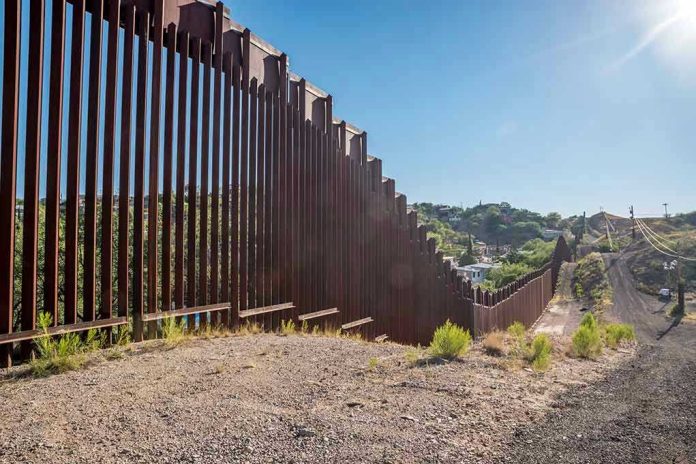
The Department of Homeland Security is unleashing an unprecedented AI-powered surveillance network across America’s borders that can track your movements for miles, identify your face without consent, and retain your data indefinitely—all while bypassing traditional oversight and privacy protections.
Story Highlights
- DHS deploying 542 new AI-enabled surveillance towers and upgrading 348 existing systems under $100 million contract through 2030
- New mobile surveillance trucks equipped with autonomous AI can detect movement miles away and operate completely unattended
- Facial recognition technology initially designed for border control now being used by ICE to identify U.S. citizens during interior enforcement operations
- Congress allocated $160 billion for immigration enforcement, representing a 65% funding increase and the largest DHS expansion in history
- Civil liberties groups challenge government claims that autonomous surveillance towers don’t impact constitutional rights
Massive Surveillance Expansion Under Trump Administration
The Department of Homeland Security is recompeting a $100 million contract to deploy 542 new Integrated Surveillance Towers and modernize 348 legacy systems across multiple continental U.S. sites. General Dynamics Information Technology, Advanced Technology Systems Co., and Elbit Systems of America secured positions on the broader $1.8 billion tower modernization contract in 2024. These autonomous towers, hundreds of which Anduril Industries has deployed since 2019, represent a fundamental shift from traditional border barriers to AI-driven detection networks. Work continues through May 2030 under the current contract vehicle.
Autonomous Mobile Surveillance System Raises Privacy Concerns
DHS’s new Modular Mobile Surveillance System mounts AI-powered observation towers on standard 4×4 vehicles, creating mobile enforcement capabilities unprecedented in scope. The M2S2 system operates in dual modes—attended with agents present or completely unattended with autonomous AI surveillance making independent detection decisions. These systems can detect motion several miles away, with artificial intelligence pinpointing target locations within 250 feet of actual position. The technology employs computer vision originally developed for war drones, distinguishing between people, animals, and vehicles by analyzing thousands of image frames. All collected video, maps, and sensor data must be retained for at least 15 days and locked against deletion under any circumstances, classified as Controlled Unclassified Information.
Facial Recognition Technology Expands Beyond Border Operations
Mobile Fortify, an AI facial recognition tool initially developed for Customs and Border Protection, is increasingly being deployed by ICE agents for interior enforcement operations throughout the United States. The New York Times reported in February 2026 that ICE agents are using this technology to identify U.S. citizens during enforcement actions, raising serious Fourth Amendment concerns. Beryl Lipton, senior investigative researcher at the Electronic Frontier Foundation, warns that “border enforcement doesn’t stop at the line on the map or the moment of crossing.” WIRED’s reporting indicates the facial recognition technology is being used by DHS for identity verification tasks it wasn’t designed for, raising significant accuracy and reliability questions about a system now targeting American citizens.
Constitutional Rights Face Technology-Driven Erosion
The Electronic Frontier Foundation directly challenges DHS’s classification of detection-only systems as non-“rights-impacting,” arguing that autonomous towers are capable of taking high-resolution images that the government could theoretically analyze later without warrants or probable cause. This represents exactly the kind of government overreach that should alarm every American who values constitutional protections. The surveillance infrastructure now includes tethered aerostats hovering thousands of feet over the desert, unattended ground sensors detecting footsteps, and license plate scanners disguised as traffic cones. Environmental organizations and Native American tribes also warn about impacts on endangered wildlife, disrupted water flows, and stadium-style floodlights planned for Big Bend’s darkest skies, demonstrating how federal overreach damages both liberty and land.
Questionable Effectiveness Despite Massive Spending
While border crossings have reached 50-year lows according to DHS Secretary Kristi Noem, policy analyst Kathleen Bush-Joseph from the Migration Policy Institute notes that “the dominant drivers for the drop in border crossings have been increased enforcement by Mexican authorities and the Trump administration’s deterrence campaign.” The actual marginal impact of this expensive surveillance infrastructure remains unclear. Congress allocated over $160 billion for immigration enforcement through the “One Big Beautiful Bill,” representing a 65% DHS funding increase. Defense contractors enjoy significant revenue opportunities through multi-year contracts worth billions, but American taxpayers deserve transparent data on whether these AI towers actually improve border security or simply expand government surveillance capabilities over citizens and communities far from any border.
Sources:
DHS, CBP Integrated Surveillance Tower Contract – GovConWire
DHS Seeks AI-Powered Mobile Surveillance Trucks for Border – TechBuzz.ai
AI Technology Expands from Border to Interior Enforcement – The Marshall Project