
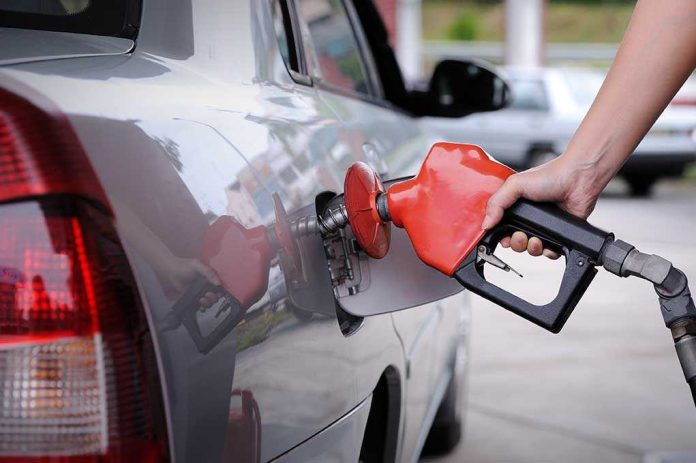
Gas at $2.99 a gallon feels like a holiday miracle, but the real story is what this sudden relief at the pump reveals about power, policy, and who actually wins when prices fall.
Story Snapshot
- Gas prices dipped below $3 nationally for the first time in more than four years, landing at $2.99 a gallon.
- Holiday travelers gain welcome relief, yet long-term energy costs and policies remain unresolved.
- Price swings expose how global markets, domestic production, and regulation collide in your monthly budget.
- Conservatives see a reminder that affordable energy and abundance beat symbolic green gestures every time.
What Falling Gas Prices Really Mean For Ordinary Drivers
Drivers watching the station marquee slide under $3 a gallon are not thinking about OPEC meetings or federal rulemaking; they are doing mental math on Christmas gifts and grocery runs. A national average of $2.99 for regular gas, the lowest in over four years, instantly puts cash back into family budgets. For a commuter burning 15 gallons a week, that drop from the mid-$3 range can mean hundreds of dollars saved over a few months.
This relief at the pump also changes behavior in real time. Families who delayed road trips start planning weekend getaways again. Contractors with pickup trucks can take more jobs without raising bids. Delivery businesses stretch their margins instead of raising fees. Price declines this sharp do not just feel good; they move decisions on everything from where people shop to whether they visit out-of-town relatives for the holidays.
How Policy, Production, And Global Events Collide At The Pump
Gas prices fall for specific reasons, not by magic. A combination of strong domestic production, moderating global demand, seasonal slowdowns after the summer driving peak, and fewer disruptions in refining can all push prices lower. When supply exceeds demand and refineries run smoothly, the consumer finally gets a break. That dynamic directly supports the conservative case for encouraging production rather than constraining it with aggressive regulation.
Energy policy also shapes how long these low prices last. When leaders restrict drilling leases, slow pipeline approvals, or chase headline-grabbing climate targets that make refining more expensive, they create friction in the system that eventually shows up in what drivers pay. Short-term dips below $3 can distract from longer arcs of policy that quietly push costs higher. A common-sense approach recognizes that reliable, affordable fuel is not a luxury; it is foundational to a functioning, mobile economy.
They say 1st time. U.S. Energy Secy.: Gas prices fall below $3 for first time in over 4 years https://t.co/L066zl1iKa
— Musk Rat Partner (@PartnerRat) December 6, 2025
The Political Spin Versus The Pocketbook Reality
Public celebrations from officials when gas drops below $3 tell one version of the story, but voters pay attention to the full timeline. Many Americans remember when prices surged well above that level in recent years, squeezing budgets and forcing trade-offs on essentials. Relief arriving “just in time for the holidays” feels less generous when households recall months of strain from earlier spikes that coincided with policy debates over fossil fuels and climate priorities.
American conservative values put accountability and long-term stability ahead of photo-op announcements. A single data point at $2.99 does not erase volatility that families lived through. Voters ask whether leaders supported policies that expanded domestic production capacity and infrastructure or sided with activist goals that treat hydrocarbons as a problem to be punished. That lens leads many to view falling prices less as a political victory lap and more as a welcome byproduct of underlying supply strength and market correction.
How Households Can Turn A Temporary Dip Into Real Gain
Drivers who remember how fast prices climbed in recent years understand that $2.99 may not last. The smartest move is to treat this window as an opportunity, not a new normal. Families can redirect the monthly savings toward paying down credit cards, replenishing emergency funds, or catching up on deferred maintenance that prevents bigger expenses later. Conservative financial habits pair naturally with conservative energy instincts: use windfalls wisely and plan for volatility.
Businesses that depend on transportation can also use this season to strengthen their position. Locking in longer-term supply contracts where possible, upgrading to more efficient vehicles, and tightening routes while fuel is cheap builds resilience for the next upswing. Markets will continue to swing, global events will interfere, and policymakers will keep debating. But when gas slides below $3, the clearest message is that a nation committed to robust energy production and rational regulation can still deliver tangible relief to the people who keep its economy moving.
Sources:
National Average Dips Below $3 a Gallon for First Time in 4 Years